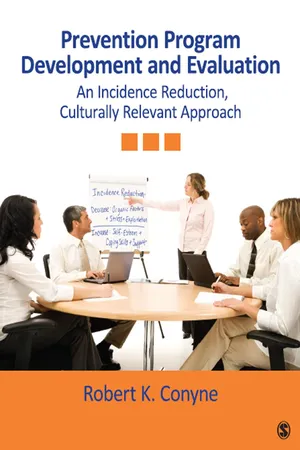
Prevention Program Development and Evaluation
eBook - ePub

Prevention Program Development and Evaluation

An Incidence Reduction, Culturally Relevant Approach

  1. 232 pages
  2. English
  3. ePUB (mobile friendly)
  4. Available on iOS & Android
eBook - ePub

Prevention Program Development and Evaluation

An Incidence Reduction, Culturally Relevant Approach

About this book

The use of seatbelts, the requirements for smoke detectors, and other kinds of public health interventions have been highly successful in reducing disability, injuries, and premature mortality. Prevention in mental health— identifying and treating mental illnesses before they become full blown syndromes or identifying people at risk for a condition—is just as critical to public mental health. This research-based resource gives practitioners a nuts-and-bolts guide to designing and evaluating prevention programs in mental health that are culturally relevant and aimed at reducing the number of new problems that occur.

Key Features

  • Employs a 10-step prevention program development and evaluation model that emphasizes the concepts of community, collaboration, and cultural relevance
  • Offers a brief, practical, how-to approach that is based on rigorous research
  • Identifies specific prevention program development and evaluation steps
  • Highlights examples of "everyday prevention" practices as well as concrete prevention programs that have proven, effective implementation
  • Promotes hands-on learning with practical exercises, instructive figures, and a comprehensive reference list


Intended Audience
Written in a straightforward and accessible style, Prevention Program Development and Evaluation can be used as a core text in undergraduate courses devoted to prevention or in graduate programs aimed at practice issues. Current practitioners or policymakers interested in designing prevention programs will find this book to be an affable guide.

Frequently asked questions

Yes, you can cancel anytime from the Subscription tab in your account settings on the Perlego website. Your subscription will stay active until the end of your current billing period. Learn how to cancel your subscription.
No, books cannot be downloaded as external files, such as PDFs, for use outside of Perlego. However, you can download books within the Perlego app for offline reading on mobile or tablet. Learn more here.
Perlego offers two plans: Essential and Complete
  • Essential is ideal for learners and professionals who enjoy exploring a wide range of subjects. Access the Essential Library with 800,000+ trusted titles and best-sellers across business, personal growth, and the humanities. Includes unlimited reading time and Standard Read Aloud voice.
  • Complete: Perfect for advanced learners and researchers needing full, unrestricted access. Unlock 1.4M+ books across hundreds of subjects, including academic and specialized titles. The Complete Plan also includes advanced features like Premium Read Aloud and Research Assistant.
Both plans are available with monthly, semester, or annual billing cycles.
We are an online textbook subscription service, where you can get access to an entire online library for less than the price of a single book per month. With over 1 million books across 1000+ topics, we’ve got you covered! Learn more here.
Look out for the read-aloud symbol on your next book to see if you can listen to it. The read-aloud tool reads text aloud for you, highlighting the text as it is being read. You can pause it, speed it up and slow it down. Learn more here.
Yes! You can use the Perlego app on both iOS or Android devices to read anytime, anywhere — even offline. Perfect for commutes or when you’re on the go.
Please note we cannot support devices running on iOS 13 and Android 7 or earlier. Learn more about using the app.
Yes, you can access Prevention Program Development and Evaluation by Robert K. Conyne in PDF and/or ePUB format, as well as other popular books in Social Sciences & Social Work. We have over one million books available in our catalogue for you to explore.


Appendix B

Laying the Groundwork (Steps 1–8) for Community, Collaboration, and Cultural Relevance

STEP 1: Establish and maintain a team
STEP 2: Identify a potential community issue
STEP 3: Explore related professional literature
STEP 4: Develop a germinal, motivating idea
STEP 5: Engage stakeholder planning council
STEP 6: Create a shared vision and mission
STEP 7: Stimulate community readiness
STEP 8: Assess
    a.   Conduct local ecological assessment
    b.   Search for evidence-based programs


Appendix C

Implement and Evaluate (Steps 9–10)

STEP 9: Design the prevention program plan
STEP 10: Design the prevention program evaluation plan


Appendix D

PPD&E Step 9: Design the Prevention Program Plan

a.   Determine problem in general terms
b.   Use adapted incidence reduction formula
c.   Set objectives
d.   Choose among alternative strategies
e.   Plan implementation
      •  Objective
      •  Strategies
      •  Activities
      •  Tasks
      •  Resources
      •  Timelines


Appendix E

PPD&E Step 10

Design the Prevention Program Evaluation Plan

a. Process/formative evaluation
 
Key prevention processes:
    •  Context considered
    •  Community orientation
    •  Cultural relevance/fit
    •  Collaboration/partnerships
    •  Fidelity
    •  Guided adaptability
    •  Evidence based
 
b. Outcome/summative evaluation
 
Key prevention questions:
    •  Were new cases eliminated or diminished?
    •  Were deficits reduced?
    •  Was the environment improved?
    •  Were strengths and natural supports increased?
Key prevention criteria:
    •  Adequacy, appropriateness
    •  Effectiveness, efficiency
    •  Side effects, sustainability
    •  Transferability, dissemination
    •  Usefulness and general contribution

Appendix F

Basic Incidence Reduction Formulae

A. Original Albee Incidence Reduction Formula
Decrease: (Organic Factors + Stress + Exploitation)
Increase:
(Self-Esteem + Coping Skills + Support Groups)
B. Adapted Incidence Reduction Formula: GENERAL Version
Decrease: DEFICITS

Environmental Risks...

Table of contents

  1. Cover page
  2. Title
  3. Copyright
  4. Contents
  5. List of Tables, Figures, and Learning Exercises
  6. Preface
  7. Acknowledgments
  8. SECTION I: PREVENTION FOUNDATION
  9. SECTION II: PROGRAM DEVELOPMENT AND EVALUATION
  10. SECTION III: TEN-STEP PREVENTION PROGRAM DEVELOPMENT AND EVALUATION APPROACH
  11. Appendix A. Ten-Step PPD&E Model
  12. Appendix B. Laying the Groundwork (Steps 1–8) for Community, Collaboration, and Cultural Relevance
  13. Appendix C. Implement and Evaluate (Steps 9–10)
  14. Appendix D. PPD&E Step 9: Design the Prevention Program Plan
  15. Appendix E. PPD&E Step 10: Design the Prevention Program Evaluation Plan
  16. Appendix F. Basic Incidence Reduction Formulae
  17. Appendix G. PPD&E Step 9b: Identify the Problem
  18. Appendix H. Useful Web Sites
  19. References
  20. Author Index
  21. Subject Index
  22. About the Author