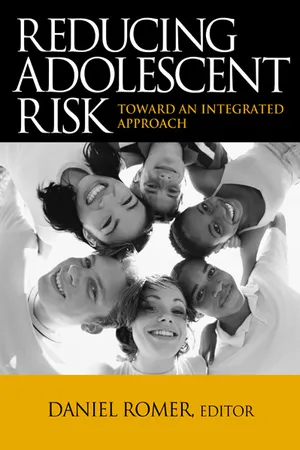
Reducing Adolescent Risk
eBook - PDF

Reducing Adolescent Risk

Toward an Integrated Approach

  1. 536 pages
  2. English
  3. PDF
  4. Available on iOS & Android
eBook - PDF

Reducing Adolescent Risk

Toward an Integrated Approach

About this book

"What an extraordinary volume! This book brings together current research integrating adolescent risk and protection across a wide range of topics and disciplines. It is a major contribution to the field."

— Robert Wm. Blum, MD, MPH, PhD, Professor and Director, Center for Adolescent Health and Development, University of Minnesota

"This book is clearly the best source now available on the topic of adolescent risk taking and its prevention. With chapters written by the very best people in the field, describing the latest thinking and findings, it is an essential guide and resource for prevention researchers and program developers."

— Bruce Simons-Morton, EdD, MPH, Chief, Prevention Research Branch Division of Epidemiology, Statistics, and Prevention Research, National Institute of Child Health and Human Development

Ā 

"This report shines a bright light on the road our nation has taken to improve adolescent health, the approaching fork, and the path most likely to attain our destination."

— Lloyd J. Kolbe, PhD, Director, Division of Adolescent and School Health, U.S. Centers for Disease Control And Prevention

Ā 

"Reducing Adolescent Risk: Toward an Integrated ApproachĀ weaves together current research findings with prevailing prevention strategies to shed further light on theĀ developmental pathways leading to a variety of interrelatedĀ adolescent risk behaviors. In doing so, the authorsĀ skillfully make the case for more integrated policy approachesĀ and forĀ comprehensiveĀ programming at the community level that bothĀ recognizes the connections between risk behaviors and maximizes young people?s positive potential."

— Karen Pittman, Executive Director, The Forum for Youth Investment & President, Impact Strategies, Inc.

Many risk behaviors have common developmental pathways. However, most prevention strategies approach adolescent risk behaviors as individual problems requiring separate solutions. This policy of treating one behavior at a time encourages a fractured approach to adolescent health.

Reducing Adolescent Risk: Toward an Integrated Approach focuses on common influences that result in a number of interrelated risk behaviors in order to design more unified, comprehensive prevention strategies. Edited by Daniel Romer, this book summarizes presentations and discussions held at the Adolescent Risk Communication Institute of the University of Pennsylvania Annenberg Public Policy Center. Concentrating on common causes for varied risk behaviors, a group of leading researchers and intervention specialists from different health traditions synthesize current knowledge about risks to adolescent health in several areas, including drugs and alcohol, tobacco, unprotected sex, suicide and depression, and gambling.

Promoting healthy adolescent development, this innovative volume includes

    • Results of the National Risk Survey
    • Contributions from experts on adolescent decision making and problem solving
    • Research agendas for programs that reduce multiple risks
    • Potential intervention strategies to reduce more than one risk at a time
    • Major findings from the conference that should be pursued in future research

Primarily intended for graduate students, scholars, and researchers in psychology, sociology, social work, and public health, Reducing Adolescent Risk is also an extraordinary resource for policy makers in government organizations and foundations.

Ā 

Ā 

Frequently asked questions

Yes, you can cancel anytime from the Subscription tab in your account settings on the Perlego website. Your subscription will stay active until the end of your current billing period. Learn how to cancel your subscription.
At the moment all of our mobile-responsive ePub books are available to download via the app. Most of our PDFs are also available to download and we're working on making the final remaining ones downloadable now. Learn more here.
Perlego offers two plans: Essential and Complete
  • Essential is ideal for learners and professionals who enjoy exploring a wide range of subjects. Access the Essential Library with 800,000+ trusted titles and best-sellers across business, personal growth, and the humanities. Includes unlimited reading time and Standard Read Aloud voice.
  • Complete: Perfect for advanced learners and researchers needing full, unrestricted access. Unlock 1.4M+ books across hundreds of subjects, including academic and specialized titles. The Complete Plan also includes advanced features like Premium Read Aloud and Research Assistant.
Both plans are available with monthly, semester, or annual billing cycles.
We are an online textbook subscription service, where you can get access to an entire online library for less than the price of a single book per month. With over 1 million books across 1000+ topics, we’ve got you covered! Learn more here.
Look out for the read-aloud symbol on your next book to see if you can listen to it. The read-aloud tool reads text aloud for you, highlighting the text as it is being read. You can pause it, speed it up and slow it down. Learn more here.
Yes! You can use the Perlego app on both iOS or Android devices to read anytime, anywhere — even offline. Perfect for commutes or when you’re on the go.
Please note we cannot support devices running on iOS 13 and Android 7 or earlier. Learn more about using the app.
Yes, you can access Reducing Adolescent Risk by Daniel Romer in PDF and/or ePUB format, as well as other popular books in Psychologie & Psychologie du dƩveloppement. We have over one million books available in our catalogue for you to explore.

Table of contents

  1. Cover
  2. Contents
  3. Preface
  4. 1 - Prospects for an Integrated Approach to Adolescent Risk Reduction
  5. Part I: ADOLESCENTS AS DECISION MAKERS: Section A - Differing Views of Adolescent Decision Making
  6. 2 - Changing Views on the Nature and Prevention of Adolescent Risk Taking
  7. 3 - Is Decision Making the Right Framework for Research on Adolescent Risk Taking?
  8. 4 - The Two Faces of Adolescent Invulnerability
  9. Part I: Section B - Affect, Risk Perception, and Behavior
  10. 5 - Risk Perception: Construct Development, Links to Theory, Correlates, and Manifestations
  11. 6 - Affect, Analysis, Adolescence, and Risk
  12. 7 - Toward an Understanding of the Role of Perceived Risk in HIV Prevention Research
  13. 8 - Alcohol and Illicit Drugs: The Role of Risk Perceptions
  14. 9 - Adolescents’ Risk Perceptions and Behavioral Willingness: Implications for Intervention
  15. Part I: Section C - Problem-Solving Approaches
  16. 10 - A Problem-Solving Approach to Preventing Early High-Risk Behaviors in Children and Preteens
  17. 11 - Contemporary School-Based Prevention Approaches and the Perceived Risks and Benefits of Substance Use
  18. 12 - Decision-Making Competence and Risk Behavior
  19. 13 - Time Perspective: A Potentially Important Construct for Decreasing Health Risk Behaviors Among Adolescents
  20. 14 - The Influence of School Atmosphere and Development on Adolescents’ Perceptions of Risk and Prevention: Cynicism Versus Skepticism
  21. Part II: COMMON PATHWAYS AND INFLUENCES ON ADOLESCENT RISK BEHAVIOR: Section A - Multiple-Problem Youth
  22. 15 - Preventing Multiple Problem Behaviors in Adolescence
  23. 16 - Screening and Early Intervention for Antisocial Youth Within School Settings as a Strategy for Reducing Substance Use
  24. 17 - Preventive Interventions for Externalizing Disorders in Adolescents
  25. Part II: Section B - Personality and Other Predispositions
  26. 18 - Genetic Basis of Substance Use and Dependence: Implications for Prevention in High-Risk Youth
  27. 19 - Health Risk Takers and Prevention
  28. 20 - Cognitive Vulnerability to Depression: Implications for Adolescent Risk Behavior in General
  29. Part II: Section C - Peers and Parents
  30. 21 - EMOSA Sexuality Models, Memes, and the Tipping Point: Policy and Program Implications
  31. 22 - Sustaining and Broadening Intervention Effect: Social Norms, Core Values, and Parents
  32. Part II: Section D - Media Interventions
  33. 23 - Adolescent Risk Behavior Research and Media-Based Health Messages
  34. 24 - Using Beliefs About Positive and Negative Consequences as the Basis for Designing Message Interventions for Lowering Risky Behavior
  35. Part III - PERSPECTIVES FROM DIFFERENT RISK RESEARCH TRADITIONS: Section A - Gambling
  36. 25 - Adolescent Gambling: Risk Factors and Implications for Prevention, Intervention, and Treatment
  37. 26 - Understanding Youth Gambling Problems: A Conceptual Framework
  38. 27 - A Perspective on Adolescent Gambling: Relationship to Other Risk Behaviors and Implications for Prevention Strategies
  39. 28 - Why Pay Attention to Adolescent Gambling?
  40. Part III: Section B - Sexual Behavior
  41. 29 - Risk and Protective Factors Affecting Teen Pregnancy and the Effectiveness of Programs Designed to Address Them
  42. 30 - Healthy Sexual Development: Notes on Programs That Reduce the Risk of Early Sexual Initiation and Adolescent Pregnancy
  43. 31 - Adolescent Sex and the Rhetoric of Risk
  44. Part III: Section C - Suicide
  45. 32 - Suicide Risk Among Adolescents
  46. 33 - Some Strategies to Prevent Youth Suicide
  47. 34 - Implications of Focusing on Black Youth Self-Destructive Behaviors Instead of Suicide When Designing Preventive Interventions
  48. Part III: Section D - Alcohol, Tobacco, and Drugs
  49. 35 - Alcohol, Tobacco, and Marijuana Use Among Youth: Same-Time and Lagged and Simultaneous-Change Associations in a Nationally Representative Sample of 9- to 18-Year-Olds
  50. Part IV: OVERARCHING APPROACHES AND RECOMMENDATIONS FOR FUTURE RESEARCH
  51. 36 - Positive Youth Development Is Necessary and Possible
  52. 37 - Youth Development Programs and Healthy Development: A Review and Next Steps
  53. 38 - A Contextual Perspective for Understanding and Preventing STD/HIV Among Adolescents
  54. 39 - Findings and Future Directions
  55. Appendix A - Reducing Adolescent Risk: Conference Schedule, June 27-30, 2002
  56. Appendix B - Conference Attendees, June 27 – June 30, 2002
  57. References
  58. Name Index
  59. Subject Index
  60. About the Editor
  61. About the Contributors