"Each chapter contains recommendations for legislators, policy makers, researchers, and families. This book should be on the desk, and minds, of legislators, attorneys, social workers and other mental health professionals who encounter and wish to ameliorate the effects of violence in the lives of their young constituents, clients, and patients."
—JOURNAL OF CHILD AND FAMILY STUDIES
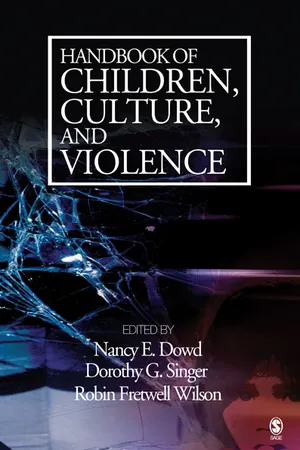
Questions relating to violence and children surround us in the media: should V-chips be placed in every television set? How can we prevent another Columbine school shooting from occurring? How should pornography on the internet be regulated? The Handbook of Children, Culture and Violence addresses these questions and more, providing a comprehensive, interdisciplinary examination of childhood violence that considers children as both consumers and perpetrators of violence, as well as victims of it.
The Handbook offers much-needed empirical evidence that will help inform debate about these important policy decisions. Moreover, it is the first single volume to consider situations when children are responsible for violence, rather than focusing exclusively on occasions when they are victimized. Providing the first comprehensive overview of current research in the field, the editors have brought together the work of a group of prominent scholars whose work is united by a common concern for the impact of violence on the lives of children.
The Handbook of Children, Culture and Violence is poised to become the ultimate resource and reference work on children and violence for researchers, teachers, and students of psychology, human development and family studies, law, communications, education, sociology, and political science/ public policy. It will also appeal to policymakers, media professionals, and special interest groups concerned with reducing violence in children?s lives. Law firms specializing in family law, as well as think tanks, will also be interested in the Handbook.
eBook - ePub
Handbook of Children, Culture, and Violence
- 536 pages
- English
- ePUB (mobile friendly)
- Available on iOS & Android
eBook - ePub
Handbook of Children, Culture, and Violence
About this book
Information
Part I
CHILDREN AS VICTIMS
CHAPTER 1
Child Witnessing of Domestic Violence
NAOMI CAHN
What happens to children when they see violence between their parents? Is there any impact on children when they see their mother or father with bruises inflicted by a partner? Discussions of family violence frequently distinguish between neglect or violence directed at children and violence directed at adults while children are present. Violence against children is legally considered either child abuse or child neglect. Witnessing violence directed at adults has generally not been treated as harmful to children.
Historically, courts deciding custody and visitation questions were inclined to dismiss the idea that witnessing partner abuse resulted in any relevant impact on children (Cahn, 1991). There is increasing sociological and psychological research that documents the detrimental effects on children of exposure to violence, regardless of the child’s own direct victimization. The existence of violence in the family, even when not directed toward children, shapes children’s behavior both in the short- and long term. Between 10 and 20% of all children are at risk for exposure to domestic violence (National Clearinghouse, 2003), and estimates are that 3.3 to 10 million children are exposed to domestic violence in their homes annually (Bernard, 2003). For many children, this exposure results in behavioral, emotional, and psychological problems.
Courts in virtually all states now consider domestic violence in custody decision making, and this can even result in a rebuttable presumption against giving custody to the batterer. Similarly, in domestic violence proceedings for civil protection orders, courts may impose protections for children who have been exposed to domestic violence, and may also allow these children to bring such proceedings themselves (Lemon, 1999). Child exposure to domestic violence is also important in child protection proceedings. As part of a plan to keep the child safe, the mother’s relationship with her batterer may be important. Mothers may also be held accountable for failing to protect their children who have been exposed to domestic violence (Dunlap, 2004). Other legal actions to which child exposure may also be relevant include tort suits based on domestic violence exposure and criminal sentencing.
This chapter discusses the sociological and psychological studies showing the impact on children of exposure to domestic violence, describes some of the available treatment options, and reviews the legal system’s approach to these issues. A total of 85% (or almost 600,000 victimizations) of all domestic violence each year occurs against women, and the remaining 15% occurs against men (Rennison, 2003). Thus, although this chapter will generally refer to male batterers and female victims, it is important to note that children also witness battering by same-sex partners and by women against men.
Based on this analysis, there are four principles that should guide legal approaches to child exposure. First, child witnessing of domestic violence must be a critical component of any legal proceeding that affects children. Second, the adult victims of domestic violence should be supported, not penalized, in their continuing relationship with their children. Third, the safety of the adult victim and the child should be of paramount importance. Finally, the batterer’s exposure of children to domestic violence should be a consideration in other legal proceedings relating to the batterer.
IMPACT ON CHILDREN: GENERAL THEMES
Although they may be the third parties within a battering relationship between intimate partners, children are victims. Even when they are not themselves the target of the abuse, children are affected cognitively, emotionally, and physically by their parents’ violence. Children can be exposed to domestic violence in several different ways (Fantuzzo & Mohr, 1999). They may actually witness or hear the abuse. “Hiding in their bedrooms out of fear, the children may hear repeated threats of injury, verbal assaults on their mother’s character, objects hurled across the room, suicide attempts, beatings, and threats to kill” (Field, 1998, p. 3). They may also be involved in the immediate aftermath of the violence by, for example, dialing 911, talking to the police, or visiting their parent in the hospital (Fantuzzo & Mohr, 1999). And they may be exposed to more long-term consequences of the violence through seeing the bruises on their mother or seeing her crying and depressed. One recent study found that more than 80% of battered mothers believed that their children overheard the abuse, and more than 75% reported that their children saw evidence of the abuse (Edleson, Mbilinyi, Beeman, & Hagemeister, 2003).
While research on the effect of domestic violence on children is still comparatively new, three major themes have emerged from the data. First, the existence of domestic violence in a family often translates into a direct risk of physical harm for children (Lyon, this volume, Chap. 2). The children of fathers who are abusive to their partners are 30 to 60% more likely to be physically abused as well. It is still not clear whether abused mothers are more likely to be physically abusive toward their children than are non-abused mothers (National Clearinghouse, 2003; Stark, 2002). Child witnessing and direct child victimization are strongly interconnected (Huth-Bocks, Levendosky, & Semel, 2001). One researcher has described the co-occurrence of witnessing domestic violence and being a victim of child maltreatment as the “double whammy” for children (Edleson et al., 2003).
Second, apart from possible physical abuse, children who witness abuse are at risk for severe behavioral and other psychological problems. Studies carried out over the last 25 years consistently agree that child witnesses to violence are at a higher risk for a wide range of behavioral, emotional, and intellectual problems than are children who have not been exposed to violence (Huth-Bocks et al., 2001). In fact, child witnesses of domestic violence suffer from some of the same consequences as do children who are direct victims of child mal-treatment (Bernard, 2003). The effects of exposure to domestic violence may continue into adulthood (Edleson, 2004), although not all children experience such long-term effects.
Seeing one parent attack another may traumatize children in a variety of ways, ranging from interference with the parent–child bond to destroying a child’s sense of security. Because children learn behaviors from their parents, they may ultimately imitate the abuser’s actions toward the victim-parent or resort to violence in their own relationships. Studies that compare children of battering relationships who have not themselves been subject to abuse to children who have neither witnessed nor been subject to abuse, find that the children of the battering relationship show more aggression, exhibit impaired cognitive and motor abilities, and are delayed in verbal development. Other studies, as discussed below, further confirm that parental violence has negative behavioral and emotional effects on children who witness it.
Third, not all children who witness domestic violence will exhibit these problems nor be subject to direct physical abuse (Bernard, 2003; Stiles, 2002). Some children exposed to domestic violence show no greater problems than those who have not been exposed (Edleson, 2004). Some children who are exposed to violence face no greater risks than children who live in “distressed” relationships without abuse (Stark, 2002). A number of factors may influence the degree to which child witnesses are affected. They include: the age of the child witness, gender, intellectual ability, socioeconomic status, level of social support, the quality of the child’s relationship with the parents, and the amount of time that has passed since the child’s exposure to violence (Stiles, 2002). For example, younger children are more vulnerable to effects from exposure (National Clearinghouse, 2003). A good relationship with the child’s victim-parent or another trusted person can help the child to handle the trauma (Bernard, 2003).
Direct abuse of the child also significantly affects a child’s resilience. Children who are direct victims of domestic violence appear to experience the most severe effects (Bernard, 2003; Huth-Bocks et al., 2001). The most careful studies indicate that abused children who also witness domestic violence exhibit the most problematic behavior, while witnessing alone leads to “moderate” problems (Judicial Council of California, 2003). Unfortunately, however, many studies fail to distinguish between witnessing domestic violence and direct victimization of the child. While child abuse in the general population is present in only an estimated 6% of families, child abuse occurs in approximately 40% of families where partner abuse has occurred (Judicial Council of California, 2003).
SPECIFIC EFFECTS ON CHILDREN
This section provides an overview of the available data, and develops the themes articulated above concerning the impact on children of witnessing partner abuse.
Psychological Impact
On a psychological level, child witnesses tend to exhibit higher levels of anxiety and depression than do children who have not witnessed violence (Edleson, 1999; Stiles, 2002). Feelings of fear, anger, grief, shame, distrust, and powerlessness are among the host of emotional reactions that child witnesses may suffer (Bernard, 2003). Given these reactions, not surprisingly child witnesses also have a higher risk of suicide (Bernard, 2003). Some research has found that adolescent witnesses “are more likely to have a fatalistic view of the future resulting in an increased rate of risk taking and antisocial behavior, such as school truancy, early sexual activity, substance abuse, and delinquency” (Stiles, 2002, p. 12).
Behavioral Impact
Children’s behavior may be impacted in many ways when they are exposed to domestic violence.
School Performance
Many children’s school performance suffers following exposure to domestic violence. Poor performance in school appears to have at least three aspects. First, there is some evidence that child witnesses have poorer intellectual functioning than non-witnesses, coupled with an increased risk of learning difficulties (Miller et al., 1989, as cited in Bernard, 2003). Second, witnesses tend to have obedience problems and are at higher risk of lying and cheating (Stiles, 2002). Finally, these children may develop social problems, manifesting in an inability to develop relationships with others (Stiles, 2002).
Aggressiveness
Aggressiveness is one of the most widely discussed behaviors exhibited by children who have witnessed domestic violence. It is important to remember that not every child that is exposed to domestic violence will respond with aggressive behaviors and that many additional factors play a role in affecting an individual child’s response. Nevertheless, child witnesses are more likely to respond to conflict in an aggressive manner (Bernard, 2003; Edleson, 1999; Stiles, 2002). This aggressiveness results in an increased risk of fighting and bullying (Stiles, 2002). In addition to aggression, child witnesses may exhibit more anger and temperament problems than non-witnessing children (Edleson, 1999). Child witnesses exhibit both signs of aggression and signs of fearfulness and inhibition. In a carefully controlled study of 167 children in Seattle, Washington, the authors found that children exposed to domestic violence were 1.6 times more likely than other children to score in the borderline area of disturbance to the more clinically disturbed range for externalizing behaviors, such as aggressiveness. The authors found little differences in social competence or internalizing behaviors, such as depression (Kernic et al., 2003).
Some research suggests child witnesses are also more likely to end up in juvenile court. Child witnesses become involved in the justice system, not only for violent crimes, but also for sexual crimes and involvement with drugs and alcohol. Some studies have found that a child’s exposure to violence within the home was significant in predicting the child’s behavior outside of the home, and that child witnesses were more likely to try to commit suicide, abuse both alcohol and drugs, and engage in other delinquent acts (Edleson, 2004; National Resource Center on Domestic Violence, 2002).
Child witnesses come to view violence as an acceptable way to resolve problems. Even more frightening, some child witnesses accept violence as part of a normal relationship. These attitudes can lead to child witnesses growing up to be abusers or victims of abuse. Boys are significantly more likely to approve of violence than girls (Edleson, 1999).
Relationship With Each Parent and Siblings
The existence of domestic violence in the home may result in the “children’s paradox”: children may feel loyal to one or both of their parents, and yet be fearful because of the existence of the violence (Wolfe, 2002). Children who have been exposed to domestic violence are more likely to be disobedient at home, and adolescent witnesses have higher rates of interpersonal problems with other family members, especially interparental conflict (Stiles, 2002).
Battered women seem to share many of the same beliefs about parenting styles and behaviors with non-battered women (Judicial Council of California, 2003). One study found that the existence of domestic violence in the family did not negatively affect the intellectual quality of the home environment for preschoolers, although maternal depression, which is linked to domestic violence, did predict a less intellectually stimulating home environment (Huth-Bocks et al., 2001).
Long-Term Effects
In addition to these immediate effects, children who witness domestic violence may also suffer from troubling long-term effects. Some scholars have suggested that child witnesses, males in particular, are likely to become abusers in their own relationships. While daughters may be less likely than sons to become involved in a violent relationship as an adult, women who have been exposed to domestic violence as children are more likely to tolerate abuse when they do experience it (Wolfe, 2002). In addition, emotional problems such as depression may carry through to adulthood. A study in 1995 of undergraduate students indicated that witnessing violence as a child was associated with adult depression and trauma-related symptoms for both men and women, and with low self-esteem for women (Bancroft & Silverman, 2002, as cited in Judicial Council of California, 2003). Thus, for children who live with a batterer, the continuing violence reinforces the lesson that violence is acceptable and puts them at risk for becoming abusers themselves.
Risks From Continuing Contact With the Batterer
Given the potential damage to children who witness domestic violence, significant questions arise as to whether children should continue to have contact with the batterer. Perpetrators pose risks to children even if the children are no longer living with them. These risks include the obvious ones of neglectful or abusive parenting or exposure to additional domestic violence in the perpetrator’s new relationship. In addition, perpetrators may undermine the mother’s parenting and use the child as a pawn against the mother by trying to discover the mother’s location or using visits as occasions for further violence against her (American Bar Association, 2004).
TREATMENT OPTIONS
Because of the growing awareness in the mental health community that exposure of children to domestic violence constitutes a widespread public health concern, more post-treatment programs now serve child witnesses. Courts, social workers, shelters, and community-based organizations have begun to develop programs responding to children. These interventions focus on providing serv...
Table of contents
- Cover Page
- Dedication
- Title
- Copyright
- Contents
- Table and Figures
- Introduction
- Prologue: Developmental Variations Among Children and Adolescents—An Overview of the Research and Policy Implications
- Acknowledgments
- Part I. Children as Victims
- Part II. Children as Consumers Of Violence
- Part III. Children as Perpetrators of Violence
- Author Index
- Subject Index
- About the Editors
- About the Contributors
Trusted by 375,005 students
Access to over 1.5 million titles for a fair monthly price.
Study more efficiently using our study tools.
Frequently asked questions
Yes, you can cancel anytime from the Subscription tab in your account settings on the Perlego website. Your subscription will stay active until the end of your current billing period. Learn how to cancel your subscription
No, books cannot be downloaded as external files, such as PDFs, for use outside of Perlego. However, you can download books within the Perlego app for offline reading on mobile or tablet. Learn how to download books offline
Perlego offers two plans: Essential and Complete
- Essential is ideal for learners and professionals who enjoy exploring a wide range of subjects. Access the Essential Library with 800,000+ trusted titles and best-sellers across business, personal growth, and the humanities. Includes unlimited reading time and Standard Read Aloud voice.
- Complete: Perfect for advanced learners and researchers needing full, unrestricted access. Unlock 1.5M+ books across hundreds of subjects, including academic and specialized titles. The Complete Plan also includes advanced features like Premium Read Aloud and Research Assistant.
We are an online textbook subscription service, where you can get access to an entire online library for less than the price of a single book per month. With over 1.5 million books across 990+ topics, we’ve got you covered! Learn about our mission
Look out for the read-aloud symbol on your next book to see if you can listen to it. The read-aloud tool reads text aloud for you, highlighting the text as it is being read. You can pause it, speed it up and slow it down. Learn more about Read Aloud
Yes! You can use the Perlego app on both iOS and Android devices to read anytime, anywhere — even offline. Perfect for commutes or when you’re on the go.
Please note we cannot support devices running on iOS 13 and Android 7 or earlier. Learn more about using the app
Please note we cannot support devices running on iOS 13 and Android 7 or earlier. Learn more about using the app
Yes, you can access Handbook of Children, Culture, and Violence by Nancy E. Dowd,Dorothy G. Singer,Robin Fretwell Wilson in PDF and/or ePUB format, as well as other popular books in Psychology & Developmental Psychology. We have over 1.5 million books available in our catalogue for you to explore.