![]()
PART I
Introduction
![]()
1
Demystifying Organizational Learning
It began when the CEO read a book by one of the leading gurus of organizational learning. The book touched a deep desire to transform her organization into something special, something that would not only serve the shareholders but also enable individuals to realize their potential. It was easy to lose sight of these deeper values in the daily struggle to keep one's head above water, but now she was determined to act on them.
The CEO contracted with a consulting firm experienced in the “learning organization” to facilitate the annual retreat of the executive team. Her team came away inspired after 3 intensive days of lectures, exercises, dialogue, and reflection. Many of them had never engaged their colleagues or even themselves so deeply or let themselves envision what they might accomplish. There were, of course, skeptics who had seen this all before. To them, it was little more than empty rhetoric, wishful thinking, and a diversion from the cold hard realities of organizational life. However, they kept their doubts to themselves and played along.
The HR Department was assigned to roll out an organizationwide program for becoming a learning organization. Vision and value statements began to appear in the CEO's addresses, in memos, on walls, and on the organization's Web site. A large investment was made in training. One division, which was selected for an intensive pilot program, embraced these ideas and experienced an upsurge of motivation and teamwork. A general training program in organizational learning was designed for all employees, but in practice it was carried out primarily at middle and supervisory levels. There was plenty of enthusiasm, and soon the language of organizational learning began to seep into normal organizational discourse.
Then things got stuck. The problem was not resistance to change or the ideas themselves. To the contrary, these ideas almost inspired many employees at all levels, though there were also plenty of skeptics. The problem was translating them into everyday action. The ideas, exercises, and tools that were so inspiring in training seemed to fall flat when transferred to the actual work. Learning projects were initiated but rarely carried through. After undergoing training, many employees had the feeling of being “all dressed up with nowhere to go.” The gap between rhetoric and action provided an opening for those who knew all along that organizational learning was just another fad to be endured. Skepticism grew and even turned to cynicism.
What's more, the executive team's commitment to the program began to wane. The CEO continued to refer to the learning organization in her speeches, but when the organization encountered serious financial trouble, funding for training and projects was cut back and learning took a back seat to survival. On the individual level, many employees had been influenced by these ideas, and there were a few pockets of ongoing activity. The organization, however, was not transformed. And after a while, it shifted focus to implementing a new system for knowledge management.
We have encountered this story again and again in many variations in organizations large and small, in business, government, military, educational, and social services. In fact, we have been in this story as researchers, teachers, consultants, and organizational members ourselves. This story deeply concerns us because it reflects what we call the “mystification” of organizational learning (Lipshitz, Popper, & Friedman, 2002). According to Webster's Collegiate Dictionary, “mystify” means to “bewilder” or “make mysterious or obscure.” And, indeed, we have observed that the more that is written and discussed about organizational learning, the less clarity and agreement there seems to be about what it means and how it can be put into practice in the everyday life of managers and their organizations (Berthoin-Antal, Dierkes, Child, & Nonaka, 2001).
We care deeply about the problem of mystification because we believe that the idea that organizations learn represents one of the most significant advances in management theory in the last 50 years. During the past decade, organizational learning has emerged as a critical concern for managers (Arthur & Aiman-Smith, 2002, p. 738; Senge, 1990). It has been called an “essential core competency” for managers, consultants, and researchers (Sugarman, 2001, p. 62). Today it would be hard to find any organization that does not aspire to be a learning organization (Gerhardi, 1999, p. 103). Nevertheless, organizational learning remains an elusive concept for managers and researchers alike (Arthur & Aiman-Smith, 2002; Crossan & Guatto, 1996; Crossan, Lane, & Roderick, 1999; Easterby-Smith, 1997; Garvin, 2000).
It may sound a bit strange (and bad for sales), but our purpose in writing this book is not to inspire you. There are already plenty of good inspirational works on organizational learning and the learning organization. We admire many of these works and have incorporated their ideas into our own practice, but our purpose is not to add another one. Rather, our goal is to present a set of ideas aimed at demystifying organizational learning so as to make it more accessible to managers, researchers, or consultants in their everyday practice. This means addressing three basic questions: How can organizations actually learn? What is the key for productive organizational learning? When is productive organizational learning likely to occur?
Our ongoing struggle with these questions has led us to develop a solid, research-based, and integrative multi-facet model of organizational learning that can help bridge the gap between theory and practice. This model draws on existing theory and research, practitioner accounts, and our own insights as researchers and consultants (Lipshitz, Popper, & Friedman, 2002). We believe that this model provides managers and researchers with conceptual tools that will enable them to more effectively initiate, enhance, support, and/or research organizational learning from any position within an organization.
The story told at the beginning of this chapter could apply to practically any innovation in management, but organizational learning presents a special, more extreme case of mystification and its consequences. Therefore, we begin this chapter with a look at the factors that have led to the mystification of organizational learning. Then we begin the task of demystification by briefly presenting the multi-facet model, the way in which each chapter develops this model, and how you might read this book.
THE MYSTIFICATION OF ORGANIZATIONAL LEARNING
Both the academic and the popular literature on organizational learning have contributed to the process of mystification in five ways: (1) multiple parochial disciplines, (2) treating organizations like people (the problem of anthropomorphism), (3) splitting the field into visionaries and skeptics, (4) chic and mystique, and (5) actively mystifying the concept.
Multiple Parochial Disciplines
The mystification of organizational learning is partly produced by the multiplicity of viewpoints from which it has been studied. Twenty years ago, a survey of the field of organizational learning found that there was “considerable inconsistency in what is being observed and how it is being measured” (Fiol & Lyles, 1985, p. 811). Six years later, research on organizational learning still reflected a lack of cumulative and integrative work, little agreement on what organizational learning is, and few research-based guidelines for managers wishing to promote it (Huber, 1991). Despite the explosive growth in the literature, the field still lacks theoretical integration or convergence on what is meant by the term (Berthoin-Antal et al., 2001; Crossan et al., 1999; Garvin, 2000, p. 10; Snell, 2001). Operationally defining and measuring organizational learning has proven to be “excruciatingly hard to do” (Arthur & Aiman-Smith, 2002, p. 739) so that there is still a lack of cumulative empirical research (Lant, 2000). In other words, the more organizational learning is studied, the more obscure it seems to become. Indeed, some observers suggest that the learning organization resembles “a management Rorschach test” because one can see whatever one wants to see in this concept (Yeung, Ulrich, Nason, & Von Glinow, 1999, p. 10).
Why has it been so difficult to achieve conceptual clarity in the field of organizational learning? At least part of the answer appears to be that organizational learning has acted as a kind of conceptual magnet, attracting scholars from multiple parochial disciplines to focus on the same phenomenon—or different phenomena under the same name. The learning metaphor has offered fertile ground in which each discipline could stake its claim, generating its own terminology, assumptions, concepts, methods, and research. For example, the Handbook of Organizational Learning and Knowledge includes separate chapters for each of the following disciplinary perspectives on organizational learning: psychology, sociology, management science, economics, anthropology, political science, and history (Dierkes, Berthoin-Antal, Child, & Nonaka, 2001).
The existence of a variety of perspectives on organizational learning was identified early on by Argyris and Schön (1978), who concluded that the challenge was to “invent a productive synthesis of fragmentary approaches” (p. 331). Synthesis, however, has been difficult to come by. The more organizational learning and related phenomena have been observed and studied, the more conceptually complex and ambiguous they have become (Argyris, 1980; Barnett, 2001; Castillo, 2002; Ortenblad, 2002). Divergence begets divergence, giving rise to a secondary stream of organizational learning literature offering typologies and conceptual frameworks for making sense of the theoretical diversity.
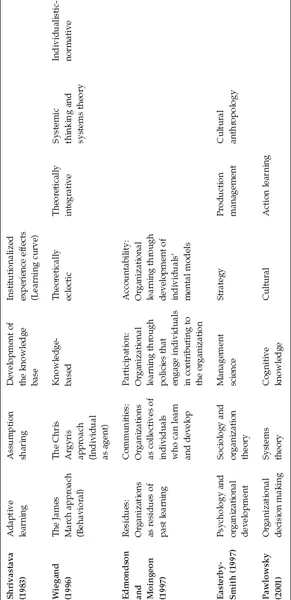
The attraction of organizational learning for multiple parochial disciplines may be a reflection of the complexity and multidimensionality of the phenomenon itself (Berthoin-Antal et al., 2001). There are many ways of dividing up the field, inviting new perspectives and new typologies. Table 1.1 presents a sample of typologies that have emerged over the past 20 years and illustrates the diversity of ways in which the field can be conceptualized.
Table 1.1 is merely intended to compare these frameworks rather than offer an alternative typology. Our view is that adding another typology would only contribute to the mystification of organizational learning at this point in the development of the field. Pawlowsky (2001) expressed this view when he questioned whether “new contributions should be valued as increases in knowledge about organizational learning or whether they just add to the growing diversity.” He then answered the question by stating that “the current growth of literature… coincides with a sense of ambiguity, lack of consensus… and even growing confusion” (p. 64). Even so, Pawlowsky himself suggested a new framework of five perspectives on organizational learning based on different theoretical traditions and assumptions.
Treating Organizations Like People
Much of the thinking on organizational learning assumes that organizations learn like people learn. This assumption entails anthropomorphism—attributing a human capacity (learning) to a non-human entity (organization) (Doving, 1996). There is, for example, a high degree of similarity between Kolb's model of how individuals learn from experience (Kolb, 1984) and the Shaw and Perkins model of organizational learning (Shaw & Perkins, 1992). The only substantive difference is the addition of “dissemination” in the latter (see Chapter 2 for a graphic comparison of these two models).
Table 1.1 Conceptual Frameworks for Organizational Learning
It is, however, far from self-evident that organizations are actually capable of learning. Kolb's model is plausible because the human nervous system enables people to execute the processes specified by the model. It is not at all clear how organizations can perform the operations specified by Shaw and Perkins. Simply extrapolating from individual learning to organizational learning overlooks significant differences between the two. It also obscures the critical question of how the learning of individual organizational members becomes “organizational.”
Researchers who take a behavioral approach to organizational learning solve the problem of anthropomorphism by more or less ignoring it or defining it away (e.g., Arthur & Aiman-Smith, 2002; Baum, Xiao Li, & Usher, 2000; Cyert & March, 1963). They define organizational learning in terms of outcomes (changes in standard operating procedures) but treat learning processes as a “black box.” Nevertheless, they still draw heavily on anthropomorphic metaphors such as imitation, improvisation, experiential learning, and vicarious learning (Baum et al., 2000) or exploration versus exploitation (March, 1991).
Researchers who take a more cognitive approach to understanding organizational learning have attempted to look inside the black box. Argyris and Schön (1978) addressed the question of anthropomorphism directly by asking, “What is an organization that it may learn?” Recognizing that only individuals can act as agents of learning, they suggested that organizational learning occurs when individual members reflect on behalf of the organization. They linked learning to changes in mental “theories of action” that not only drive individual behavior but which can be inferred at the organizational level as well. The drawback of this latter solution to the problem of anthropomorphism is that the transition from individual to organizational learning remains unspecified.
Much of the practitioner-oriented literature on learning organizations uses anthropomorphic language that appeals to the imagination but masks complexity. For example, Garvin began his book on the subject by discussing how learning is an essential aspect of everyone's life. A few paragraphs later, he shifted effortlessly, and uncritically, from individual learning to organizational learning, offering a “few simple litmus tests” to help managers know whether their organizations are learning...