eBook - ePub
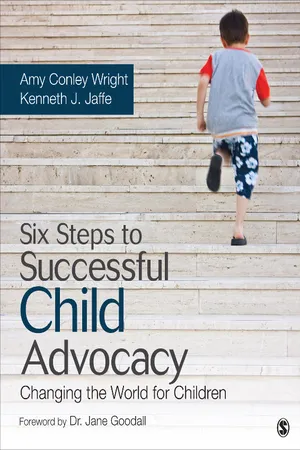
Six Steps to Successful Child Advocacy
Changing the World for Children
- 224 pages
- English
- ePUB (mobile friendly)
- Available on iOS & Android
eBook - ePub
Six Steps to Successful Child Advocacy
Changing the World for Children
About this book
Six Steps to Successful Child Advocacy: Changing the World for Children offers an interdisciplinary approach to child advocacy, nurturing key skills through a proven six-step process that has been used to train child advocates and create social change around the world. The approach is applicable for micro-advocacy for one child, mezzo-advocacy for a community or group of children, and macro-advocacy at a regional, national, or international level. This practical text offers skill-building activities and includes timely topics such as how to use social media for advocacy. Case studies of advocacy campaigns highlight applied approaches to advocacy across a range of issues, including child welfare, disability, early childhood, and education. Words of wisdom from noted child advocates from the U.S. and around the world, including a foreword from Dr. Jane Goodall, illustrate key concepts. Readers are guided through the process of developing a plan and tools for a real-life child advocacy campaign.
Information
C H A P T E R 1
Introduction
In rural Zimbabwe, young children are often raised by their siblings due to the death of their parents from the HIV/AIDS epidemic ravaging the country. These young children often miss out on the stimulation and care they need while their siblings supervise them rather than attend school. In 2007, the International Child Resource Institute (ICRI) was invited by the Women’s University in Africa to build a child care center at a primary school site on their rural campus in Murambinda. At first, the child care center functioned in a tiny cottage overrun by rats, with more than 60 children napping on concrete floors without blankets. From these meager beginnings, ICRI child advocates worked with the community to design and build a child care center with bricks handcrafted out of the local adobe soil by village volunteers. Staff were carefully trained on developmentally appropriate care and education of young children, and the center was designed to stimulate all domains of children’s development, using locally made materials and found objects. National media covered the grand opening, which helped to elevate respect for the preschool teachers and awareness of the center as a national model early childhood care and health program and training center for early childhood educators.
On the other side of the world, in Brazil, street children in the 1990s were routinely “disappeared” by off-duty police and soldiers employed by businessmen to clear them off the streets near their businesses and presumably kill them with total impunity from prosecution. The National Movement for the Street Children of Brazil (Movimiento) invited ICRI to collaborate on developing advocacy strategies and bringing international attention to this issue. Advocates collected stories from street children about their lives, finding that many were not orphans, but instead came from poor homes with parents who could not afford to care for them. An international letter-writing campaign was launched that intensified after the Candelária massacre, when a group of men including off-duty police officers opened fire on children sleeping in the courtyard of a church, killing eight of them and wounding many more. In response, Movimiento organized street children around the country and brought them to Brasilia (the capital of Brazil) to occupy the national capitol building while the legislators were out at lunch. The international and national attention from these events prompted a national educational campaign about street children and a number of prosecutions with a drop ever since in the number of disappearances.
Elsewhere in Latin America, the nation of Chile in the 1990s had an unacknowledged problem with various forms of child abuse, including sexual abuse. Initially, officials denied that sexual abuse existed in Chile, pointing to their tradition of Catholicism and refusing to admit that such a thing could happen in their country. ICRI was invited by the Ministry of Justice to conduct the first trainings of staff across the country at their programs for abused and neglected children. Training included detection and treatment of child sexual abuse for psychologists and methods for investigation and prosecution of perpetrators for judges and lawyers. After the first year of training, a scandal occurred when news broke of government officials’ involvement with a child prostitution ring. National outrage prompted attention to child abuse and neglect, and the national government expanded the number of child abuse and neglect centers around the country. ICRI provided assistance to the national government in its effort to improve enforcement of their laws on child sexual abuse through prevention, treatment, and legal action. Teachers and program leaders were given information on the psychological impacts of child maltreatment and provided with intervention strategies to help children and their families.
Shifting to Nepal, a national law passed in 2000 mandated that children could no longer accompany their parents who were sent to prison. As a result, many children were living on the streets or under inadequate care, leaving them vulnerable and at great risk. During this period, there was a rapid increase in the development of group homes for the children of prisoners. The Central Child Welfare Board of the Nepali government asked ICRI to facilitate the establishment of a national coalition of organizations working with children of prisoners. These organizations were in competition for limited funds from the government and international donors, which created conflict. ICRI leadership organized a meeting to encourage 20 disparate children of prisoners groups to recognize that it was in their enlightened self-interest to join forces and share resources, such as fundraising efforts, staff training, and administrative support. While collaboration seemed doubtful on day one, by day four of the facilitation, the coalition had chosen a name (Network for Children, Prisoners, and Dependents) and committed to the terms of their collaboration. Since its development, the Network has received commendations from civil society groups and the government of Nepal; it has also received numerous grants for improvements to group home care, such as solar water heating, sanitation development, teacher training, and child psychology support services. Moreover, it serves as a model of networking that the country of Nepal had not seen before.
Another model of community collaboration is the grassroots, community based, youth-driven advocacy group Homies Organizing the Mission to Empower Youth (HOMEY), formerly fiscally and programmatically sponsored by ICRI. HOMEY emerged in the 1990s in response to gang violence in the diverse and densely populated Mission neighborhood in San Francisco, California. HOMEY’s founders, former gang members themselves in many cases, wanted to prevent violence in their neighborhood and give youth alternatives to gang life. With financial support from the city of San Francisco and private foundations, HOMEY offers vocational training, microloans for small businesses, community advocacy, and peace-building strategies for youth and young adults. The Homies have been invited to most city youth-related commissions and boards, including efforts to reform juvenile justice. HOMEY also organizes and participates in community forums that defuse tensions between rival gangs. Their work has contributed to reducing violence and death among youth in the Mission and increasing positive behaviors among youth such as school attendance and entrepreneurship.
These are just a few examples of successful advocacy on behalf of children and youth around the world. The themes they have in common and the steps taken to achieve these victories will be explored in this and subsequent chapters.
WHAT IS SUCCESSFUL CHILD ADVOCACY?
The word advocacy derives from the Latin “advocare,” meaning “to call,” and is related to “vocem,” meaning “voice” (“Advocate,” 2011). Advocacy, then, can be understood as using voice or acting as the voice of another. In relation to children, the importance of advocacy is particularly acute. Children generally cannot act as their own voice in important issues affecting them, such as policy development or matters of the court (see Box 1.1, The Silent Voice of the Child). Acting as the voice of children, advocacy often involves calling things as they are and identifying problems. It also involves calling on those who hold positions of authority in society to engage and involve them in solving problems for children. Child advocacy can be directed toward a problem that affects a single child or a cause that affects a group of children. This distinction is known as case advocacy versus class or cause advocacy (Kirst-Ashman & Hull, 2008).
BOX 1.1
The Silent Voice of the Child
By Evelyn Quartey-Papafio, Officer in charge of the National Nursery Teachers’ Training Centre, Ghana Education Service (Ghana)
If I have a voice, everyone will hear what I have to say.
If I have a voice, I would be treated with more respect.
Silent though I seem; I ask you to open your eyes.
Look, look again at the expression on my face.
Look, and look again.
My expression says, I am human, I have rights.
Treat me with respect, show me love, listen to me.
Let the joys of my heart flow naturally.
Whisper to me and I will listen to you.
My innocence quietly says,
Lead me on, that I may grow tall.
From the Experience of a Preschool Teacher:
“Teacher Rosemond yelled at me,” 4-year-old Anita said as soon as she was picked up from the preschool.
“What happened?” her mum asked.
There was a brief silence, then Anita started another conversation about the fun she had with her friends at the playground. Later, all the family heard about the yelling, including Anita’s father way off in his office, before he got home. Finally, Anita confessed the reason to Marian, her elder sister. “I refused to write ‘5’ when Teacher Rosemond asked me to,” she explained.
When Marian asked why, Anita sharply said Teacher Rosemond was not her teacher. She only substituted for her regular teacher, who was fond of all the children in the class. That evening, Anita wrote “5” on every piece of furniture, wall, and book cover in the house to demonstrate her ability to write “5.”
A grandma called across the compound to Anita, “Stop playing in the mud and come up here.” “You’ve spoilt the fun, Grandma,” Anita murmured angrily, as she put her playthings away.
Anita has no voice, she just has to obey.
Who will speak for the child out there? Who will show the millions out there how to politely address the child or support his or her learning and development? Do adults respect the rights of the child? How patiently do adults listen to the children?
Successful child advocacy is simply those efforts that meet their intended goal of making positive change for children. As will be discussed later in this chapter, advocacy can take place on different levels; these include advocacy on behalf of a particular child, a group of children, or an issue affecting many children in the larger society. It is the premise of this book that the underlying methods of advocacy are basically the same for a range of goals. Often, the ultimate goal of advocacy is some type of policy change or the development of a critical mass that helps to implement that change. Policy change may involve a broad swath of activities that can include the passage of legislation, preventing passage of harmful legislation, establishing a new project, expanding an existing project, and other tangible outcomes.
Many methods are available in the successful child advocacy arsenal. These include legislative advocacy, legal advocacy, media advocacy, and organizational advocacy. Legislative advocacy is an effort to influence the passage of public policy. Efforts may be intended to secure the passage of favorable legislation or block unfavorable legislation. In some countries, such as the United States, there are restrictions on lobbying activities by nonprofit tax-exempt organizations. Another approach to making system-level change is legal advocacy, particularly class-action lawsuits on behalf of a group (or class) of people. In the United States, many changes to state or county-run child welfare systems have occurred due to successful class-action lawsuits. Advocates may turn to this option when they encounter difficulty making legislative change and can demonstrate that systems have not been held accountable for meeting promises to disempowered clients (Center for the Study of Social Policy, 1998). Media campaigns may complement legislative or legal advocacy or stand alone by helping to change public opinion on a certain matter. Organizational advocacy is a strategy to change practices for serving children and families, often from the inside by someone in a professional role in the organization.
WHY ARE CHILDREN IN SPECIAL NEED OF ADVOCACY?
Children are dependent on adults for their care (as discussed by Dr. Jane Goodall in the Preface), and this has meant historically that they have often been maltreated. Historian and psychotherapist Lloyd deMause (1995) noted,
The history of childhood is a nightmare from which we have only recently begun to awaken. The further back in history one goes, the lower the level of child care, and the more likely children are to be killed, abandoned, beaten, terrorized, and sexually abused. (p. 1)
History is replete with examples of treatment of children that would be seen as sadistic in our own time, including the common practice of infanticide in the Ancient Greek and Roman empires; child sacrifice among the Aztec, Mayan, and Incan cultures; and mutilation such as castration of boys to preserve their high singing voices (the Castrati in 16th through 19th century Italy) and foot binding of girls in China until the 19th century (deMause, 1995; Grille, 2009). The view of children as people in their own right, rather than simply chattel of their fathers or masters, is of relatively recent origin.
Just as their age puts children into a class that often faces discrimination, children can also be part of other oppressed groups based on their race/ethnicity, caste, religion, social class, socioeconomic status, sexual orientation, and family structure as well as other elements of their background. Children who face particularly acute challenges include members of racial and ethnic groups like the Roma in Eastern Europe, Africans in Arab countries, Indigenous in Latin America and Australia, and African Americans and Latinos in the United States. These children are often subject to systems that seem to foster negative outcomes. For example, the Children’s Defense Fund and American Civil Liberties Union have brought attention to what they call the Cradle to Prison Pipeline or School to Prison Pipeline, a systematic series of injustices and prejudice in the systems that serve poor children of color that seem to lead them inexorably toward school dropout and criminality from the time they are born or enter school (American Civil Liberties Union, 2008; Children’s Defense Fund, 2007). These unjust systems are important targets for advocacy.
Many of the protections children enjoy today, particularly in the Western world, are products of the zeal of reformists during the Progressive Era, a term used by historians to describe the late 18th century and early 19th century in the United States and other Western countries. The child saving movement during the Progressive Era advocated for and achieved the development of social services systems serving children and youth. These included the child welfare system to investigate cases of child maltreatment and put children in substitute care. In the United States, the origin of child welfare services is often attributed to the advocacy of social worker Etta Wheeler on behalf of a maltreated child named Mary Ellen Wilson. Wheeler learned of Mary Ellen’s severe maltreatment at the hands of her adoptive mother, and after initial attempts to spur intervention by New York City officials failed, she contacted the founder of the American Society of Prevention of Cruelty to Animals, Henry Bergh. They worked together to gain evidence of Mary Ellen’s maltreatment ...
Table of contents
- Cover Page
- Halftitle
- Dedication
- Title
- Copyright
- Brief Contents
- Detailed Contents
- Acknowledgments
- Foreword
- Preface
- 1 Introduction
- 2 Parameters of Advocacy
- 3 Planning Your Project With the Six Steps to Successful Child Advocacy
- 4 Step 1—Knowing Your Issue
- 5 Step 2—Research for Background and Impact
- 6 Step 3—Preparing Effective Materials
- 7 Step 4—Making Meetings That Work
- 8 Step 5—Conducting Strategic Follow-Up
- 9 Step 6—Reinforcing Successful Advocacy Outcomes
- 10 Where Do We Go From Here?
- Index
- Advertisement
Trusted by 375,005 students
Access to over 1.5 million titles for a fair monthly price.
Study more efficiently using our study tools.
Frequently asked questions
Yes, you can cancel anytime from the Subscription tab in your account settings on the Perlego website. Your subscription will stay active until the end of your current billing period. Learn how to cancel your subscription
No, books cannot be downloaded as external files, such as PDFs, for use outside of Perlego. However, you can download books within the Perlego app for offline reading on mobile or tablet. Learn how to download books offline
Perlego offers two plans: Essential and Complete
- Essential is ideal for learners and professionals who enjoy exploring a wide range of subjects. Access the Essential Library with 800,000+ trusted titles and best-sellers across business, personal growth, and the humanities. Includes unlimited reading time and Standard Read Aloud voice.
- Complete: Perfect for advanced learners and researchers needing full, unrestricted access. Unlock 1.5M+ books across hundreds of subjects, including academic and specialized titles. The Complete Plan also includes advanced features like Premium Read Aloud and Research Assistant.
We are an online textbook subscription service, where you can get access to an entire online library for less than the price of a single book per month. With over 1.5 million books across 990+ topics, we’ve got you covered! Learn about our mission
Look out for the read-aloud symbol on your next book to see if you can listen to it. The read-aloud tool reads text aloud for you, highlighting the text as it is being read. You can pause it, speed it up and slow it down. Learn more about Read Aloud
Yes! You can use the Perlego app on both iOS and Android devices to read anytime, anywhere — even offline. Perfect for commutes or when you’re on the go.
Please note we cannot support devices running on iOS 13 and Android 7 or earlier. Learn more about using the app
Please note we cannot support devices running on iOS 13 and Android 7 or earlier. Learn more about using the app
Yes, you can access Six Steps to Successful Child Advocacy by Amy Conley Wright,Kenneth J. Jaffe in PDF and/or ePUB format, as well as other popular books in Social Sciences & Social Work. We have over 1.5 million books available in our catalogue for you to explore.