This second book in the Prevention Practice Kit provides counselors, psychologists, and other mental health workers with practical steps that need to be considered by prevention practitioners as they engage with others in developing and delivering prevention projects. A context for engaging in prevention practice is provided, including discussion of how prevention fits with traditional models of psychology, descriptions of theoretical models for doing prevention practice, and examples of empirically-supported prevention interventions.
The reader will learn about a new set of Prevention Guidelines being proposed to the American Psychological Association, and why these recommendations are important to consider. The book highlights the essential aspects of collaboration, cultural relevance, social justice, and program dissemination, and addresses knotty ethical issues surrounding confidentiality in prevention and health promotion efforts. In addition, the book provides information on funding and readily available resources for prevention. Finally, examples and activities are provided throughout the book—accompanied by a set of learning exercises—to help readers apply what they learn.
This book is part of the Prevention Practice Kit: Action Guides for Mental Health, a collection of eight books each authored by scholars in the specific field of prevention and edited by Dr. Robert K. Conyne and Dr. Arthur M. Horne. The books in the collection conform to the editors? outline to promote a consistent reading experience. Designed to provide human services practitioners, counselors, psychologists, social workers, instructors, and students with concrete direction for spreading and improving the practice of prevention, the series provides thorough coverage of prevention application including a general overview of prevention, best practices, diversity and cultural relevance, psychoeducational groups, consultation, program development and evaluation, evidence base, and public policy.
This book is endorsed by the Prevention Section of the Society of Counseling Psychology of the American Psychological Association. Fifty percent of all royalties are donated to Division 17 of the APA.
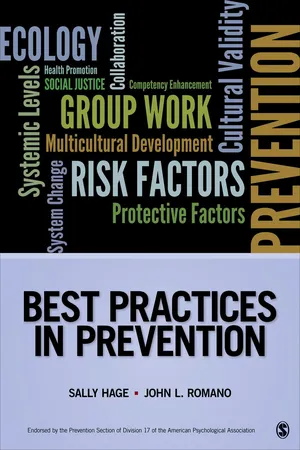
- 73 pages
- English
- PDF
- Available on iOS & Android
eBook - PDF
Best Practices in Prevention
About this book
Information
Table of contents
- BEST PRACTICES IN PREVENTION-FRONT COVER
- BEST PRACTICES IN PREVENTION
- BRIEF CONTENTS
- DETAILED CONTENTS
- ACKNOWLEDGMENTS
- CHAPTER 1: WHY PRACTICE PREVENTION? WHY NOW?
- Focus of This Book
- Factors Accounting for Shift to Prevention
- How Does Prevention Fit With Traditional Models of Psychology?
- Theoretical and Conceptual Models for Prevention
- CHAPTER 2: FOUR THEORIES AND PERSPECTIVES TO SUPPORT PREVENTION INTERVENTIONS
- Transtheoretical Model of Behavior Change
- Theory of Reasoned Action and Planned Behavior
- Positive Psychology
- Social Justice
- CHAPTER 3: GUIDELINES FOR PREVENTION PRACTICE, RESEARCH, AND EDUCATION
- CHAPTER 4: RESEARCH-INFORMED PREVENTION PRACTICE: LEARNING FROM THE WISDOM OF SCIENCE
- Empirically Supported Prevention Applications
- Components of Successful Prevention Programs
- Targeting Risk and Protective Factors
- Risk Factors
- Protective Factors
- Translating Research to Practice
- CHAPTER 5: SOCIAL JUSTICE AND PREVENTION
- Social and Cultural Relevance in Prevention
- Black Parenting Strengths and Strategies Program
- Importance of Collaboration and Community Involvement
- Reaching Out About Depression
- Strengths, Prevention, Empowerment, and Community Project
- CHAPTER 6: ETHICAL AND PROFESSIONAL ISSUES IN PREVENTION
- Informed Consent
- Confidentiality
- Evaluation
- Prevention Program Dissemination and Stakeholders
- Funding and Resources for Prevention
- CHAPTER 7: APPLYING PREVENTION LEARNING: FIVE LEARNING EXERCISES
- Learning Exercise 1
- Learning Exercise 2
- Learning Exercise 3
- Learning Exercise 4
- Learning Exercise 5
- REFERENCES
- INDEX
- ABOUT THE AUTHORS
Trusted by 375,005 students
Access to over 1.5 million titles for a fair monthly price.
Study more efficiently using our study tools.
Frequently asked questions
Yes, you can cancel anytime from the Subscription tab in your account settings on the Perlego website. Your subscription will stay active until the end of your current billing period. Learn how to cancel your subscription
No, books cannot be downloaded as external files, such as PDFs, for use outside of Perlego. However, you can download books within the Perlego app for offline reading on mobile or tablet. Learn how to download books offline
Perlego offers two plans: Essential and Complete
- Essential is ideal for learners and professionals who enjoy exploring a wide range of subjects. Access the Essential Library with 800,000+ trusted titles and best-sellers across business, personal growth, and the humanities. Includes unlimited reading time and Standard Read Aloud voice.
- Complete: Perfect for advanced learners and researchers needing full, unrestricted access. Unlock 1.5M+ books across hundreds of subjects, including academic and specialized titles. The Complete Plan also includes advanced features like Premium Read Aloud and Research Assistant.
We are an online textbook subscription service, where you can get access to an entire online library for less than the price of a single book per month. With over 1.5 million books across 990+ topics, we’ve got you covered! Learn about our mission
Look out for the read-aloud symbol on your next book to see if you can listen to it. The read-aloud tool reads text aloud for you, highlighting the text as it is being read. You can pause it, speed it up and slow it down. Learn more about Read Aloud
Yes! You can use the Perlego app on both iOS and Android devices to read anytime, anywhere — even offline. Perfect for commutes or when you’re on the go.
Please note we cannot support devices running on iOS 13 and Android 7 or earlier. Learn more about using the app
Please note we cannot support devices running on iOS 13 and Android 7 or earlier. Learn more about using the app
Yes, you can access Best Practices in Prevention by Sally Hage,John L. Romano, Sally M. Hage, John L. Romano in PDF and/or ePUB format, as well as other popular books in Social Sciences & Education Counseling. We have over 1.5 million books available in our catalogue for you to explore.