![]()
1
CHARACTER DEVELOPMENT
“I was trying to raise myself to be a black man in America and beyond the given of my appearance, no one around me seemed to know exactly what that meant.”
—Obama, Dreams from My Father*
“I was different, after all, potentially suspect; I had no idea who my own self was.”
—Obama, Dreams from My Father*
“I have brothers, sisters, nieces, nephews, uncles and cousins, of every race and every hue, scattered across three continents, and for as long as I live, I will never forget that in no other country on Earth is my story even possible.”
—Obama, “A More Perfect Union”*
Barack Obama thinks of himself as an African American, the son of an African father and American mother. His duel ancestry has given him the credentials, experience, and desire to bridge the racial divide in ways that most Americans, black or white, can not. Because of his background, Obama believes that he can understand and empathize with the struggles, attitudes, and feelings of Americans of all races, which is the reason that he begins his campaign speeches with his life story:
I am the son of a black man from Kenya and a white woman from Kansas. I was raised with the help of a white grandfather who survived a Depression to serve in Patton’s Army during World War II and a white grandmother who worked on a bomber assembly line at Fort Leavenworth while he was overseas.
I’ve gone to some of the best schools in America and lived in one of the world’s poorest nations. I am married to a black American who carries within her the blood of slaves and slaveowners—an inheritance we pass on to our two precious daughters.
I have brothers, sisters, nieces, nephews, uncles and cousins, of every race and every hue, scattered across three continents, and for as long as I live, I will never forget that in no other country on Earth is my story even possible.1
Obama has used his diverse background to introduce his uniqueness as a candidate, to demonstrate his capacity to understand and empathize with the problems people face, to praise America, and to justify his political goals.
Race and Roots
That Obama categorizes himself as African American is a consequence of his skin color, his mixed racial ancestry, and the belittling and discrimination he personally experienced growing up in a race-conscious America.2 In Dreams from My Father, he writes about his first day at Punahou Academy in Hawaii after his return from Indonesia, when students mocked his name and his African ancestry. “A redheaded girl asked to touch my hair and seemed hurt when I refused. A ruddy-faced boy asked me if my father ate people.”3
In The Audacity of Hope he wrote,
I can recite the usual litany of petty slights that during my forty-five years have been directed my way: security guards tailing me as I shop in department stores, white couples who toss me their car keys as I stand outside a restaurant waiting for the valet, police cars pulling me over for no apparent reason. I know what it’s like to have people tell me I can’t do something because of my color, and I know the bitter swill of swallowed-black anger.4
The young Obama’s conscious association with African Americans, beginning in his middle school years, reinforced his growing racial identity, his perceptions of discrimination, and his search for community—all of which contributed to his identity decisions.5
During this period of his life, Obama strove to be like other African Americans his age. He adopted what he perceived to be their mannerisms, their likes (sports, especially basketball) and dislikes (hitting the books hard). In later years he reflected on his experience in an article he wrote for his high school alumni magazine:
As an African-American teenager in a school with few African-Americans, I probably questioned my identity a bit harder than most. As a kid from a broken home and family of relatively modest means, I nursed more resentment than my circumstances justified, and didn’t always channel those resentments in particularly constructive ways.6
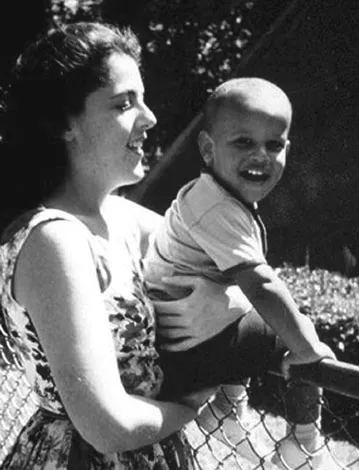
Young Barack with his mother, Ann Dunham Obama.
Source: AP Photo/Obama Presidential Campaign
Added to this racial identity quest was the personal challenge of succeeding as an African American in a society dominated by whites. Obama did not want his acceptance and achievements diminished by his maternal ancestry. “I ceased to advertise my mother’s race at the age of twelve or thirteen, when I began to suspect that by doing so I was ingratiating myself to whites… .”7
Embracing the African American experience, growing up, trying to figure out his identity, and subsequently writing of his struggle to do so, Obama’s coming of age is the story of an adolescent and young man, finding and accepting himself for who he was and what he overcame. He saw his struggle as unique and surmounting the hurdles that threatened to define and limit him as extraordinary and extemporary, so much so that he wrote about them.
That Obama believed his life experience, his trials and tribulations, to be so different and of such interest that they would engage the attention of others is evidence of considerable grandiosity and self-conceit. Moreover, in telling his story in Dreams from My Father, Obama embellishes his narrative with such detail and conveys such strong emotions that some of the real world subjects in the manuscript indicated to reporters that Obama’s description of personalities and events were exaggerated.8 Subsequently, in middle age, running for president, Obama seemed a little embarrassed by the raw feelings he expressed and impetuous actions he described in the book. He attributes the emotions he felt and the activities in which he engaged in his teen years to being “an adolescent male with a lot of hormones and an admittedly complicated upbringing.”9
Obama evidences little anger in public life today.10 In fact, he seems to repress his emotions. He is amazingly self-disciplined and self-confident. He needs to be in control, keeps his grandiosity, which he retains, under wraps, and displays a cool rationality.
The Obama running for elected office seemed comfortable with himself and his mixed racial heritage; he wore that heritage as a mantra, a badge of social acceptance, much to the dismay of some older African American leaders who have complained that he is not “black enough,” and that he somehow talks down to people of his own race.11
Obama is careful not to project himself as a typical African American politician. In his own words, “I’m rooted in the African-American community, but not limited by it.”12 Throughout his career he has demonstrated that he is not a traditional politician, that his diverse background enables him to understand and appreciate the plight of a large cross-section of Americans. His appeal has been to a new generation; he projects a new image, a person who has moved beyond race to resemble what America has become, a multiracial society in which racial and ethnic minorities can aspire to achieve the American Dream just like those in the white, Anglo majority. He has combined that appeal with a “can do” mentality.
Obama is both the model for the “can do” dream as well as the preacher who paved the way. During his 2008 presidential campaign, he is the messenger but also the person who personifies the message. To get to that point, however, he had to work to rid himself of resentment toward an absent and irresponsible father and perhaps also to a mother who pursued her own career goals doing research in Indonesia (to earn a Ph.D. in Anthropology) while her only son returned to Hawaii to live with his maternal grandparents.
His yearning to discover his roots was evident from the time Obama first realized he was different. He talks about his teen years and his experience of “the constant, crippling fear that I didn’t belong somehow, that unless I dodged and hid and pretended to be something I wasn’t, I would forever remain an outsider, with the rest of the world, black and white, always standing in judgment.”13
Searching for roots to claim as his own was a necessary, arduous, and painful task for young Obama, heightened not only by his mixed racial ancestry and the absence of his African father but also by his mother’s second marriage to a man from Indonesia and the five years Obama spent living in that country from the age of six to ten. His was a persistent search for identity, one in which he first tried to acknowledge and accept his blackness, then his African ancestry, subsequently his religious commitment and community, and finally his brand of Americanism.
Finding roots is an important part of self-understanding for most people. It helps define who we are and what we value and believe. For Obama, roots provided him with a sense of belonging, a heritage from which he could explain his thinking, reactions and emotions, and eventually, aspirations. In his own words, “I am a prisoner of my own biography: I can’t help but view the American experience through the lens of a black man of mixed heritage… .”14
Roots also helped the young Obama ground himself in reality, aiding him in severing the fantasies he created as a child, his dreams about his father. Roots provided a foundation on which he could stand and appreciate how the culture and tradition of racial, ethnic, and religious groups contributed to the fabric of American society. These roots and that appreciation helped him to avoid the escapism in which his grandfather, father, and mother engaged and the loneliness that followed from it for each of them.15 By realizing his ties to others, roots helped free him from his own loneliness and helped him to define and accept himself. It gave him an identity and community.
The desire for sturdy roots is one reason Michelle Obama and her family were so attractive to Barack. They were the stable, close-knit African American family he never had and, over time, had wanted so much. Her parents understood their heritage. They had their own family stories that traced their lineage back to slavery in America. They were part of the great migration of African Americans to the urban centers following World War II, a tight-knit family that provided for itself. Hard-working and responsible, Michelle’s parents gave their children opportunities they never had. Both Michelle and her brother attended Princeton as undergraduates, and Michelle earned a law degree from Harvard.
In addition to providing brethren and tradition, a community of shared history, common values, a sense of belonging, roots also may have satisfied another personal need for Obama—the need to contain his own grandiosity by placing himself within a larger and less self-centered environment. Growing up in a household of three adults, with no appropriate male role model16 and without a sibling for his first six years, Obama was likely indulged, probably not materially—the family was of modest means—but more likely emotionally. The attenti...