Raise organizational effectiveness to improve the quality of instruction and dramatically impact student achievement!
Working in tandem with the powerful National Education Association?s KEYS initiative (Keys to Excellence in Your Schools), this second edition focuses on how to change a school?s organizational structure and culture to improve the quality of teaching and learning.
Each chapter, revised and updated to address continuous improvement and narrowing the achievement gap, provides a wealth of knowledge from leading experts in the field including Patricia A. Alexander, Eva L. Baker, James A. Banks, Peter Cookson, Lorna M. Earl, Richard F. Elmore, Michael Fullan, Geneva Gay, Willis D. Hawley, Jacqueline Jordan Irvine, Kenneth Leithwood, Ann Lieberman, Judith Warren Little, Lynne Miller, P. Karen Murphy, Fred M. Newmann, Sonia Nieto, Janet Ward Schofield, Walter G. Stephan, Gary Sykes, and Linda Valli.
Educators at all levels, policymakers, and parents will discover how to apply the lessons learned from research. This essential handbook provides new chapters, including exemplary practice on teaching and learning for a multicultural society and on continuous school improvement.
Now you can advance to the next level of change with an integral resource for school reform.
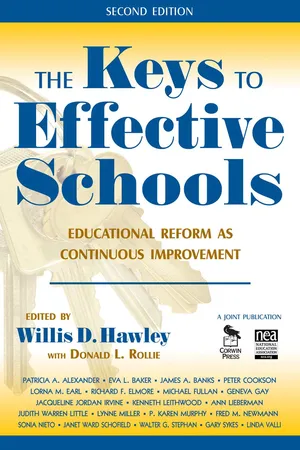
eBook - ePub
The Keys to Effective Schools
Educational Reform as Continuous Improvement
- 248 pages
- English
- ePUB (mobile friendly)
- Available on iOS & Android
eBook - ePub
About this book
Information
CHAPTER ONE
Educational Reform as Continuous Improvement
The chapters in this book are relevant to virtually any comprehensive effort aimed at creating the conditions in schools that promote continuous improvement. The book was initially prepared to serve as a resource document for the National Education Association’s (NEA, 1997) KEYS project. KEYS is an acronym for “Keys to Excellence in Your Schools.” Through reviews of research and in consultation with prominent scholars, NEA has identified numerous factors essential to effective schools and has developed a survey instrument designed to gather data on these items, and, in turn, to feed back the data to participating schools. The items cluster into six main domains:
- Knowledge of teaching and learning
- Shared understanding and commitment to high goals
- Open communication and collaborative problem solving
- Continuous assessment for teaching and learning
- Personal and professional learning
- Resources to support teaching and learning
The KEYS project is one example of the larger effort to transform the teaching profession. The National Commission on Teaching and America’s Future (NCTAF, 1996) documented the problem as follows:
Low expectations for student performance
Unenforced standards for teachers
Major flaws in teacher preparation
Painfully slipshod teacher recruitment
Inadequate induction for beginning teachers
Lack of professional development and rewards for knowledge and skill
Schools structured for failure rather than success (p. 24)
This is not the first time that the reform of schools has brought teaching to the forefront (Fullan, Galluzzo, Morris, & Watson, 1998). Such a focus on teaching needs to start with the recruitment and professional development of effective and committed teachers. As we have argued in our study, The Rise and Stall of Teacher Education Reform (Fullan et al., 1998), a comprehensive sustained initiative should incorporate the following:
- A stronger knowledge base for teaching and teacher education
- Plans for attracting able, diverse, and committed students to the career of teaching
- Redesigning of teacher preparation programs field of practice so that the links to both arts and sciences and to the field of practice are strengthened
- Reform in the working conditions of schools
- Development and monitoring of external standards for progress as well as for teacher development
- Candidates and teachers on the job
- A rigorous and dynamic research enterprise focusing on teaching, teacher education, and assessment and monitoring of strategies (p. 58)
We have also said that teachers, ranging from the individual teacher in the classroom to the most visible union leader, must “help to recreate the profession.” Hargreaves and I concluded in What’s Worth Fighting for Out There (1998) that the teaching profession has not yet come of age and that the next decade, furthermore,
will be a defining era for the teaching profession. Will it become a stronger learning profession? Will it become a force for societal change and social practice? Can it develop its own visions of and commitments to educational and social change, instead of simply vetoing and reacting to the change agendas of others? (p. 103)
More recently, the National Academy of Education systematically mapped out a comprehensive curriculum for preparing teachers for a changing world (Darling-Hammond & Bransford, 2005; National Academy of Education, 2005). The KEYS initiative and the chapters in this book are written in the spirit of changing the conditions under which teachers work, so that continuous improvement is built into the culture of the school and the infrastructure that supports it.
The KEYS project, with its survey instrument, feedback, action planning, and online professional development in the schools and districts participating in the program, is engaged in very difficult work. The ultimate goal is to mobilize thousands of schools and districts in transforming professional development and organizational learning. The KEYS project by itself will not accomplish such fundamental reform. It can, however, have a significant impact by connecting the powerful concepts in the KEYS instrument with the content priorities embedded in the new teaching and learning curricula being developed across the nation; these are premised on an understanding that systematic, evidence-driven professional development, a focus on teaching and learning, the development of learning schools and school districts, and success for all students are closely intertwined.
What we need, then, is to consolidate the knowledge base about what makes for continuous improvement and, correspondingly, to mobilize sets of actions among educators, in partnership with others, to engage in reform initiatives that are based on this knowledge base.
The chapters in the book align with the themes in the KEYS project as follows:
Knowledge of teaching and learning: P. Karen Murphy and Patricia A. Alexander (Chapter 2)
Shared understanding and commitment: Fred M. Newmann (Chapter 3)
Communication and problem solving: Judith Warren Little (Chapter 4)
Assessment for teaching and learning: Eva L. Baker (Chapter 5); Lorna M. Earl (Chapter 6)
Personal and professional learning: Ann Lieberman and Lynne Miller (Chapter 7); Willis D. Hawley and Linda Valli (Chapter 8)
Supportive requirements: Kenneth Leithwood (Chapter 9); Willis D. Hawley and Gary Sykes (Chapter 10); James A. Banks, Peter Cookson, Geneva Gay, Willis D. Hawley, Jacqueline Jordan Irvine, Sonia Nieto, Janet Ward Schofield, and Walter G. Stephan (Chapter 11); Richard F. Elmore (Chapter 12)
The assumption of KEYS is that schools and districts that focus on the six clusters—and do so in a way that closely connects these themes to particular curriculum priorities—will increase their capacity to achieve coherence and focus and will affect learning for all students within the system.
In this introductory chapter, first, I start with the core argument that professional development, pedagogical improvement, and student learning need to be tightly interwoven for schools to be effective. The chapters by Newmann, Little, Baker, and Earl form the basis of this conclusion. Murphy and Alexander summarize research that identifies essential knowledge about student learning.
Second, I reinforce the argument by examining personal and professional learning. These ideas are founded on the chapters by Valli and Hawley, and Lieberman and Miller.
Third, you can’t have learning organizations without having schools and districts as learning systems and without having teaching as a learning profession. The last section focuses on districts as learning systems and on teaching as a profession. Elmore, Leithwood, Hawley and Sykes, and Banks et al. provide the conditions and requirements necessary for continuous learning to be embedded.
DEEP UNDERSTANDING OF HOW PEOPLE LEARN
The fundamental goal of school improvement is, of course, improved student learning, especially raising the bar and closing the gap so that all students can learn at high levels. Quality teaching is the key determinant of student learning. In the last several years, research on learning has significantly altered traditional understanding of how people learn, and this research is changing the definition of high-quality teaching. Murphy and Alexander were commissioned by the American Psychological Association to synthesize and summarize research on learning and to identify implications of this research for how we think about teaching. Their chapter in this book provides a succinct but authoritative review of research on teaching and learning that is relevant to the development of strategies to restructure schools as learning organizations for both students and teachers. Darling-Hammond and Bransford (2005) have more recently provided a comprehensive knowledge base for what teachers will need to know and do, individually and collectively, in the 21st century, including the following: knowledge of theories of learning; developmentally appropriate teaching to fit the individual needs of students; knowledge of curriculum and subject matter; assessment; classroom management; and, equally important, how teachers develop and learn both in preservice and once they enter the profession.
PROFESSIONAL COMMUNITY, PEDAGOGICAL IMPROVEMENT, AND STUDENT LEARNING
Newmann’s chapter makes the case, strongly backed up by research he conducted with his colleagues, that three core elements must come together in a highly interactive and systematic way if a school is to become effective. First, there must be a professional learning community in which teachers and others develop (as a result of continuous interaction) shared understanding and commitment to achieve high-level outcomes for all students. Second, this joint work must focus on critically assessing and adopting new instructional practices that are best suited for accomplishing high-level outcomes for all students. Third, in turn, shared systematic use of data for learning, so that changes in teaching are keyed to what students are learning or not learning, is crucial for success. In brief, these three factors—professional community, instructional practice, and assessment of student work—feed on each other to create new synergies tantamount to continuous improvement.
Little’s chapter establishes the theoretical underpinnings relative to Newmann’s findings on shared understanding. Little indicates why professional development, communication, and collaboration must go together and shows how this cluster affects the “culture” of schools. Hargreaves and I have called this the need to reculture school professional relationships away from isolating, balkanized, and superficial collegiality toward strong forms of collaboration (Fullan & Hargreaves, 1996; Hargreaves & Fullan, 1998). Similarly, Little talks about three supporting conditions for culture building: (1) shared interests and shared responsibility, (2) opportunity to interact and learn, and (3) resources. Little concludes with a point that we will return to in the last section, that collaboration does not mean agreement and does not mean absence of conflict. As I shall argue later, the more people collaborate, the more they have to disagree about.
Until recently, student assessment was not carefully examined in the work on collaborative cultures. It has now become clear, as the chapters by Baker and Earl demonstrate, that assessment of student work and corresponding planning for improvement are essential for school effectiveness. In a recent compendium, professional learning communities and assessment for learning have been closely linked, to demonstrate how students benefit (DuFour, Eaker, & DuFour, 2005).
Baker takes up the issue of improving the learning of students who are tested by involving students in reflecting on their work and by engaging teachers in altering their teaching in order to help students reach academic goals. Earl extends these ideas by claiming that “classroom assessment has been shown to be one of the most powerful levers for enhancing student learning.” Earl concludes,
In the long run, teachers develop agreement about the nature and quality of their assessment and of the students’ work. By sharing the decisions about how to assess, there are fewer discrepancies in student assessment standards and procedures between grades and/or classes; they develop a deeper understanding of curriculum and of individual students; and they engage in the intense discussions about standards and evidence that lead to a shared understanding of expectations for students, more refined language about children and learning, and consistent procedures for making and communicating judgments.
As Hargreaves and I have also said, teachers must become “assessment literate” for two reasons (Hargreaves & Fullan, 1998). One is that external assessment and accountability are here to stay. The “out there” is now “in here,” and educators need to “move toward the danger” and learn to hold their own in the politically contentious arena of debating how well students are doing. Second, becoming assessment literate is absolutely essential for examining and improving one’s own teaching practices in order to get better results. Examining student work with other teachers is a powerful strategy for enhancing teaching and learning. Thus, professional learning community, instructional practices, and student learning go hand in hand.
PERSONAL AND PROFESSIONAL LEARNING
In their chapter, Valli and Hawley consolidate learning about professional development in 10 basic principles or “essentials” of effective teacher learning:
- Professional development should be based on collaborative analyses of the differences between (a) actual student performance and (b) goals and standards for student learning.
- Professional development should be primarily school based and built into the day-to-day work of teaching.
- Professional development should involve teachers in the identification of what they need to learn and in the development of the learning experiences in which they will be involved.
- The content should reflect the best research on the given topic (e.g., how to enhance the literacy of adolescents).
- The content of professional development should focus on what students are to learn and how to address the different problems students may have in learning that material.
- Professional development should provide experiential opportunities to gain an understanding of and reflect on the research and theory underlying the knowledge and skills being learned.
- The way teacher learning is facilitated should mirror th...
Table of contents
- Cover Page
- Title
- Copyright
- Contents
- Introduction to the Second Edition
- Preface: The Problem of Continuous School Improvement
- About the Editors
- About the Contributors
- 1. Educational Reform as Continuous Improvement
- 2. Contextualizing Learner-Centered Principles for Teachers and Teaching
- 3. Improving Achievement for All Students: The Meaning of Staff Shared Understanding and Commitment
- 4. Professional Communication and Collaboration
- 5. Teacher Use of Formal Assessment in the Classroom
- 6. Assessment as Learning
- 7. Transforming Professional Development: Understanding and Organizing Learning Communities
- 8. Design Principles for Learner-Centered Professional Development
- 9. Organizational Conditions That Enhance Teaching and Learning
- 10. Continuous School Improvement
- 11. Essential Principles for Teaching and Learning for a Multicultural Society
- 12. Local School Districts and Instructional Improvement
- Index
Trusted by 375,005 students
Access to over 1.5 million titles for a fair monthly price.
Study more efficiently using our study tools.
Frequently asked questions
Yes, you can cancel anytime from the Subscription tab in your account settings on the Perlego website. Your subscription will stay active until the end of your current billing period. Learn how to cancel your subscription
No, books cannot be downloaded as external files, such as PDFs, for use outside of Perlego. However, you can download books within the Perlego app for offline reading on mobile or tablet. Learn how to download books offline
We are an online textbook subscription service, where you can get access to an entire online library for less than the price of a single book per month. With over 1.5 million books across 990+ topics, we’ve got you covered! Learn about our mission
Look out for the read-aloud symbol on your next book to see if you can listen to it. The read-aloud tool reads text aloud for you, highlighting the text as it is being read. You can pause it, speed it up and slow it down. Learn more about Read Aloud
Yes! You can use the Perlego app on both iOS and Android devices to read anytime, anywhere — even offline. Perfect for commutes or when you’re on the go.
Please note we cannot support devices running on iOS 13 and Android 7 or earlier. Learn more about using the app
Please note we cannot support devices running on iOS 13 and Android 7 or earlier. Learn more about using the app
Yes, you can access The Keys to Effective Schools by Willis D. Hawley in PDF and/or ePUB format, as well as other popular books in Education & Leadership in Education. We have over 1.5 million books available in our catalogue for you to explore.