- 263 pages
- English
- PDF
- Available on iOS & Android
eBook - PDF
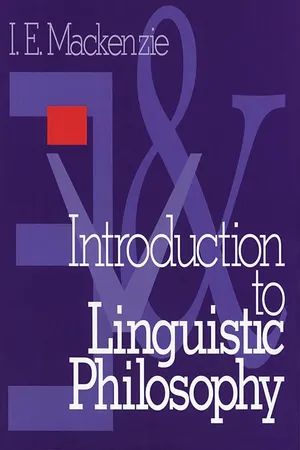
Introduction to Linguistic Philosophy
About this book
This auspicious new volume is designed for linguists who are interested in the deeper issues of their science. Introduction to Linguistic Philosophy lays a solid foundation of linguistic philosophy presenting theories of leading linguistic analysts such as Frege, Russell, Wittgenstein, Carnap, and Quine. I. E. MackenzieÆs exploration into these theories equips readers for advanced work on most topics in semantics and the study of language. The structure of this book reflects the fact that the philosophical study of language is not systematic, but centers on aspects of language that are considered to be of fundamental conceptual significance. Therefore, this book need not be read in any specific order. Whenever a chapter presupposes an understanding of something that is explained elsewhere in the book, a specific cross-reference is given. MackenzieÆs approach to the philosophy of language stresses the importance of observing how language is used rather than the assuming that it conforms to a pre-existing logical structure. In addition to dealing with foundational issues, such as truth, meaning, and the nature of language, this book explores specific linguistic phenomenaùdescriptions, names, non-extesional contexts and quantificationùwhich have attracted considerable philosophical attention. Introduction to Linguistic Philosophy is a student-centered resource that is recommended for students in linguistics, communication, and philosophy.
Information
Publisher
SAGE Publications, IncYear
1997Print ISBN
9780761901754
9780761901747
Edition
1eBook ISBN
9781452249452
Table of contents
- Cover
- Contents
- Introduction
- The Scope of This Book
- Some Important Terms
- The Structure of the Book
- Acknowledgments
- Part I - Foundational Issues
- Chapter 1 - Meaning and the Nature of Language
- 1.1. What is Meaning?
- 1.2. Does the Structure of Language Reflect the Structure of the World?
- 1.3. Summary
- Chapter 2 - The Semantic Conception of Truth
- 2.1. No Absolute Truth
- 2.2. The Semantic Conception of Truth
- 2.3. Summary
- Chapter 3 - Logical Truth and Analyticity
- 3.1. Unconditional and Contingent Truths
- 3.2. Logical Truth
- 3.3. Analyticity
- 3.4. Summary
- Part I: Further Reading
- Part II - Naming
- Chapter 4 - Names, Sense, and Nominatum
- 4.1. The Name Relation
- 4.2. The Paradox of the Name Relation
- 4.3. Solution to the Paradox of the Name Relation
- 4.4. Summary
- Chapter 5 - The Causal Theory of Names
- 5.1. Ordinary Proper Names
- 5.2. Modal Sentences
- 5.3. Epistemic Sentences
- 5.4. Names of Natural Kinds
- 5.5. Summary
- Part II: Further Reading
- Part III - Definite Descriptions
- Chapter 6 - Description and Analysis
- 6.1. Russell's Theory of Descriptions
- 6.2. The Acquisition of the Referential Function
- 6.3. Three Additional Puzzles Solved by Russell
- 6.4. Scope
- 6.5. Wittgenstein
- 6.6. Summary
- Chapter 7 - Descriptions as Names
- 7.1. The Fregean Theory
- 7.2. Referential Descriptions
- 7.3. Summary
- Part III - Further Reading
- Part IV - Nonextensional Contexts
- Chapter 8 - Modality
- 8.1. What is Logical Modality?
- 8.2. Interchangeability and Existential Generalization
- 8.3. Necessity as a Semantic Predicate
- 8.4. Kripke: Essentialism
- 8.5. Frege-Kaplan: The Middle Way
- 8.6. The Method of Extension and Intension
- 8.7. Summary
- Chapter 9 - Propositional Attitudes
- 9.1. What are Propositional Attitudes?
- 9.2. Interchangeability and Quantifying In
- 9.3. Quine
- 9.4. Kaplan: Cognitive Fixes
- 9.5. Individuating Attitude Objects
- 9.6. Summary
- Part IV - Further Reading
- Part V - Generality
- Chapter 10 - Indefinite Noun Phrases, Fregean Quantifiers, and Class Theory
- 10.1. Indefinite Noun Phrases
- 10.2. Scope Ambiguities Concerning Indefinite Noun Phrases
- 10.3. Logical Analysis of Indefinite Noun Phrases
- 10.4. Numerically Definite Quantifiers
- 10.5. Expanding the Theory
- 10.6. Summary
- Part V - Further Reading
- References
- Index
- About the Author
Trusted by 375,005 students
Access to over 1.5 million titles for a fair monthly price.
Study more efficiently using our study tools.
Frequently asked questions
Yes, you can cancel anytime from the Subscription tab in your account settings on the Perlego website. Your subscription will stay active until the end of your current billing period. Learn how to cancel your subscription
No, books cannot be downloaded as external files, such as PDFs, for use outside of Perlego. However, you can download books within the Perlego app for offline reading on mobile or tablet. Learn how to download books offline
Perlego offers two plans: Essential and Complete
- Essential is ideal for learners and professionals who enjoy exploring a wide range of subjects. Access the Essential Library with 800,000+ trusted titles and best-sellers across business, personal growth, and the humanities. Includes unlimited reading time and Standard Read Aloud voice.
- Complete: Perfect for advanced learners and researchers needing full, unrestricted access. Unlock 1.5M+ books across hundreds of subjects, including academic and specialized titles. The Complete Plan also includes advanced features like Premium Read Aloud and Research Assistant.
We are an online textbook subscription service, where you can get access to an entire online library for less than the price of a single book per month. With over 1.5 million books across 990+ topics, we’ve got you covered! Learn about our mission
Look out for the read-aloud symbol on your next book to see if you can listen to it. The read-aloud tool reads text aloud for you, highlighting the text as it is being read. You can pause it, speed it up and slow it down. Learn more about Read Aloud
Yes! You can use the Perlego app on both iOS and Android devices to read anytime, anywhere — even offline. Perfect for commutes or when you’re on the go.
Please note we cannot support devices running on iOS 13 and Android 7 or earlier. Learn more about using the app
Please note we cannot support devices running on iOS 13 and Android 7 or earlier. Learn more about using the app
Yes, you can access Introduction to Linguistic Philosophy by Ian E. Mackenzie in PDF and/or ePUB format, as well as other popular books in Languages & Linguistics & Linguistics. We have over 1.5 million books available in our catalogue for you to explore.