Group Activities for Families in Recovery offers therapists a wealth of activities designed to help families struggling with addiction address problem areas of functioning, and ultimately shift from dysfunctional patterns to healthy living. Written by expert practitioners in family-oriented substance abuse treatment programs, this text focuses on group therapy as a key component to treatment.
Beginning with a brief overview of the issues involved in working from a systemic family therapy perspective of addiction, the text discusses practical guidelines for working with families in groups and how to best utilize the exercise in the book. The collection of 30 group activities are suitable for a variety of family-oriented substance abuse treatment groups. They are divided into seven sections covering the key issues of:
1. Family Structure
2. Family Identity
3. Sober Fun
4. Toward Health
5. Anger Management
6. Healthy Communication
7. Parenting
The activities are varied and include topics presented through expressive arts (drawing, writing, acting), game-playing, problem solving, enactments, worksheets, and roleplaying. The activities can be used individually, incorporated into another program, or stand alone as a 16-week (or longer) program. They can also be adapted for use in groups where children or present, or for adult-family groups.
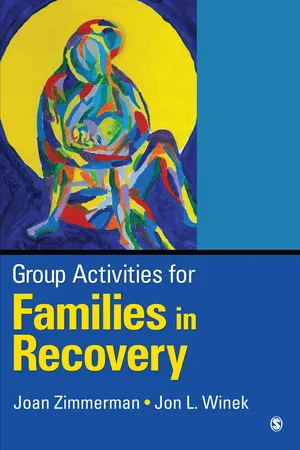
- 256 pages
- English
- ePUB (mobile friendly)
- Available on iOS & Android
eBook - ePub
Group Activities for Families in Recovery
About this book
Information
Part 1
Introduction
The purpose of this source book is to provide structured activities for families that are involved in substance abuse treatment.
When considering substance abuse treatment, we must consider contextual issues. First, we must be concerned with the context in which the substance abuse takes place. An important component of the development and maintenance of substance abuse is that people with addiction live in families that also have significant issues. This is not to blame the family for the addict’s difficulties or blame the addict for the family issues. Both co-occur, and both need to change for lasting change in addicts and their families.
Second, we must consider the context in which treatment takes place. In our experience, removing the addict from the family for treatment and then returning him or her to the family after “successful” treatment is a recipe for relapse. Rather, the whole family (not just the addict) needs to make significant changes in its structure and process, creating an environment that will allow the recovering addict to maintain sobriety. Treating families as a whole presents some unique issues and challenges for the service delivery system.
While family is an important issue in substance abuse treatment, work is also needed to support the addict in getting clean, staying clean, and preventing and dealing with relapse. The activities included here are designed for the recovery portion of treatment that follows successful detoxification from substances. Detoxification for some drugs can cause severe adverse physical and emotional symptoms and, as a result, should only occur under the supervision of trained personnel. Our family-based activities for families in recovery is part of an intensive outpatient program (IOP). The IOP treatment program for substance abuse is a 3-hour group that meets three times/week. In our group, we use the Matrix model materials (Center for Substance Abuse Treatment, 2006) during two meetings each week, addressing individually focused issues related to substance abuse and recovery. In the third meeting of the week, we invite family members and supports to the group and facilitate these family-focused activities. The assumption is that because substance abuse impacts the entire family, effective treatment requires both individual and family treatment.
WHOLE AND PARTS
Most of the exercises in this workbook came out of our work with a family-oriented outpatient substance abuse treatment program (Winek et al., 2010). In this program, the substance abuser meets in individual group twice a week, and once a week, the group meets with families. The substance abuser also has a counselor that works with him or her (and the families when appropriate) and the person’s substance abuse is monitored via urine analysis. Thus, this workbook is part of a larger whole. It is designed to be utilized in its entirety in situations in which the leaders guide the group through a different exercise at each meeting. It is also appropriate to use it in parts, where the leader selects exercises that are relevant for issues as they arise in the group. Our group often gives rise to issues that clients are invited to process in their individual work. At times, clients also bring issues from their individual sessions to the family group. Thus, we see our work with the group as both a whole and a part.
The exercises could be implemented as part of a larger treatment program, as we use them, or as stand-alone treatment. If they are utilized as a stand-alone program, it would be important to screen for clients with severe addiction issues. It is essential that the level of care available to the client is appropriate to the client’s needs. If it becomes apparent that the addicted person needs additional support or therapy, it becomes the responsibility of the group leader to assist the client in getting this support. Also, it is important that the group leaders are available briefly after group to assist clients that are triggered by the group process. Although this produces a time burden on the group leader, spending half an hour after a group may be more effective than helping a client recover from a relapse.
ORIGINS
The activities in this book have been utilized in the family group described above over an extended period of time. Most of the activities have been modified after being utilized in group, and many have been modified multiple times. Like most group leaders, we beg, borrow, and share ideas among other leaders and sourcebooks. We have tried to be diligent in tracing back to their origins the ideas we base our exercises on. In some instances, however, components of our exercises have been in common usage for so long that we have been unable to give full credit where it is due. It is a short journey for a really good idea to become part of the treatment culture, and in these instances, the origins are often quickly lost. Thus, we apologize in advance if we fail to give full credit to some of the ideas we build on and welcome feedback about the origins of these ideas.
ASSUMPTIONS
In our view, it is important to spell out the assumptions that our exercises are based upon. Speaking our assumptions that are embedded in our approach allows the reader direct access to the foundations of our work. Rather than make the reader search the text for clues to our assumptions, we chose to simply state them.
At its very core, the exercises in this book are based on systems theory. Systems theory is a theory about how parts of ecology are connected to form a whole and how the whole (in this case) gives rise to an addiction. Once an addiction is established, we become concerned with how the ecology of the addict unwittingly participates in the maintenance of the addiction. Thus, on the most basic level, we can say that given the addict’s family situation, biological makeup, experiences, and history, the addict engages in the “natural” amount of drug or alcohol use. From here, it follows that the ecology needs to change in order for abstinence to be the natural state of the family ecology.
Our approach to working with families with substance abuse is based on a contextual world view. This perspective is a little difficult to grasp at first because it inverts conventional wisdom. In the conventional world view, we see clients as mostly (if not wholly) autonomous from the social and emotional context. Our worldview is built upon an emphasis of the importance of the context that the clients live their life in. We have found, however, that this view allows us to understand addiction within the context in which it occurs. It also advantages the therapist by providing a deep understanding of addiction.
Our position rejects theories that see addiction as the result of a single cause. For example, the view of the addict as a moral failure, someone with a genetic predisposition, or the product of a multigenerational process is seen as overly simplistic. Rather, given the whole of the person’s life experience, his or her living situation, history, biological predisposition to addiction, and significant relationships, that person is doing what his or her environment mandates. Given this, it becomes clear that it is not enough for the individual to just stop drinking. If the addicted person simply wills him- or herself to stop using, the environment that helped give genesis to the use is still intact.
Thus, a contextual perspective focuses on multiple issues that almost always coexist in the addict’s life and family. Given that addiction occurs in the context of the environment, seeing the context as a focus of treatment creates the opportunity to affect the functioning of the addict’s family system, thereby affecting the functioning of the addict.
When we say a “natural” amount of use, we simply mean natural in terms of what the environment supports. Given this, we see that treatment that does not pay attention to the environment is, very often, doomed to failure. Often, addicts enter a period of sobriety and clean living that is short lived if the environment is unaltered. The addict often slides back into old behaviors (including using) that are supported by that environment. This can often be avoided by working with the whole of the family system, creating an opportunity for change in the environment, creating a context that supports sobriety rather than addictive living.
EVERYONE IS IMPACTED
Given the relational emphasis of systems theory and our clinical experience, we see that everyone in a family is impacted by substance abuse. Impacts can be direct or indirect, but the lives of the entire family are impacted by the addict’s substance abuse. Thus, it is extremely important to work with whole families (or as many family members as possible). Given this, we are frequently encouraging and welcoming of extended family members. We frequently invite clients to bring nonrelated parties who provide our clients emotional support and accountability. For our clients, emotional distance and being cut off from families is common. Although many of our clients have some significant family-like relations they can call on in a time of need, most of them reach us after years of living in their addiction, generally resulting in profound wounds to relationship with their families.
One important way healing takes place in our groups is by allowing an opportunity for family members to talk with each other about how they are impacted by the substance abuse. Alcoholic/addictive families often have unspoken rules of secrecy, and many of the families in our groups have not talked about these issues before coming to group. All families have privacy rules, but alcoholic families take privacy too far and develop rules of secrecy. In our minds, this secrecy is a darkness that allows substance abuse to flourish. Talking with each other (both with their own family members and with other families who have had similar experiences) about the impact of substances on their life brings light to the darkness of secrecy.
LEARN FROM LISTENING AND WATCHING
Part of systems theory is its emphasis on treating the patterns of interaction that support the family’s problem. Since these patterns occur on an abstract level, it is often difficult to observe them in your own family. Likewise, the secrecy that is often present in families that struggle with addiction leads to an assumption that the problems of your family are unique. This is especially salient for the children who are raised in families with addiction issues. However, when you are in group with other families and you observe a pattern in someone else’s family, you can often become aware of the pattern in your own family more readily. This also helps the families realize that they are not the first family to face an addiction. Thus, our families learn about themselves by seeing other families struggle with similar issues.
Families can also utilize what they learn about other families to develop new ways of coping within their own family. We have heard many of our group members, both addicts and family members, share their feelings of intense relief at realizing they are not alone with their experiences.
CHILD FOCUS
As we stated above, addicts often grow up in families in which their parent or parents struggled with addiction. This lead to an assumption of our approach that holds that addiction is not only a family problem but also a multigenerational family problem. We strive to be mindful of the impact of the addiction on the families’ children. Our exercises have modifications for when children are present, and we think that having children present leads to the best outcome. We also strive to be ever mindful of the impact of the addiction on the children. In part, we hold the focus on the children by asking ourselves and each other, “How does this impact the children?”
HEALTHY CARING, NOT ENABLING
Enabling is a process that is common in substance-abusing families: One person enables the substance abuser by blocking the addict from experiencing the consequences of addictive behavior. Typically, the person who acts as an enabler gets her or his sense of self from others. This is very common in our society and, in fact, in many situations is idealized and taught to others.
We find that it is helpful to differentiate between healthy caring and enabling. We have discussed elsewhere (Winek et al., 2010) that enabling is often only perceived after we have crossed over from healthy caring. In its simplest form, enabling is continuing to support a person who does not appreciate the support or who utilizes the resources to unhealthy means. For example, healthy caring may involve paying your adult child’s rent during a period of transition, such as after the birth of your grandchild. However, paying your child’s rent when he or she is using other funds to purchase drugs would cross over into enabling.
We find that family members often struggle with and respond negatively to the concept of enabling but are more open to the idea of “healthy helping.” Coming from the perspective of learning how to help their loved one in a way that is helpful in the long term seems, in our experience, to be an almost universally desired goal for family members. Processing the difference between healthy caring and enabling is an important issue for the group to discuss. By talking with others with similar issues, the clients are more likely to find a healthy balance between supporting and enabling.
FAMILIES AND SUBSTANCE ABUSE—A BRIEF OVERVIEW
As stated above, family therapy concerns itself with the patterns of interaction that occur in a family. On a basic level, the interactions that go on between family members are referred to as family process. Family process involves how family members communicate and interact with each other. We can contrast this to “content,” which is what families communicate about. Family therapy involves working with the family’s process to help the family develop new processes, or ways of interacting. So a family therapist helps a family move from an unhealthy process that gives rise to and supports addiction to a more healthy family process that supports sobriety.
In developing a systemic understating of family systems, one has to consider the relationship between process and structure. Structures are enduring patterns and rules of interaction that occur over time. For example, parents working together to rear the children are a healthy structure. Structure refers to the family’s process over time. When processes are repeated day in and day out, they become fixed and patterned. Structural family therapy developed by Minuchin (1974) and his colleagues is a highly successful and validated approach (Winek, 2010) that seeks to actively alter structure in families to help families develop more healthy structures and, ultimately, healthier functioning. In many of the activities in this workbook, the desired outcome is an exploration of the family’s past and current structure and an invitation to identify and develop more healthy structures. Let us explore some key family structure concepts below.
ROLES
Role theory has a long history in sociology (Mead, 1934; Merton, 1949). In this approach, we consider the rights, duties, expectations, and norms in each social role we perform. From this perspective of role theory, people evaluate themselves and others based upon their ability and performance of their various social roles. Examples of social roles in families include parent, child, provider, partner, and so forth. We speak of role expectation as what is expected by someone in that role. For example, we have an expectation that the role of a parent is to keep his or her young child safe. Role strain is the effort required to perform a role, while role stress is the stress we experience as we perform our various roles.
Role theory is an established social theory that has been applied to a wide variety of situations. In family and substance abuse, it is a particularly robust way to view the ways families function. Role theory looks at social position as a series of roles that people perform in order to accomplish the goal of the organization. In families, we identify basic goals, which are to provide food, shelter, and clothing for family members. Families with children have the additional goal of providing nurturing and socialization...
Table of contents
- Cover Page
- Title Page
- Copyright Page
- Contents
- PART 1: INTRODUCTION
- PART 2: STRUCTURE OF FAMILY GROUP FOR FAMILIES WITH SUBSTANCE ABUSE
- PART 3: THE CURRICULUM
- CURRICULUM SECTION I: FAMILY STRUCTURE
- CURRICULUM SECTION II: FAMILY IDENTITY
- CURRICULUM SECTION III: SOBER FUN
- CURRICULUM SECTION IV: TOWARD HEALTH
- CURRICULUM SECTION V: ANGER
- CURRICULUM SECTION VI: COMMUNICATION
- CURRICULUM SECTION VII: PARENTING
- Bibliography
- About the Authors
Trusted by 375,005 students
Access to over 1.5 million titles for a fair monthly price.
Study more efficiently using our study tools.
Frequently asked questions
Yes, you can cancel anytime from the Subscription tab in your account settings on the Perlego website. Your subscription will stay active until the end of your current billing period. Learn how to cancel your subscription
No, books cannot be downloaded as external files, such as PDFs, for use outside of Perlego. However, you can download books within the Perlego app for offline reading on mobile or tablet. Learn how to download books offline
Perlego offers two plans: Essential and Complete
- Essential is ideal for learners and professionals who enjoy exploring a wide range of subjects. Access the Essential Library with 800,000+ trusted titles and best-sellers across business, personal growth, and the humanities. Includes unlimited reading time and Standard Read Aloud voice.
- Complete: Perfect for advanced learners and researchers needing full, unrestricted access. Unlock 1.5M+ books across hundreds of subjects, including academic and specialized titles. The Complete Plan also includes advanced features like Premium Read Aloud and Research Assistant.
We are an online textbook subscription service, where you can get access to an entire online library for less than the price of a single book per month. With over 1.5 million books across 990+ topics, we’ve got you covered! Learn about our mission
Look out for the read-aloud symbol on your next book to see if you can listen to it. The read-aloud tool reads text aloud for you, highlighting the text as it is being read. You can pause it, speed it up and slow it down. Learn more about Read Aloud
Yes! You can use the Perlego app on both iOS and Android devices to read anytime, anywhere — even offline. Perfect for commutes or when you’re on the go.
Please note we cannot support devices running on iOS 13 and Android 7 or earlier. Learn more about using the app
Please note we cannot support devices running on iOS 13 and Android 7 or earlier. Learn more about using the app
Yes, you can access Group Activities for Families in Recovery by Joan Zimmerman,Jon L. Winek in PDF and/or ePUB format, as well as other popular books in Social Sciences & Education Counseling. We have over 1.5 million books available in our catalogue for you to explore.