- 235 pages
- English
- ePUB (mobile friendly)
- Available on iOS & Android
eBook - ePub
About this book
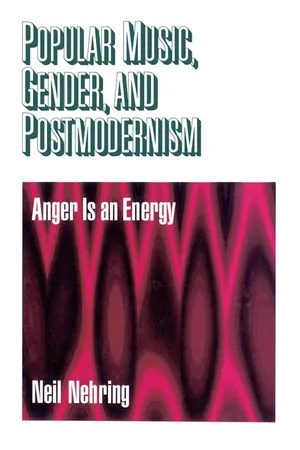
Popular Music, Gender, and Postmodernism begins by tracing the migration of cynical academic ideas about postmodernism into music journalism. The result has been a widespread fatalism over the presumed ability of the music industry to absorb any expression of defiance in hiphop and rock. Commercial "incorporation" supposedly makes a charade of musical outrage, somehow disconnecting anger in music from any meaning or significance. Author Neil Nehring documents the considerable damage done by the journalistic employment of this tenet of postmodern theory, particularly in the case of the late Kurt Cobain of Nirvana, whose emotional intensity was repeatedly belittled for its purported incoherence. As a rebuttal to academic postmodernism and its exploitation by the mass media, Popular Music, Gender, and Postmodernism emphasizes that emotion and reason are mutually interdependent. Though mistakes can occur in the conscious choice of an object at which to direct oneÆs feelings, the preverbal appraisal of social situations that generates emotions is always perfectly rational. Nehring also surveys work in literary criticism, psychology, and especially feminist philosophy that argues on the basis for the political significance of anger even prior to its full articulation. The emotional performance in popular music, he concludes, cannot be discounted on the grounds, for example, that lyrics such as CobainÆs are difficult to understand. After detailing more and less progressive approaches to emotion in music criticism, Nehring focuses on recent punk rock by women, including the Riot Grrrls.
Information
PART 1

CHAPTER 1

No Respect for Suffering
An Introduction to Postmodernism
Before launching into problems related to emotion and popular music, I begin with some initial assertions about postmodernism in general; ample evidence for them appears throughout the remainder of Part 1. My arguments are based on a compound of leftist politics that I am reluctant to pin down as any single -ism (as was the Situationist International), except in terms of a cultural anarchism encouraging a critical, democratic attitude toward conformist common sense. As Noam Chomsky has recently observed, anarchism in terms of loathing the state makes little sense at a time when the anarchs wishing to eliminate government come from the Right and seek to unleash the discipline of an even worse authority, that of the ostensibly “free” market.
The new wave of authoritarians, ripping away at any shred of security possessed by those outside the plutocracy, have actually been abetted by post modern theorists, whose cynicism leads them to supply their nominal opponents with the means to condemn insubordinate cultural forms such as angry popular music. Where postmodernism has done a great deal of damage by fixating on what people cannot do because of the power of corporate capitalism, I prefer to dwell on what they can do in spite of it. I would prefer, ideally, to be dialectical about the matter, but the merchants of the postmodern are so widespread and so incapable of dialectical thought that they need to have as much counterweight as possible thrown at them.
Another thing I want to make clear at the outset is that I do not mean to attack the various forms of identity politics concerned with gender, race, ethnicity, and sexual orientation, which are often associated with postmodernism by both opponents and proponents. It makes perfectly good sense to question and revise modernity, or the period since the Enlightenment, given its oppressive drive for authoritative, unitary interpretations and judgments—by supposedly disinterested, rational white men, of course—regarding everything from the political sphere to literary texts. Closer scrutiny of the actual complexity and contradictions that different social identities pose in social life and in artistic forms is hardly objectionable, in light of the white male’s traditional certainties about his perspective’s rectitude (placing an “e” before that last word would be a cliché by this point). I have no interest, therefore, in joining the recent jeremiads by leftists critical of identity politics, a genre including Todd Gitlin’s The Twilight of Common Dreams (1995), Michael Lind’s The Next American Nation (1995), and Michael Tomasky’s Left for Dead (1996).
What I consider objectionable about postmodernism, instead, originates in more exclusively theoretical work that has rebelled against modernity by portraying identity as unstable, even completely in flux or chaotic. This picture is often crossed with a loathing of mass culture not at all postmodern but a direct inheritance from romanticism and modernism. Some postmodern theory, particularly that emanating from France, goes even further, actually advocating the dissolution of any identity and, by extension, the abandonment of any social goals claiming a rational basis. The rationalist notion of testing ideas and interpretations through examination of material experience, one’s own and that of others, and arriving at a legitimate claim to the truth is presumably inherently repressive. A project with such a large scope can only be totalitarian, in theory, because it inculcates false notions of individual and collective agency in people when the “power” of the discourses we try to master, instead, inescapably controls and directs our efforts. The result of this view, a reluctance to promote any large-scale politics, hardly helps matters when the master narratives of neoconservative politicians and pundits, who are uninhibited by such compunctions, already go unchallenged in the mass media.
Because some versions of identity politics do follow postmodern theory, I am under no illusion that my characterization of postmodernism will offend only the epigones of theorists of more dubious value, such as Jean Baudrillard. But I will argue nonetheless—with a good deal of feminist theory, in particular, to back me up—that we need, in various forms depending on the person or groups in question, some relatively stable sense of individual and collective identity to assert against the status quo. Multiculturalism and pluralism are vital; theories of the fictionality, fragmentation, and nonexistence of identity are another matter. Identity politics ought to be uncoupled from the rubric of postmodernism—although not from a concerted questioning, revision, and improvement of the legacy of modernity—and they certainly are in my own thinking in what follows. Identities, however diverse, ought to be a matter of assertion, not dissolution, and Part 2 argues that the fundamental basis for a reasonably authentic assertive identity lies in emotion.
Postmodernism can be perplexing, even for the initiated, because there are many versions of it, ranging from the positive and celebratory to the negative and apocalyptic. Virtually all those versions share a common basis, however, belying the seemingly opposed extremes of enthusiasm and despair: the attribution of an enormous passivity to nonintellectuals. The postmodern perspective on the general populace differs very little from the views of romantics and modernists (from about 1790 to 1940), except in its extremity. Intellectual passivity, or distraction, is now considered either a radically subversive force or the dismal endpoint of history—yet both sides, revealingly, employ a similar rhetoric in diagnosing a universal “schizophrenia,” or delusional detachment. One prominent variation on this theme is to treat schizophrenia as insufficiently developed and to issue prescriptions for its cultivation.
In general, postmodernism involves developments in three areas:

These three areas do have a common denominator—a crippling loss of faith in human agents, both individuals and groups. Modernism had already grappled with alienation, or a sense of separation from others and from the possibility of fulfillment through everyday experience. Thus, modernist works of art are largely monuments to the internal processes of their individual creators, deliberately refusing any political engagement.
“Post-” modernism basically means pushing modernism over the edge by giving up on the lonely individual as well as possibilities for political action: The problem is no longer alienation but sheer fragmentation. The difference, however, is not all that clear-cut when anxiety, bewilderment, and panic have been staples of “cultural and artistic expression over the last 150 years,” as Angela McRobbie points out. The self-consciousness of contemporary artists about following modernism hardly merits description as postmodernism: artistic practices often held to typify the postmodern—such as self-reflexiveness, pastiche (a degraded form of montage), and indeterminacy, all reflecting a preoccupation with the weakness of the individual—occur throughout modernism. The only difference from modernism in what passes for postmodern, therefore, lies merely in the increasing extremity of descriptions of fragmentation. Thus the “category of fragmentation,” says McRobbie, has “become either too technical to be of general use (i.e. in [the psychoanalyst Jacques] Lacan’s work) or too vague to mean anything more than torn apart.”2
In the case of popular music, Sara Cohen finds it “rather naive” that an academic postmodernist such as Lawrence Grossberg describes rock and roll in terms of discontinuity and fragmentation and that a postmodern critic such as Simon Reynolds celebrates schizoid music that takes listeners nowhere. Such assertions about “a blurring of levels and categories, of places, spaces, times and identities [are] based upon little information about the ways in which people actually use and value” music. Holly Kruse agrees that the examination of actual lived experience in any music scene inevitably calls into question the claims of postmodern theorists, such as Grossberg and Steve Redhead, that “rock culture allows youths to enact ever-changing sexual and gendered identities in a space of radically conflicting social messages,” as opposed to more straightforwardly “oppositional musical identities.”3
For the theorists of fragmentation, the only material entities left—that is, the only real actors in the world—seem to be language and the ideologies expressed through it. As in postmodernism’s relation to modernism, the “post-” in poststructuralism essentially means moving beyond the already pessimistic identification of such structures by structuralism. The structuralist linguist Ferdinand de Saussure had assigned the individual a subordinate status in relation to the language-system (or langue), essentially in keeping with the modernist sense of the difficulty the beleaguered artist faced in forging poetry out of ordinary language. Sometimes described as the persistence of literary modernism in academic theory, poststructuralism does take a further, more desperate step, depicting a subject whose very existence depends on language. The actual interdependence or dialectic between structure and subject, or language and its users, is often reduced to a one-dimensional world with minimal possibilities for action. Any sense that the structures of language might be enabling as well as constraining is lost.
Some versions of poststructuralism crossed with identity politics, especially in feminist, queer, and postcolonial studies, have usefully exposed the division of the world into superiors and inferiors by structures such as gender and Orientalism. Although there ought to be some distinction possible between undermining those specific constructs and altogether repudiating language—the structure overarching them—academic and creative responses to the cultural construction of gender and race often share the fatalism about language at the core of poststructuralism. Whether in écriture féminine, queer theory on troubling gender, or postcolonial fiction (e.g., Wilson Harris’s Palace of the Peacock [1960], an early, more original variant)—not to mention French postmodern equations of schizophrenia with anarchism, as in Gilles Deleuze and Felix Guattari’s Anti-Oedipus—postmodernists on the attack often counsel not just the exposure and critique of the destructive, inhumane forms of identity offered by the dominant culture. The further quest becomes the undermining of any and all identities through a dissolution of language, meaning, or both.
The resulting quandary is inadvertently summed up very well by Bruce Robbins in a statement intended to justify, to the layperson, postmodern theories concerning the instability of identity. Compelled to speak plainly, he maintains that such theory “gathers people and groups who are trying to deconstruct the same identities they also rely on.”4 A juggling act of this sort is plausible, although the deconstruction of identity typically becomes an end in itself at the expense of actual politics, by requiring a disabling acknowledgment of a free-floating power that supplies identities. But the circularity of Robbins’s description strikes me as entailing futility rather than empowerment in the first place. That the activity he describes could easily be considered an alarming stasis seems confirmed, for example, in the case of feminist theory. Feminist intellectuals have been negotiating for some time now an intractable deadlock between an academic, “ludic,” or playful postmodern quest for dissolution, on the one hand, and cultural or radical feminist calls for assertion, on the other, which requires the stable basis of an identity. A feminist rock musician, Nina Gordon of Veruca Salt, deplores a situation in which feminism “seems to be more about criticising other people’s visions of feminism than supporting each other.”5
In reviewing Mas’ud Zavarzadeh and Donald Morton’s Theory as Resistance (1994), which advocates a revival of systemic (or holistic) social criticism, Rob Wilkie points out that the various ludic postmodern theories not only have no special claim to stymieing the system, but may actually serve it very well (a charge of complicity that we will see launched against postmodernism in general).6 Theory emphasizing the slipperiness of meaning and identity, due to their construction through language, may only serve in higher education to produce the kind of employees needed by postindustrial capitalism: Students accustomed to considering identity something multiple and even indefinable will adapt better to the insecurity of “downsizing,” of being routinely shuffled between jobs. Many others, of course, have noted the alacrity with which buttoned-down college administrators have embraced a sanitized, business-oriented version of multiculturalism.
The postmodern reduction of all experience to matters of language amounts to a “materialization of the sign,” as John Clarke puts it in New Times and Old Enemies (1990), or a preoccupation with discourses and ideologies transmitted through it, “and the dematerialization of everything else.”7 His view was amply borne out in 1996, in an incident that became notorious in the press as well as in academia, when physicist Alan Sokal hoaxed the determinedly cutting-edge journal Social Text with a fairly impenetrable article replete with ludicrous scientific claims. The journal’s editors (including Bruce Robbins) published Sokal nonetheless because his text is laced with postmodern clichés, first and foremost the bald-faced argument that “an external world” does not exist because “physical ‘reality,’ no less than social ‘reality,’ is at bottom a social and linguistic construct.”8
A similar though perfectly serious insistence on dematerializing social life—a withdrawal from “sociality by problematising language” in abstract arguments—characterizes many of the varieties of postmodernism. Some postmodernists find a modest sort of freedom in fragmentation, but that instability in identity, in their systems, always remains subject to control by discourse. Chantal Mouffe, one of the founders of a “post-Marxism” abandoning the structures of social class and identities based on them, says in a revealing oxymoron that the subject “is always precariously and provisionally fixed . . . at the intersection of various discourses” (emphasis added). The variety of discourses forming the subject are active and volatile, that is, but the “fixed” subject appears quite passive. An exponent of queer theory, Judith Butler (who shares with Mouffe a basis in Nietzsche and Foucault that I elaborate in Chapter 2), even has it that no subject exists to house the “converging relations of power” and its discourses. There is “no site at which such relations converge,” which is essentially what Mouffe is saying—that discourse is everything.9 Even the physical body, according to Butler, is nothing more than a discursive construction, the sort of claim parodied in Alan Sokal’s hoax in Social Text.
It is certainly the case that identity, whether individual or collective, must be “achieved, negotiated, invented” through discourses not entirely authentic to oneself. But to speak of the subject as a “fixed essence” produced by “abstract forces or technologies,” says Sara Cohen—and especially to erase the subject altogether—effectively obliterates the efforts of real persons to define themselves. In light of such abstractions concerning social experience, Kwame Anthony Appiah suggests that postmodernism needs to be countered by “a certain simple respect for human suffering.”10 If people are indeed in distress to anything like the extent portrayed by postmodern academics and journalists, a simple respect for misery would seem to be in order, instead of fatalism or even ridicule. Yet I now have graduate students well versed in postmodern theory telling me that the experience of physical pain depends on how a culture constructs it—that suffering is a relative, subjective matter and somehow no cause for alarm.
The more dire views of postmodernism, centered on discourse and power, have been heavily influenced by Michel Foucault, by now a celebrity whose books are featured in Tower Records. His descriptions of power operating virtually untouchably have been highly influential on the fatalistic strain of postmodernism. (I have in mind the “middle” period in Foucault’s career, work of the mid-1970s like Discipline and Punish and Power/Knowledge, which by all accounts has had the most widespread influence.) Through their control of specialized discourses, Foucault found, various institutions such as medicine, psychiatry, and the penal system control language itself. Foucault emphasized at the same time that power is not exercised by a...
Table of contents
- Cover Page
- Title Page
- Copyright Page
- Contents
- Acknowledgments
- Introduction
- PART 1
- PART 2
- Notes
- Index
- About the Author
Trusted by 375,005 students
Access to over 1.5 million titles for a fair monthly price.
Study more efficiently using our study tools.
Frequently asked questions
Yes, you can cancel anytime from the Subscription tab in your account settings on the Perlego website. Your subscription will stay active until the end of your current billing period. Learn how to cancel your subscription
No, books cannot be downloaded as external files, such as PDFs, for use outside of Perlego. However, you can download books within the Perlego app for offline reading on mobile or tablet. Learn how to download books offline
We are an online textbook subscription service, where you can get access to an entire online library for less than the price of a single book per month. With over 1.5 million books across 990+ topics, we’ve got you covered! Learn about our mission
Look out for the read-aloud symbol on your next book to see if you can listen to it. The read-aloud tool reads text aloud for you, highlighting the text as it is being read. You can pause it, speed it up and slow it down. Learn more about Read Aloud
Yes! You can use the Perlego app on both iOS and Android devices to read anytime, anywhere — even offline. Perfect for commutes or when you’re on the go.
Please note we cannot support devices running on iOS 13 and Android 7 or earlier. Learn more about using the app
Please note we cannot support devices running on iOS 13 and Android 7 or earlier. Learn more about using the app
Yes, you can access Popular Music, Gender and Postmodernism by Neil Nehring in PDF and/or ePUB format, as well as other popular books in Education & Education General. We have over 1.5 million books available in our catalogue for you to explore.