eBook - PDF
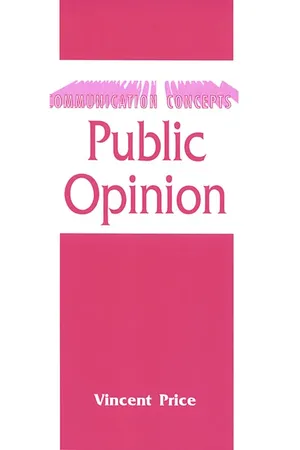
Public Opinion
About this book
What is perhaps most amazing about this little book is its comprehensiveness. In little more than a 100 pages, Price manages to discuss the relevance of ?public opinion? to just about every major mass communication theory. . . . The reference list alone would be a valuable resource for anyone studying public opinion. . . . Price does a stellar job of explaining in easy-to-understand language what most of these references have to say about public opinion. . . . The two greatest contributions of the book are Price?s organization of the vast literature on public opinion, coupled with his distillation of major works, including some truly hefty tomes, into a few simple words. Those who have grappled with the thoughts of Habermas and Blumer, for example, will greatly appreciate Price?s succinct and insightful descriptions of the relevance of these difficult works to the study of public opinion. Another strong point is the book?s currency: while you will find references to works published in the 1920s, you also will find books, articles, and reports published in the 1990s. . . . If you are new to the study of public opinion and communication, this book is the most painless, yet valuable introduction I can recommend. If you think you already know a lot about public opinion, the book may be even more valuable: it may dispel you of the notion that anyone knows a lot about public opinion." --Journalism Quarterly Public opinion--is it a simple aggregation of individual views, or instead some kind of collective-level, emergent product of debate and discussion? What is the role of public opinion in popular government? How do the mass media shape public opinion, or link it to governmental decision-making? Price?s Public Opinion explores such questions by tracing the historical development and application of the concept of public opinion. It examines the concept?s origins in Enlightenment thought and follows its evolution as a tool for social-scientific research. Intended as a map of the sprawling research terrain, Public Opinion introduces the conceptual mechanisms underlying public opinion research and shows how these concepts are used in an attempt to resolve enduring theoretical, normative, and practical questions. Because public opinion is one of the most vital and enduring concepts in the social sciences, this book will enjoy wide application in psychology, sociology, political science, journalism, and communication research in both academic and applied settings.
Information
About
the
Author
Vincent
Price
is
Associate
Chair
of
the
Department
of
Communica-
tion
and
Faculty
Associate
at
the
Center
of
Political
Studies
in
the
Institute
for
Social
Research
at
the
University
of
Michigan.
His
research
interests
center
on
mass
communication,
public
opinion,
and
persuasion.
He
is
on
the
editorial
board
of
Public
Opinion
Quarterly,
and
last
year
co-edited
a
special
issue
of
Communication
Research
devoted
to
levels
of
analysis
in
communication
scholar-
ship.
Besides
contributing
articles
to
those
journals,
he
has
publish-
ed
papers
on
public
opinion
in
several
other
books
and
journals,
including
The
Handbook
of
Communication
Science.
His
doctoral
dis-
sertation,
completed
at
Stanford
University
in
1987,
won
awards
from
both
the
International
Communication
Association
and
the
Associa-
tion
for
Education
in
Journalism
and
Mass
Communication.
112
UVergne,
TN
USA
Ol
December
2009
165597LV00002B/3/A
9
780803
940239
Table of contents
- Cover
- Contents
- Foreword
- Acknowledgments
- Chapter 1 - Introduction
- Outline of the Volume
- Chapter 2 - Problems of Public Opinion
- Origins of the Idea
- Anticipations and Approximations
- Early Conceptions of Opinion
- Early Conceptions of Public
- The Birth of Public Opinion
- Emergence of a Public Sphere
- Ambiguities in the Meaning of Public Opinion
- Public Opinion and Majority Rule
- Public Opinion as an Object of Study
- Enduring Problems of Public Opinion
- Lack of Competence
- Lack of Resources
- Tyranny of the Majority
- Susceptibility to Persuasion
- Domination by Elites
- Chapter 3 - Conceptualizing the Public
- Crowd, Public, and Mass
- The Crowd
- The Public
- The Mass
- Issues and Publics
- Phases of Development
- Actors and Spectators
- Expanding Public Debate
- After an Issue is Resolved
- Observing the Public
- The General Public
- The Voting Public
- The Attentive Public
- The Active Public
- Issue Publics
- Chapter 4 - Conceptualizing Opinions
- Opinions and Attitudes
- Opinions as Expressions
- Opinions as Thoughtful
- Opinions as Adaptations of Attitudes to Specific Issues
- Inferring Psychological Bases for Opinions
- Schemata
- Values
- Group Identifications
- Forming Opinions
- Observing Opinions
- What is it about?
- What are the Choices?
- Is it Well Considered?
- How Well Organized?
- How Strongly Held?
- Will it Lead to Committed Action?
- How does it Relate to Other People?
- Chapter 5 - Conceptualizing Public Opinion Processes
- Collective and Individual Aspects
- The Notion of Public Debate
- Dynamics of Group Decision Making
- Public Debate in Larger Social Settings
- Political Actors, Journalists, and the Attentive Public
- Public as Spectator
- The Roles Played by Journalists
- Observing Public Opinion
- Using Survey Data
- Using Content Analysis
- Using Less-Structured Survey Techniques
- Observing the Process of Public Debate
- Conclusion: Public Opinion as a Communication Concept
- References
- Author Index
- About the Author
Trusted by 375,005 students
Access to over 1.5 million titles for a fair monthly price.
Study more efficiently using our study tools.
Frequently asked questions
Yes, you can cancel anytime from the Subscription tab in your account settings on the Perlego website. Your subscription will stay active until the end of your current billing period. Learn how to cancel your subscription
No, books cannot be downloaded as external files, such as PDFs, for use outside of Perlego. However, you can download books within the Perlego app for offline reading on mobile or tablet. Learn how to download books offline
We are an online textbook subscription service, where you can get access to an entire online library for less than the price of a single book per month. With over 1.5 million books across 990+ topics, we’ve got you covered! Learn about our mission
Look out for the read-aloud symbol on your next book to see if you can listen to it. The read-aloud tool reads text aloud for you, highlighting the text as it is being read. You can pause it, speed it up and slow it down. Learn more about Read Aloud
Yes! You can use the Perlego app on both iOS and Android devices to read anytime, anywhere — even offline. Perfect for commutes or when you’re on the go.
Please note we cannot support devices running on iOS 13 and Android 7 or earlier. Learn more about using the app
Please note we cannot support devices running on iOS 13 and Android 7 or earlier. Learn more about using the app
Yes, you can access Public Opinion by Vincent Price in PDF and/or ePUB format, as well as other popular books in Languages & Linguistics & Communication Studies. We have over 1.5 million books available in our catalogue for you to explore.