![]()
CHAPTER 1
Action Research in Phases of Teaching
Action Research in Phases of Teaching
This chapter shows how action research can be used to enhance the craft of teaching by assisting teachers to organize and facilitate effective programs of student learning.
It describes how action research can assist teachers to take into account the characteristics and abilities of their students—intelligences, personalities, emotional states, stages of development, and family backgrounds.
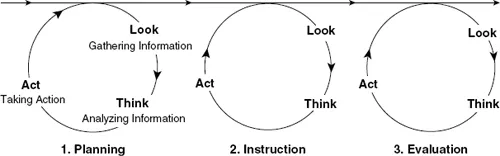
Action research is presented as a cyclical, repetitive process of inquiry that guides teacher preparation and instruction:
| Look: | Gathering information |
| Think: | Reflecting on, or analyzing, the information |
| Act: | Planning, implementing, and evaluating student learning |
Action learning is presented as a similar process of inquiry that guides student learning—Look, Think, Act.
Action research and action learning are parallel processes that enable teacher and student to work in tandem to accomplish effective learning processes.
The chapter then briefly describes how action research can be applied to three phases of instruction—planning, instruction, and evaluation.
MYSELF AS TEACHER: THE REFLECTIVE PRACTITIONER
As a classroom teacher I would start the school year thinking about the classroom that was to emerge in the coming weeks—the students that would come to me, and the task of teaching them. Who are the children? What will they be like? What will they need to learn? How will I plan and organize the learning that my students must accomplish? There would be so much to do! Although initially a little daunted by the task, my professional preparation and experience provided the set of resources with which to systematically construct a syllabus and organize my classroom so that I was ready for the arrival of my students.
The students would arrive in class on the first day of school eager to see what their teacher had in store for them. For the more able, excitement and expectation at the possibilities of engaging in interesting and rewarding activities fed the positive experience they expected from school. Others were more wary, conscious of the sometimes precarious demands that are made of them, and the possibility of embarrassment or feelings of inadequacy that accompany them as they enter the classroom.
As I gained experience, I became more aware of the many dimensions of my students that I had to take into account as I planned lessons for my class. They often came from quite diverse backgrounds, the racial, ethnic, and national diversity evident in their dress, behaviors, interests, attitudes, and responses. These, in turn, were clearly influenced by their family circumstances, the television shows they watched, the type of parenting they had received, and the quality of their community life, as well as their individual dispositions and abilities, and their relationships with their peers.
But I also learned that I couldn’t take anything for granted, and that often my “eyeballing” of students could lead to quite mistaken conclusions. I remember “Max,” whose slouched body and scruffy clothes, together with a rather sullen appearance, masked a little “gem.” Although initially somewhat reticent, he could transform the class with insightful, witty, and ultimately informative remarks, and his knowledge of the inner workings of a computer became legendary in the class.
As I built my understanding of my students, I became increasingly sensitive to their different needs, capabilities, and attitudes and the creative teaching strategies I could employ to engage them in learning activities that not only held their attention but, in the best of times, excited them greatly. Becoming frustrated with the tired response of one class to the social studies program I had planned, I gave them their head and asked them to explore a topic of their own choosing, asking only that they provide an interesting presentation to the class that used a variety of media. The outcomes were quite spectacular, resulting in a parents night in which students proudly presented their projects to an assembled group of family members.
As I reflect on my work with students, therefore, I am reminded that teaching, such a rewarding profession when done well, requires me to engage all aspects of my professional self—my head, my heart, and my hands. To do it well, I need to quite consciously employ reflective processes of inquiry that enable me to answer the questions in the first paragraph of this section. I now see this reflective process as action research—a process of systematic inquiry that provides a clearly defined body of concepts and ideas with which I can accomplish the wonderful art and craft of teaching.
—E.S.
THE CRAFT OF TEACHING: ORGANIZING AND FACILITATING STUDENT LEARNING
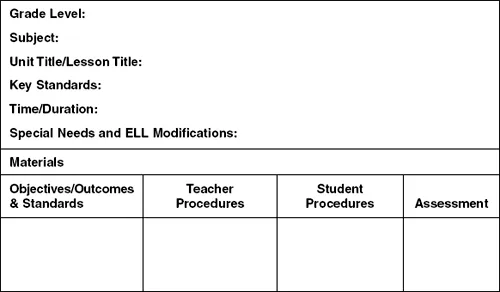
Common views of teaching see it as a relatively straightforward process, selected content being organized into a lesson plan that sets out the sequence of activities required to accomplish student learning objectives and outcomes. Preservice teachers soon learn that there is much more involved, however, and learn to accomplish the rather complex task of preparing a lesson plan. Typically, this will incorporate:
Objectives/Outcomes: What students will know and be able to do by the end of the lesson
Standards: State requirements for student learning
Procedures: A sequence of learning activities
Assessment: Tasks that demonstrate student levels of performance on each of the standards
Materials: Materials and equipment required during the lesson
Teachers commonly encompass lesson plans within a grid or table (see Figure 1.1) that enables them to check the progress of the lesson as students move through the sets of learning activities and assessment tasks.
Figure 1.1 A Typical Lesson Planning Grid
A well-planned and-executed lesson provides both teachers and students with high degrees of satisfaction, and is the basis for a successful and rewarding classroom experience. As we highlight below, however, the ability of teachers to accomplish these professionally desirable outcomes requires them to take into account the many facets of children and learning that comprise the art of teaching. Teaching is not just a mechanical process of presenting lessons and testing students, but a real craft that requires systematic and creative work to achieve the educational outcomes required of the diverse students that face teachers in their classrooms. Further, it is a social production that requires teachers to consciously build a learning community that nurtures children and enables them to work together in highly productive ways.
THE COMPLEXITIES OF TEACHING AND LEARNING
Planning a lesson is more than just setting out a program of learning, however. A teacher must take into account not only the information or skills to be learned, but also the characteristics and capabilities of the students in the class. A successful program of learning requires careful alignment of what is to be learned with the qualities of the learner.
STUDENT CHARACTERISTICS AND CAPABILITIES
Think of the different classrooms in which you have taught or which you have visited. Students in a typical classroom come from a broad range of family and community backgrounds. Some may come from very traditional families comprised of mother, father, and children. Many children, however, may live in single-parent families lacking either a father or a mother, may be part of a blended family with children from two previous families, may have parents of the same sex, may live with relatives, or may be housed in a foster home. In some high schools, students may be self-supporting, or have responsibilities for caring for their siblings. Any of these situations may vary in the degree to which they provide an environment in which children can grow and develop. Some may be stable and nurturing, the children experiencing lives that are generally harmonious and organized, while others may live in homes where parents are often in conflict, or where the dysfunctional relationships are not conducive to the experience of a happy childhood.
But differences in experience go even deeper, as some children will be raised in contexts where the parents are fully employed with adequate incomes that enable them to provide for the everyday needs of their children. Others will experience families that struggle almost from day to day to make adequate provision for food, dress, and housing. Aligned with these differences are differences in employment that characterize the broad cross-section of any society, from unskilled workers in service industries, through tradespeople, clerical, professional, and business and industry. Parental occupations provide a broad range of differences in lifestyle, aspirations, attitudes, values and behaviors, and social orientations (e.g., see the box “Occupational Preferences”).
OCCUPATIONAL PREFERENCES
When I was a teenager, my father, a working-class man, used his social contacts to arrange a clerical job for me. From his perspective, this was a “plum” occupation that would set me up for life, and he was totally surprised when I rejected his offer, indicating that I wished to continue my schooling and become a teacher. Teaching, to him, who had left school very early, was a mysterious job that seemed outside the reach of his son. It was only by strenuous argument that he allowed me, somewhat begrudgingly, to take up a path that seemed, from his perspective, to lack the promise so evident in the clerical position he had arranged. Despite my later success in my chosen occupation, he never really understood or accepted the wisdom of my choice, and I never felt that I had, in his eyes, been successful.
—E.S.
But differences in experience and orientation go even deeper than this. The racial and ethnic diversity that is part of almost any neighborhood in today’s modern society means that children will come from families that have deep-seated differences in attitudes, behaviors, and outlooks. These differences are not always evident, but have the potential to greatly affect children’s learning. Teachers need to provide learning activities that not only take account of these cultural characteristics, but take advantage of...