- 216 pages
- English
- ePUB (mobile friendly)
- Available on iOS & Android
eBook - ePub
About this book
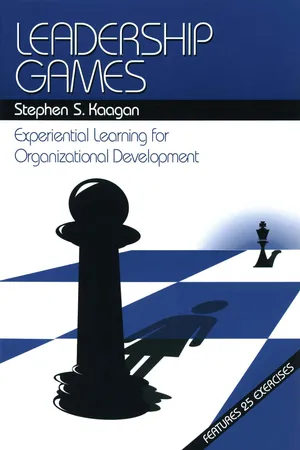
Leadership Games presents 25 practical, inexpensive experiential activities designed to be used in various leadership training and development programs. This book centers on those areas of primary concern to today?s managers-team leadership, risking innovation, fostering collaboration, managing conflict, and using diversity. The exercises are grounded in the management and educational literature, and for each exercise there is a set of explicit directions, cues on strategic considerations, including appropriate timing, indicators of successful application, and a rich sample of proposed questions that point the way to fruitful post-exercise discussions with participants. Author Stephen S. Kaagan has extensive experience both in the academic and consulting worlds, including being a past president of the Outward Bound program in Rockland, Maine. Leadership Games is unique in that it: + Explores both leadership development theory and offers practical suggestions + Provides much more than bare bones instructions on how to facilitate experiential exercises + Shows the link between the exercises and critical organizational challenges This book will be an invaluable tool for professionals and students interested in leadership, organizational studies, management, human resources, communication, gender studies, sociology, psychology, and education.
Information
CHAPTER 1
Ways of Thinking About Leadership Development
This chapter explores the terrain of contemporary initiatives in leadership development, critiques the assumptions on which they are based, and makes a case for the more cost-effective deployment of experiential approaches to educating leaders.
The Nature of the Subject
Leadership development is about teaching leadership. The role of teacher is to create and carry out a mix of activities that will have a positive effect on learners in terms of the subject being taught. In the contemporary context, the subject of leadership requires learners to become adept at shaping and fulfilling not only their own aims but those of their followers as well. As James OToole (1995) notes in Leading Change, leadership based on imposing one’s will on others increasingly engenders negative rather than positive effects.
Instrumental to leadership development is a wide range of aptitudes and capabilities, all of which affect a person’s interactions with coworkers, constituents, or customers—personal qualities, moral commitments, and management skills. The effects of leadership development are most directly felt in the social setting of an organization, where leaders and followers attempt to work together to attain common goals (Terry, 1993).
Over the past century, as organizations have grown and their numbers have spread across the landscape of human endeavor, concern with leadership development has widened and deepened. In fact, it is fair to say that the quality of leadership available to organizations and institutions has reached the threshold of becoming a major preoccupation within industrialized nations. This should not be surprising, because the performance of the people in charge is rather consequential, when most of us depend on the entities they lead for both our sustenance and our sense of well-being. To merit the label preoccupation, an issue must draw considerable comment over a sustained period from experts and others with enough time on their hands to find a public outlet for their opinions. Like the proverbial elephant, the issue must supply enough mass for pundits to be able to step back, take sightings, and assert, with little fear of contradiction, that they have described a substantial part of what is in front of them. The topic of leadership development admirably fulfills these requirements. A cursory reading of the trade journals reveals extensive discussion of various parts of the ample bulk of the leadership development elephant.
Current Dimensions
There are four major dimensions to leadership development. Taken together, they represent a useful way of fitting the parts of the elephant into a manageable frame.
- Who should do leadership development
- When, or within what time frame, it should be done
- Where should leadership development occur, or on whose turf experiences should be organized
- How should it unfold, or what materials and methods should be used to teach leadership
Who?
Four decades ago, the answer unequivocally would have been that university professors should teach leadership, especially those in business and public administration, and perhaps also in education. In the past 30 years, however, consultants have become an established and significant part of the leadership teaching corps. Their principal leverage in the field derives from an ability to respond much more quickly and directly than the professoriat to expressed needs within the workplace itself. To such immediacy the academy never intended nor was equipped to respond: Universities continue to concentrate on the long-term development of leaders, separate from the specific organizational context in which they work. Consultants can focus more on the short-term development of groups faced with specific challenges within an organizational setting.
Recently, increasing sentiment has been voiced that neither professors nor consultants can do the job of teaching leadership as well as executives or leaders themselves. Accepting the criticism of present-day leadership development as “too rote, too backward-looking, too theoretical” (Cohen & Tichy, 1997, p. 73), several leading thinkers make the case that organizational leaders themselves should take responsibility for developing leaders at all levels in their organizations. In one groundbreaking approach, executives themselves formulate their own stories about “ideas, values, edge, and energy,” and they share them with subordinates in the firm. Drawn from their own experience, the stories become the principal tools for building coworkers’ leadership skills and capacities (Cohen & Tichy, 1997).
The matter of who should do leadership development has some obvious appeal in that it identifies, albeit innocuously, heroes and villains and designates ownership rights. There is really not much of substance to the issue itself, however. In many, if not most, instances, individuals of similar background wind up with central roles as teachers; it just so happens that they are at different points in their careers when they are engaged as such.
A common scenario is the former executive who becomes a consultant and then a part-time professor, before turning into an executive again, only to close out a career as a professor or consultant. The edge that a professor might bring to leadership development, as opposed to a consultant or an executive, is solely one of perspective and breadth of understanding. These are related as much to the requisites of what should be done and how as to who does it.
In the example cited above, Cohen and Tichy (1997) assert a prominent role for executives in leadership development, but it is their own frame, not the executives’, that supplies direction for the program. When analysts offer a prominent position to the question of who should do leadership development, they are really using it as a way of provoking questions about content and methodology.
When?
Should the teaching of leadership be in short bursts of time or drawn out over longer periods? How much sustained, continuous time should be allocated? Should the time allocated to formal instruction be interspersed among longer periods of on-the-job experience, whether through organized practice sessions or through apprenticeships?
Just as the matter of who cannot be separated from the question of what and how, neither can the matter of when. Time and timing are critical adjuncts of content and methodology because they connect to the question of sequencing and its close partner, cumulative effects. That a project group can handle with great facility a charged issue involving ethnic differences is more than a matter of good fortune. Such facility has roots in the group’s prior learning. Perhaps it was fostered through a series of seemingly inconsequential setup exercises experienced in the first week the group spent together. The effect of proper sequencing will become apparent from the exercise descriptions provided later in Chapter 2 through 6.
With more time, there can be greater influence if the learning challenges are the right ones and they are ordered properly. Interspersing periods of instruction with periods of practice, stage-setting activity, or just plain fun may be the best use of available time. Letting discomfiting new ideas settle and take hold in a real work context and then later in a more remote environment, asking participants to reexamine and reshape their thinking in light of recent on-the-job experience may be the most effective ordering of elements.
A solid and enduring commitment to collaboration, for example, cannot be molded solely in the hothouse setting of a training center, or even in the more natural milieu of the workplace itself. Carefully interweaving experiences in both settings over time might produce the desired effects. The determinant of when to do something is what to do and how to carry it off.
Where?
Should leadership development activities take place in a university classroom? Or in a retreat center off the work site? Or perhaps in special training facilities at the work site? Or in unfamiliar wilderness settings, or even more remote venues such as soup kitchens? Or in the work settings of other organizations doing the same kind of work as those undergoing training? Clearly the options are more diverse today than they have ever been. Leaderless groups in a pleasant rural setting, team building aboard rubber rafts on a fast-running river, and service projects in the underground haunts of the homeless in a large city now complement expert lectures and Socratic give-and-take offered in amphitheater-style classrooms of noted business schools. Undersea or outer space may be the only frontiers left untapped.
The question of place, like that of who offers leadership education and in what time frame, is subsidiary to decision making about content and methodology. A program designer does not a priori decide that it would be beneficial to take a group of middle managers into the outback for 2 weeks of sustained team leadership training. There is usually an aim in mind, whether well- or ill-conceived, explicit or implicit, and choice of place relates to how best to achieve that aim. The outback can offer participants all the educational advantages of considerable discomfort, just as a lush resort can offer all the educational advantages of comfort. Either one or both could be essential for learning, or conversely, could stand in the way of learning. It all depends on the objectives; and objectives govern content and methodology.
Increasingly, those who teach leadership seek to fit place to purpose, and in many instances to alternate places depending on different purposes. Integrated, 3-week programs can take place in several different venues. They might begin with a short stint in the wilderness, followed by classroom or retreat center sessions, and then involve a move to an urban site for service projects. The current literature on leadership development is replete with descriptions of programs that take place in multiple sites. For example, Albert Vicere (1996) describes three very differently configured programs—the Center for Creative Leadership’s Leaderlab, AT&T’s Leadership Development Program, and Aramark’s Executive Leadership Institute. Each offers locales that purportedly complement the aims they are seeking to achieve.
What and How?
The central concerns for those designing and doing leadership development are objectives, content, and methodology. These are the wellsprings of a program. They determine the quality of the experiences participants have. Ultimately the effect on participants, in terms of what they do in the workplace, stems from these. If the what and how are solid, they can actually overcome deficiencies in the where and when, and perhaps even the who. But the reverse is not the case.
From the point of view of the participants, the principal vehicles for leadership development, in terms of content and methodology, include the following:
- Listening to a lecture
- Engaging in discussion with peers, alone or with coaches or consultants
- Pursuing a formal dialogue (Bohm, 1990) with peers, supervisors, supervisees, or some combination of these
- Analyzing a case study of another organization’s problems or one’s own
- Going through a short or long experience with peers, supervisors, supervisees, or some combination of these, and then debriefing it. The shared experience could be drawn from one’s own workplace or someone else’s. Or it could be constructed from natural circumstances like the ones a wilderness setting provides, or artificial ones like those conjured in games and simulations.
- Discussing with a coach or mentor designated problems
- Undergoing a leadership assessment, either via a survey instrument or through expert observation of behavior, exhibited either on the job or in a lab setting
Naturally, any one of these experiences can take on one or more characteristics, depending on desired content specifications. The material that participants engage with, for example, could be highly theoretical or quite practical. At the same time, it could span both, by prodding participants to formulate mental models of the behavior they exhibit on the job (Argyris, 1992; Senge, 1990) or providing them with open-ended opportunities to assess their effectiveness as professionals (Schon, 1983). Alternatively, the material might encourage participants to generate and try out new ideas and concepts, or it could focus specifically on past actions and the determination of immediate next steps in the workplace.
In another vein altogether, some of what is put in front of participants might relate to their particular work environment. Although still reflective of real-world challenges, the material could include issues and problems that obtain in a wide range of settings. On the other hand, it might on its face have little apparent relevance to particular organizational contexts, or even to issues or problems that broadly diverse participants see as germane to their work situations. In contrast, the content could be timeless and enduring, relating to how human beings face a variety of challenges that transcend any organizational milieu. Taking a different perspective altogether, it might be tied to this year’s work plan and have little foreseeable effect beyond that time frame.
Closing out the range of possibilities, the material could be quite technical or scientific, involving the acquisition of so-called hard skills. If not purely technical, its principal attribute could be its objectivity, with the consequent presence or absence of attainable skills easily discernable by observation or survey. In contrast, the material in front of participants could emphasize the personal and interpersonal, involving so-called soft skills, touching on the emotional and perhaps even the spiritual dimensions of getting a job done.
From the Literature, Some Misleading Assumptions
It ought to be abundantly apparent from the options just offered that the content and methodology of leadership development make up a deep and thick wood. This should serve as ample warning that thoughtfulness to the point of rigor and care to the point of compassion should obtain. Regrettably, content and methodology have not received the judicious treatment they deserve. The contemporary literature on leadership development—as represented in recent issues of Organizational Dynamics (Burke, 1997; Conger, 1993; Raelin, 1997), Across the Board (Csoka, 1996), the Journal of Management Development (Keys, 1990; Wells, 1990), and the Journal of Management (Keys, 1988)— betrays a coverage of these critical dimensions that is superficial at best.
This superficiality is most apparent in the assumptions made about the most appropriate means of developing leadership capacity. Conveyed as if they were givens offering essential guidance for program development, these assumptions include the following:
- Issues and problems drawn from the workplace of the participants provide the most fruitful learning challenges for contemporary leadership development.
- Experiential learning activities, organized in one form or another outside traditional instructional settings, are generally better than learning activities that are classroom-based activities.
- A highly diverse program that includes a market basket of methodologies is generally superior to an approach that is one dimensional.
- The who, when, and where of program development deserve the same level of attention as the what and how.
The problem with these assumptions is not that they are flatly false. Quite the contrary, there is a good deal of validity in them. Their principal defect is that they are misleading: They do not point the way to the most artful and cost-effective leadership development treatments. The first assumption is that the most fitting material for leadership development is the problems and issues that dominate in the workplace of the participants. Rather than invalidating the assumption outright, it is fitting to offer the simple rejoinder, drawn from tenets of good teaching, that participants in leadership development programs should spend as much time away from workplace problems and issues as they do in their midst. They could benefit equally from grappling with unfamiliar circumstances as from dealing with familiar ones. Assuredly, the unfamiliar should contain elements reminiscent enough to touch responsive chords in the participants. At the same time, differences should aid participants in overcoming dysfunctional patterns that plague them in the workplace.
It m...
Table of contents
- Cover Page
- Title
- Copyright
- Dedication
- Contents
- Prologue
- Introduction
- 1. Ways of Thinking About Leadership Development
- 2. Cueing the Exercises
- 3. Exercises on Risking Innovation
- 4. Exercises on Fostering Collaboration
- 5. Exercises on Managing Conflict
- 6. Exercises on Using Diversity
- 7. The Exercises in Play: A Story of Real Organizational Change
- 8. Conclusion
- References
- About the Author
Trusted by 375,005 students
Access to over 1.5 million titles for a fair monthly price.
Study more efficiently using our study tools.
Frequently asked questions
Yes, you can cancel anytime from the Subscription tab in your account settings on the Perlego website. Your subscription will stay active until the end of your current billing period. Learn how to cancel your subscription
No, books cannot be downloaded as external files, such as PDFs, for use outside of Perlego. However, you can download books within the Perlego app for offline reading on mobile or tablet. Learn how to download books offline
Perlego offers two plans: Essential and Complete
- Essential is ideal for learners and professionals who enjoy exploring a wide range of subjects. Access the Essential Library with 800,000+ trusted titles and best-sellers across business, personal growth, and the humanities. Includes unlimited reading time and Standard Read Aloud voice.
- Complete: Perfect for advanced learners and researchers needing full, unrestricted access. Unlock 1.5M+ books across hundreds of subjects, including academic and specialized titles. The Complete Plan also includes advanced features like Premium Read Aloud and Research Assistant.
We are an online textbook subscription service, where you can get access to an entire online library for less than the price of a single book per month. With over 1.5 million books across 990+ topics, we’ve got you covered! Learn about our mission
Look out for the read-aloud symbol on your next book to see if you can listen to it. The read-aloud tool reads text aloud for you, highlighting the text as it is being read. You can pause it, speed it up and slow it down. Learn more about Read Aloud
Yes! You can use the Perlego app on both iOS and Android devices to read anytime, anywhere — even offline. Perfect for commutes or when you’re on the go.
Please note we cannot support devices running on iOS 13 and Android 7 or earlier. Learn more about using the app
Please note we cannot support devices running on iOS 13 and Android 7 or earlier. Learn more about using the app
Yes, you can access Leadership Games by Stephen S. Kaagan in PDF and/or ePUB format, as well as other popular books in Business & Organisational Behaviour. We have over 1.5 million books available in our catalogue for you to explore.