- 161 pages
- English
- PDF
- Available on iOS & Android
eBook - PDF
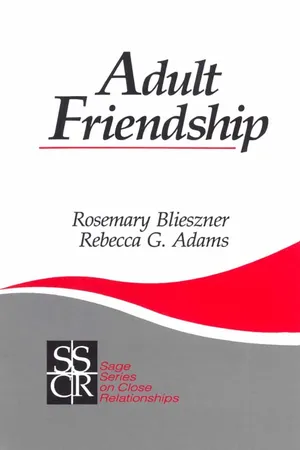
Adult Friendship
About this book
Do you have a best friend? If so, you probably share the same race and social status. Why is this so? Does social structure determine your choice of friends? Or do other factors cause you to choose friends? Co-authors Blieszner and Adams explore these issues and offer a theoretical framework which incorporates both sociological and psychological perspectives on friendship. They use this model to synthesize the research theoretically, identify gaps in the literature, scrutinize the methods used, and produce a map for future research. Adult Friendship also covers historical conceptions of friendship, the internal structure of friendship, and the phases of friendship. Clearly written yet scholarly, Adult Friendship is perfect for students, researchers and professionals in psychology, sociology, communication, gerontology, family studies and social work. "The analysis is ably argued, identifying the contributions to and gaps in the field and challenging others to give attention to the theoretical and methodological issues in the emerging research on adult friendship." --Contemporary Sociology "Adult Friendship is a noteworthy publication in the emerging area of the study of personal relationships. . . . A useful synthesis of theory and research on close relationships over the life cycle. . . . suitable for students and others wanting an introduction to the topic, yet also gives professionals more knowledgeable with this literature a fresh, distinctive perspective on it. . . .Blieszner and Adams? chapters are concise and internally well organized. . . . a worthwhile read for researchers, students, practitioners, and laypersons concerned with the study of friendship across the life span." --Journal of Marriage & The Family "This volume is an important addition to the useful Sage Series on Close Relationships. It treats a topic that has been too frequently ignored in the area of close relationship research. . . . The coverage of the literature in this volume is especially good due to the tight organizational scheme that facilitates summaries of many different findings. . . . In sum, there is no doubt that both researchers and students will find this volume to be extremely useful. This is a well-organized and comprehensive book that provides a concise summary of research on adult friendship, both from sociological and psychological perspectives. Significant gaps in the literature are identified and methodological criticisms are raised. Finally, the authors provide clear guideposts for future research on a topic that has often received too little attention in the area of close relationships." --ISSPR Bulletin
Information
Table of contents
- Cover
- Contents
- Series Editors' Introduction
- Preface
- Chapter 1 - An Integrative Model of Friendship
- A Model of Friendship
- Friendship Patterns
- Friendship Structure
- Friendship Processes
- Friendship Phases
- Connections among Elements and Levels of Friendship Patterns
- Friendship and Individual Characteristics
- Effects of Structure and Disposition on Friendship Patterns
- Effects of Gender on Friendship Patterns
- Age and Friendship
- Effects of Age on Social Structural Opportunities and Constraints and on Disposition
- Effects of Age on Friendship
- Structural, Cultural, and Historical Context
- Effects of Structural and Cultural Context on Friendship
- Effects of Subcultural Context on Friendship
- Effects of Historical Context on Friendship
- A Preview of the Rest of the Volume
- Chapter 2 - History of Friendship and Friendship Research
- The Emergence and Maturation of Adult Friendship Research
- A Lifespan Approach to Friendship
- Friendship as a Primary Focus
- Multidisciplinary Perspectives
- Friendships as Relationships
- Quality of Friend Relations
- Multiple Research Designs and Methods
- Summary
- Historical Conceptions of Friendship
- Chapter 3 - The Internal Structure of Friendship
- College Student Friendships
- Size
- Homogeneity
- Density and Configuration
- Solidarity
- Adult Friendships
- Size
- Homogeneity
- Density and Configuration
- Solidarity
- Old Age Friendships
- Size
- Homogeneity
- Density and Configuration
- Solidarity
- Gender and the Life Course
- Size
- Homogeneity
- Density
- Solidarity
- Summary and Research Implications
- Chapter 4 - Friendship Processes
- College Student Friendships
- Cognitive Processes
- Affective Processes
- Behavioral Processes
- Proxy Measures of Process
- Adult Friendships
- Cognitive Processes
- Affective Processes
- Behavioral Processes
- Proxy Measures of Process
- Old Age Friendships
- Cognitive Processes
- Affective Processes
- Behavioral Processes
- Proxy Measures of Process
- Gender and the Life Course
- Cognitive Processes
- Affective Processes
- Behavioral Processes
- Proxy Measures of Process
- Summary and Research Implications
- Chapter 5 - Phases of Friendship
- College Student Friendships
- Initiation
- Maintenance
- Dissolution
- Adult Friendships
- Initiation
- Maintenance
- Dissolution
- Old Age Friendships
- Initiation
- Maintenance
- Dissolution
- Gender and the Life Course
- Initiation
- Maintenance
- Summary and Research Implications
- Conclusion: The Interface of Structure, Processes, and Phases
- Chapter 6 - Adult Friendship Intervention
- Outcomes of Friendship Interventions
- Levels of Intervention
- Improving the Individual's Cognitive and Social Functioning
- Enhancing Dyadic Interaction
- Altering Social Relationships in Networks
- Manipulating Relationships in an Immediate Environment
- Designing Communities to Facilitate Social Relationships
- Supporting Social Relationships through Social Policies
- Implications
- Conclusions
- References
- Index
- About the Authors
Trusted by 375,005 students
Access to over 1.5 million titles for a fair monthly price.
Study more efficiently using our study tools.
Frequently asked questions
Yes, you can cancel anytime from the Subscription tab in your account settings on the Perlego website. Your subscription will stay active until the end of your current billing period. Learn how to cancel your subscription
No, books cannot be downloaded as external files, such as PDFs, for use outside of Perlego. However, you can download books within the Perlego app for offline reading on mobile or tablet. Learn how to download books offline
Perlego offers two plans: Essential and Complete
- Essential is ideal for learners and professionals who enjoy exploring a wide range of subjects. Access the Essential Library with 800,000+ trusted titles and best-sellers across business, personal growth, and the humanities. Includes unlimited reading time and Standard Read Aloud voice.
- Complete: Perfect for advanced learners and researchers needing full, unrestricted access. Unlock 1.5M+ books across hundreds of subjects, including academic and specialized titles. The Complete Plan also includes advanced features like Premium Read Aloud and Research Assistant.
We are an online textbook subscription service, where you can get access to an entire online library for less than the price of a single book per month. With over 1.5 million books across 990+ topics, we’ve got you covered! Learn about our mission
Look out for the read-aloud symbol on your next book to see if you can listen to it. The read-aloud tool reads text aloud for you, highlighting the text as it is being read. You can pause it, speed it up and slow it down. Learn more about Read Aloud
Yes! You can use the Perlego app on both iOS and Android devices to read anytime, anywhere — even offline. Perfect for commutes or when you’re on the go.
Please note we cannot support devices running on iOS 13 and Android 7 or earlier. Learn more about using the app
Please note we cannot support devices running on iOS 13 and Android 7 or earlier. Learn more about using the app
Yes, you can access Adult Friendship by Rosemary Blieszner,Rebecca G. Adams in PDF and/or ePUB format, as well as other popular books in Psychology & Social Psychology. We have over 1.5 million books available in our catalogue for you to explore.