![]()
Chapter 1
Introduction
Ethics and morality are commonly used terms, both in our everyday lives and in our professional lives. Although these are common terms, actual definitions of these terms may not be as readily discernable. What are the formal definitions of these two terms?
Ethics have been defined as “a generic term for several ways of examining the moral life” (Beauchamp & Childress, 1989, p. 9). Merriam Webster’s Collegiate Dictionary (11th edition) defined ethics as “the discipline dealing with what is good and bad and with moral duty and obligation. A set of moral principles.” Corey, Corey, and Callahan (2003) stated “ethics pertain to the beliefs we hold about what constitutes right conduct. Ethics are moral principles adopted by an individual or group to provide rules for right conduct” (p. 11). Professional associations generally set the ethical standards for a profession.
Rest (1983) defined morality as “standards or guidelines that govern human cooperation—in particular, how rights, duties, and benefits are to be allocated” (p. 558). Corey et al. (2003) wrote that morality is “concerned with perspectives of right and proper conduct and involves an evaluation of actions on the basis of some broader cultural context or religious standard” (p. 11).
A difference between these two concepts concerns to some degree the objective versus subjective interpretation of right behavior, in the case here professionally acceptable or desirable behavior. Ethics, theoretically, are generated from a more general standard set of guidelines outlined and set forth by professional organizations, whereas morality is more narrow and based on cultural and possibly religious beliefs. The problem becomes differentiating the two, because professional organizations have used certain broad ethical theories to develop codes that have been based to a large extent on cultural and religious beliefs or morality. Because morality has influenced the development of ethics, we want to propose that ethics includes morality—cultural and religious beliefs, as well as broader perspectives that are sanctioned by professional organizations—professional ethical codes. We live in a diverse and a multicultural society, and developing professional ethical codes from one or two philosophical perspectives (professional codes have been developed from Western philosophies and religious beliefs) is limiting and potentially discriminatory. We propose that ethics should be objective and based on agreed upon professional standards of practice, but include additional moral philosophies that are representative of wider cultural and geographical perspectives than just a few Western views.
Ethics and ethical decision-making are a critical part of the training and practice of professional counselors (Corey et al., 2003; Cottone & Claus, 2000; Neukrug, Miliken, & Walden, 2001; Scott, 2000). Training in ethics typically focuses on professional codes of ethics, ethical decision-making, and general theories of ethics (Corey et al., 2003; Freeman, 2000; Welfel, 2002).
One characteristic of a profession is the formulation of a professional code of ethics (Walden, Herlihy, & Ashton, 2003). Lunt (1999) stated, “codes may provide bottom-line rules or proscriptions for behavior or aspirational guidelines” (p. 251). She further stated that there are two different purposes of ethical codes: One purpose is the regulation of inappropriate behavior whereby minimal expectations and rules are stated; a second purpose is the promotion of quality services by counselors and psychologists. All ethical decision-making models include a review of professional codes of ethics (Cottone & Claus, 2000).
A substantial portion of educational training for counselors is based upon professional codes of ethics and ethical decision-making (Corey et al., 2003; Freeman, 2000; Knapp & Sturm, 2002). Freeman proposed that “Ethical standards are self-imposed regulations that provide rough guidelines for professional behavior and attempt to specify the nature of the ethical responsibilities of members, at least minimally” (p. 19). Hadjistavropoulos, Malloy, Sharpe, and Fuchs-Lacelle (2003) suggested the importance of educational training that involves a socialization process designed to instill professional values and ethics. These professional values and ethics are formulated in professional codes of ethics. Professional codes of ethics are founded on broader ethical theories, specifically western theories of ethics (Malloy, Hadjistavropoulos, Douaud, & Smythe, 2002). Professional codes of ethics for various disciplines within counseling are prevalent (American Counseling Association [ACA], 2005; American Association of Marriage and Family Therapists [AAMFT], 2001; American Mental Health Counseling Association [AMHCA], 2000; American Psychological Association [APA], 2003a; Commission on Rehabilitation Counseling Certification [CRCC], 1997). A profession is defined in part by its development and proclamation of professional ethical codes (Lindsay, 1996; Lunt, 1999; Malloy et al., 2002). Malloy et al. noted that the content of these different professional codes varies to some degree across professions. It is interesting that there are such variations because many of the professions interact and consequently ethical decision-making may differ as a result of these differences. An important question is: How do professionals resolve conflicts based upon their own professional codes of ethics? Professionals interact in teams and frequently must agree on clinical decisions; at times this may result in conflicts between their professional codes, for example, between the codes of social workers, counselors, and psychologists.
Several authors noted the limitations of professional codes of ethics in ethical decision-making (Cottone & Claus, 2000; Danzinger & Welfel, 2001; Welfel, 2002). Keith-Spiegel & Koocher (1985) suggested that professional codes of ethics were blunt instruments and may increase conceptual confusion. For instance, Tjeltveit (2000) concluded that professional codes of ethics when narrowly interpreted do not address many issues regarding managed care. Danzinger and Welfel found that only one-third of licensed counselors surveyed consulted with professional codes of ethics regarding managed care issues. Also, only four percent of the licensed counselors indicated that referring to professional codes was useful in dealing with managed care issues. Corey et al. (2003) indicated that simply learning professional ethical codes will not prepare counselors for ethical practice.
In addition to studying professional codes of ethics, another focus of educational training for counselors is in ethical decision-making (Bowers & Pipes, 2000; Corey et al., 2003; Cottone, 2001; Cottone & Claus, 2000; Garcia, Cartwright, Winston, & Borzuchowska, 2003; Mattison, 2000; Rest, 1994). Cottone and Claus provided a comprehensive review of several ethical decision-making models. The models vary with regard to complexity and focus. In general, most decision-making models include the following steps: identification of the ethical dilemma, review of professional codes of ethics, consultation with peers and supervisors, determination of risks and benefits of choices of action, and evaluation of decision after implementation. Cottone and Claus noted that there has been minimal research into the effectiveness of ethical decision-making models. Another criticism by Cottone and Claus was that the models do not include steps that focus on the use and review of ethical theories, that is, they are not grounded in philosophical ethical theories.
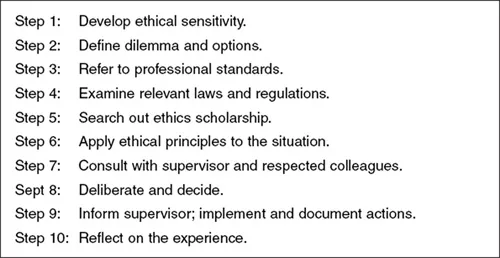
Welfel (2002) offered a sound ethical decision-making theory that incorporated several recommended approaches to ethical decision-making (Cottone & Claus, 2000). Welfel proposed ten steps to ethical decision-making (see Figure 1.1). The first step is for the professional to become sensitive to ethical issues. Welfel suggested that counselors/psychologists need to identify the potential ethical issues beginning in the first session, particularly since issues of legally mandated clients, or other relevant concerns, such as dual relationships and confidentiality, are prevalent in the profession. Counselors should begin their work with an awareness of what ethical issues may come up. Welfel noted that one way for counselors to be aware is through education and training, so that when they are making this initial assessment they will be able to identify important ethical dilemmas that may arise.
Figure 1.1 Traditional Ethical Decision-Making Model
Source: Welfel, E. (2002). Ethics in counseling and psychotherapy: Standards, research and emerging issues. Pacific Grove, CA: Brooks/Cole.
A second step is the definition of the ethical dilemma and the options for action (Welfel, 2002). This step involves concretely defining the ethical dilemma and identifying potential options for action. For example, a counselor may define the problem as possibly violating confidentiality with a client who has been violent in the past. Options might include first informing the client of the limitations of confidentiality. A second option may be to violate confidentiality and report a dangerous situation when it occurs.
A third step in the Welfel (2002) model is to refer to professional codes of ethics. As was mentioned earlier, there are numerous professional codes. The counselor may find more than one code that applies and the codes may conflict with each other. However, the task is to identify all codes that apply and use the information in later decision-making.
A fourth step according to Welfel (2002) is the review of relevant state and federal regulations and case law that may apply. For example, many states require counselors to report suspected child abuse. This action potentially violates client confidentiality if one is working with a child or parent and the abuse is detected.
A fifth step according to Welfel (2002) is a review of relevant professional ethics literature. This may involve reviewing research articles in professional journals that apply to the situation. A sixth step is the application of ethical principles based on virtue ethics (see further explanation of virtue ethics in Chapter 2) such as beneficence, nonmaleficence, etc.
A seventh step is consultation with colleagues and supervisors (Welfel, 2002). As Welfel noted, it is important to consult with trusted supervisors and seasoned colleagues to obtain feedback about the ethical dilemma confronting a counselor.
The eighth step is to decide what to do and, as Welfel (2002) noted, this is done alone. The counselor must decide based upon the information gathered and bear the responsibility for the course of action.
The ninth step is to inform appropriate people, such as supervisors, of the decision and action to be taken (Welfel, 2002). As Welfel noted, supervisors must be informed because they are legally responsible for the outcome that results from the counselor’s decision. The final step is reflection on and evaluation of the decision and the actions taken. Each step of the process should be evaluated and repeated if necessary (Welfel, 2002).
The Welfel model is comprehensive and addresses most of the steps of other models. Kitchener (1984) suggested that ethical decision-making models provide a guide for the process of decision-making and not for explicit outcomes or ethical decisions. Corey et al. (2003) stated that “your own ethical awareness and problem-solving skills will determine how you translate these general guidelines into day-to-day practice” (p. 6). However, Cottone and Claus (2000), in reviewing the practice of ethical decision-making and related research, found that little investigation has been completed. They conclude, therefore, that ethical decision-making models should be used with caution when training students.
Another recent decision-making approach proposed to improve ethical reasoning is based upon hermeneutics (Betan, 1997; Fowers & Richardson, 1996). The concept of hermeneutics is the study of interpretation based upon context (Follesdal, 2001). Follesdal suggested that hermeneutics is defined by first establishing interpretational hypotheses and then determining whether the hypotheses conflict with the text that is being interpreted.
Betan (1997) pointed out that an important omission from many of the current ethical decision-making models, e.g., Welfel’s model, is that the steps do not address the context in which the ethical issue is being interpreted. Betan further stated that
applying this hermeneutic understanding to ethics in psychotherapy, the task is not, and cannot be, simply to apply principles a priori, but instead to work toward an understanding of how the principles fit within the context, the alternatives, and the interpersonal demands of a particular ethical situation. (p. 356)
Garcia et al. (2003) proposed an ethical decision-making model that incorporates a contextual orientation, but they do not identify clearly the relevant issues.
What might be some of the contextual issues that should be addressed? Our beliefs are similar to those of Cottone and Claus (2000) that “an understanding of underlying philosophy and theoretical tenets” (p. 281) provides a basis of contextual connection to ethical decision-making. We live in a society that is not bounded by geographic limitations and cultural backgrounds. Through easy worldwide mobility, the media, and the Internet, geographic and temporal boundaries are removed. Consequently, those individuals receiving counseling services bring various backgrounds—cultural, racial, etc.—that create many more complex ethical dilemmas. Fowers and Richardson (1996) discussed components of a hermeneutic view and stated that “every culture’s traditions have some vision of the good life at their core that provide touchstones of meaning and directions for living” (p. 617). For example, the number of Asians entering and living in the United States has dramatically increased, and their ethical orientations are much different than traditional Western views; therefore, counselors must be better prepared to apply ethical decision-making that is based upon context and upon philosophical and theoretical approaches that are pertinent to the situation.
We are proposing training counselors in ethical decision-making using a hermeneutic approach. This contextualized approach is unique in the field of ethics. Specifically, we offer a model that includes a foundation in Western, Eastern, Middle Eastern, and Southern Hemisphere philosophical ethical theories. Our model of ethical decision-making incorporates considering the context of the situation, including a client’s worldview that matches a particular ethical orientation, e.g., a relevant Western, Eastern, Middle Eastern, or Southern Hemisphere view. Included in this model are a review of appropriate professional codes and an interpretation of how the various philosophical and theoretical views fit within the codes. The intent is to give practitioners a firmer foundation and understanding of the ethical issues that confront them, so decisions can be made that are based upon solid knowledge and context.
SUMMARY
Professional counselors benefit from systematic training in ethics and ethical decision-making. An important issue is forming a foundation upon which to make ethical decisions. We propose that such a foundation begins with an in-depth understanding of general culturally relevant ethical theories that represent most world philosophical views. Such an approach facilitates an understanding of the contextual issues surrounding ethical dilemmas in counseling. Cottone and Claus (2000) stated, “It is surprising to find the number of practice-based models developed apparently without attention to underlying philosophical and theoretical tenets” (p. 281). As Danzinger and Welfel (2001) discovered, counselors actually may not be using professional codes of ethics and, therefore, preparation in ethical theories may provide a broader source of information for ethical decision-making. The model provided here attempts to provide the practitioner with just such a broad-based approach to ethical decision-making, and ultimately a model to improve the ethical decision-making process.
![]()
SECTION I
Western Theories of Ethics
In the first section, we introduce Western views of ethics, covering the following theories: virtue ethics, natural law, utilitarian ethics, feminist ethics, Native American ethics, and respect for persons. Chapter 2 concerns virtue ethics. Virtue ethics provides one of the oldest Western perspectives (Shanahan & Wang, 2003). The ancient Greeks developed this particular orientation, e.g., Plato, Aristotle, and Socrates. The primary focus of this theory is on an understanding of the person’s character and related virtues.
Chapter 3 is a discussion of natural law (Harris, 2002; Shanahan & Wang, 2003). Natural law is grounded for the most part on Christian principles. Thomas Aquinas is one of the original contributors to this orientation. The primary basis of this theory is human nature and natural inclinations. These inclinations are defined in terms of biological and human values.
In Chapter 4, we discuss utilitarian ethics, which is founded upon the idea of the “most good for the most number of people.” John Stuart Mill is one of the major contributors to this theory (Harris, 2002). Many Western laws are founded in part upon utilitarian perspectives.
The next chapter...