eBook - ePub
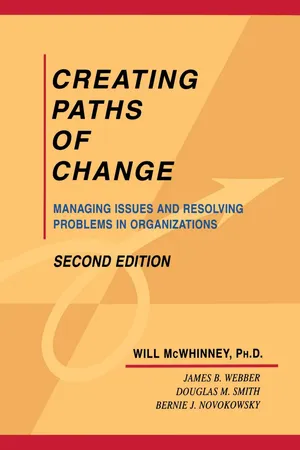
Creating Paths of Change
Managing Issues and Resolving Problems in Organizations
- 224 pages
- English
- ePUB (mobile friendly)
- Available on iOS & Android
eBook - ePub
Creating Paths of Change
Managing Issues and Resolving Problems in Organizations
About this book
Individuals, organizations, and communities constantly engage in change. Creating Paths of Change is a provides the reader with a proven strategy for making changes and resolving issues more effectively. This effective workbook is written for individuals and groupsùmanagers, entrepreneurs, and consultants ûwho are taking responsibility for the change effort. It addresses the problems faced in the daily operations of organizational life, and provides a foundation and theory for effective and sustained issue resolution. Creating Paths of Change guides the reader, in a step-by-step fashion, through the change-making or decision-making process helping the reader identify and improve his or her personal problem-solving style. The book has been used by individual managers, community volunteers, organizational consultants in a number of settings, and has been thoroughly class-tested in university courses.
Information
CHAPTER 1
You, The Agent of Change

INITIATING CHANGE
You initiate change by taking action. As an agent of change, you must face the question “How do I initiate changes that will effectively manage an issue?” To define the issue and a path to its solution requires that you begin with yourself. Who am I? How do I view the world? What resources and skills do I command? How do I habitually solve issues? To see problems clearly and recognize possible solutions you must understand yourself as the instrument who defines the problem.
“To see problems clearly and recognize possible solutions you must understand yourself as the instrument who defines the problem”
The function and motivation of someone in the role of a change agent depends upon their world views. Change agents can be managers implementing a mandated program, facilitators aiding others who have taken on a change effort, or consultants to executives. They can be foresters choosing what trees to cut or parents selecting a treatment for a sick child. Whatever the role, someone has to take responsibility for the first step.
One person’s perception of the problem and its solutions may be completely different from another’s.
Those attempting to solve problems must develop tactics for defining problems as well as tactics for determining and implementing solutions. People formulate problems based on how they view the world. This world view determines what they perceive as the primary problem, its fundamental cause, and the potential solutions. One person’s perception of the problem and its solutions may be completely different from another’s. Only you as an initiator and manager of change can define what will solve the problems that you face. You must recognize your own role in creating the problem and the accompanying conflicts.
MANAGING THE CONFLICT YOU CREATE
Conflict is the companion to change and the resolution of issues. All change produces imbalance in our environment even when done in the service of restoring balance and solving issues. People in conflict do not necessarily have ill intentions or even opposing goals. All significant and successful problem solving requires the management of conflict. It is a consideration in every one of the problem solving methods that we discuss in this book.
Conflict management, problem solving, and issue resolution are various forms of change activities. We use the language of “problems” and “issues” when we fantasize that the resolution process will go smoothly. We generally use the term “conflict” when open conflict is a presenting symptom or when we sense that the solution will take us into large interpersonal or societal issues. Obviously, the tools we employ when we acknowledge open conflict will be different than those we use when facing the diverse views in a long term urban development or the design of a new computer. Every choice must take into account the need to manage conflict. This book identifies the particular paths of change and the tools we should use whether we treat an issue as a problem or a conflict.
DETERMINING “WHAT IS REAL”
“The world is, after all, a certain way.” That is what people tend to assume and how they respond when communicating with friends or facing challenges in their environment. We solve problems and determine paths of change based on our concept of how we think the world works, what is real to us. People successfully apply many differing concepts about what is real and how to interact with others. Your version of Reality may be strikingly different from your teammates or opponents. Most small differences get smoothed over with customary pleasantries: “Excuse me,” “I hope you don’t mind,” and “It really doesn’t matter.” We develop these customs, agree to be nice to each other, and not challenge each other’s fundamental beliefs. When people hold strikingly different fundamental assumptions about what is real, even the simplest changes can lead to conflict and prevent resolution.
Determining what people believe is real enables us to better understand each other and resolve the resulting conflicts. Fortunately, these differing beliefs are associated with a distinct set of world views. Grouping people according to their typical patterns of beliefs allows us to understand their responses, and better anticipate their actions. Many current studies suggest that we can make good distinctions by grouping beliefs into a set of four different world views. This will give us enough appreciation of the differences to work most issues effectively. We present here a set of four world views based on Paths of Change (1992), by Will McWhinney. It provides a clear set of patterns which match what we see in people around us. Informally you can identify people’s preferred world views by examining the way they behave. You can use the questionnaire, The Reality Inquiry, printed at the end of this chapter to get a more reliable measure. Use it to evaluate the relative strengths of the four Realities for yourself and others.
THE FOUR REALITIES
Important differences between people and their behaviors can be described with four different world views. These four views help us understand how differently people approach resolving conflict and managing issues. How we view Reality not only defines how we solve problems but characterizes our styles of leadership and creativity as well. They also indicate how well a group’s world view matches different styles of organization and consequently indicate what paths will accomplish their goals. In addition, the four Realities reveal aspects of our personalities as do specific personality typologies such as the Myers-Briggs Type Indicator, the Kolb Learning Style Indicator, and the brain dominance instruments.
The labels we attach to these four world views may be new to you but the ideas have been around for centuries in every culture. People in Medieval Europe called them the humors; Jung calls them archetypes. Oriental cultures identified the four ways of being with the four directions; American Indians refer to the four winds. We intend that you recognize the four world views as a systemization of wisdom from many cultures.
You will likely find concepts with which you identify within each of the four Realities: Unitary, Sensory, Social, and Mythic. Some Realit...
Table of contents
- Cover Page
- Title Page
- Copyright
- Contents
- INTRODUCTION
- CHAPTER 1 - YOU, THE AGENT OF CHANGE
- CHAPTER 2 - THE MODES OF CHANGE
- CHAPTER 3 - LEADERSHIP AND THE TEAM
- CHAPTER 4 - THE GAMES OF CHANGE
- CHAPTER 5 - THE PATHS OF CHANGE
- CHAPTER 6 - SOLVING THE PROBLEM
- CHAPTER 7 - TWO CASES:
- TOOLS OF CHANGE
- REFERENCES
- THE AUTHORS
Trusted by 375,005 students
Access to over 1.5 million titles for a fair monthly price.
Study more efficiently using our study tools.
Frequently asked questions
Yes, you can cancel anytime from the Subscription tab in your account settings on the Perlego website. Your subscription will stay active until the end of your current billing period. Learn how to cancel your subscription
No, books cannot be downloaded as external files, such as PDFs, for use outside of Perlego. However, you can download books within the Perlego app for offline reading on mobile or tablet. Learn how to download books offline
Perlego offers two plans: Essential and Complete
- Essential is ideal for learners and professionals who enjoy exploring a wide range of subjects. Access the Essential Library with 800,000+ trusted titles and best-sellers across business, personal growth, and the humanities. Includes unlimited reading time and Standard Read Aloud voice.
- Complete: Perfect for advanced learners and researchers needing full, unrestricted access. Unlock 1.5M+ books across hundreds of subjects, including academic and specialized titles. The Complete Plan also includes advanced features like Premium Read Aloud and Research Assistant.
We are an online textbook subscription service, where you can get access to an entire online library for less than the price of a single book per month. With over 1.5 million books across 990+ topics, we’ve got you covered! Learn about our mission
Look out for the read-aloud symbol on your next book to see if you can listen to it. The read-aloud tool reads text aloud for you, highlighting the text as it is being read. You can pause it, speed it up and slow it down. Learn more about Read Aloud
Yes! You can use the Perlego app on both iOS and Android devices to read anytime, anywhere — even offline. Perfect for commutes or when you’re on the go.
Please note we cannot support devices running on iOS 13 and Android 7 or earlier. Learn more about using the app
Please note we cannot support devices running on iOS 13 and Android 7 or earlier. Learn more about using the app
Yes, you can access Creating Paths of Change by Will McWhinney,James B. Webber,Douglas M. Smith,Bernie J. Novokowsky in PDF and/or ePUB format, as well as other popular books in Business & Organisational Behaviour. We have over 1.5 million books available in our catalogue for you to explore.