- 208 pages
- English
- ePUB (mobile friendly)
- Available on iOS & Android
eBook - ePub
About this book
Negotiating and Influencing Skills provides the tools needed to negotiate effectively in order to obtain the best result--whether you are working on securing a contract, obtaining consensus on a goal, building commitment among your employees or classmates, coaching for employee development, or dealing with family and friends. Based on the theoretical approach to cooperative negotiating skills developed at the Harvard Project on Negotiation, the book presents a two-step process toward mastery of negotiating and influencing skills that includes the development of skills by means of interactive exercises and application of these negotiating skills in personal and professional life. Evaluation tools and many exercises are used to help the reader develop and broaden his or her negotiation style and become more flexible and fluid in approach. Difficult people and difficult situations provide us with one of the best sources of information on what we need to do differently in order to negotiate more effectively. The book examines the eight critical skills we all need to negotiate successfully with difficult people or difficult situations. Learning effective negotiating and influencing skills is a lifelong process. Reading this book is only the beginning point in that process. Suggestions are presented regarding books to read, courses to take, and the continuing use of the feedback forms provided in this book. Anyone who negotiates on a regular basis and is desirous of improving his or her negotiating and influencing skills, whether that be in the work setting or in their personal lives, will appreciate the approaches offered in this book, particularly professors and students of management, marketing, organizational communication, political science, public policy, psychology, industrial organization psychology, social work, negotiation, family studies, and law.
Information
Publisher
SAGE Publications, IncYear
1997Print ISBN
9780761911852
9780761911845
Edition
1eBook ISBN
9781506339252
1
Introduction
 | Negotiating and Influencing Skills Are Important to Learn |
In my experience in teaching negotiating skills, I have found that most people misunderstand the word negotiating. Many people assume that negotiating skills are only used in the context of labor/management negotiations. I see this differently: Negotiating and influencing skills apply in every area of our work and our personal lives. We constantly negotiate. We negotiate agreements, and agreements are what make relationships work. We also negotiate to solve problems, and we negotiate to resolve conflicts. The purpose of this book is to help you become a better interpersonal negotiator—whether the other party in the negotiation is your employer, subordinate, coworker, spouse, parent, child, or neighbor. In spite of people’s misunderstanding of the topic, I did not want to drop the word negotiating from the title of the course because negotiating is exactly what we need to learn. After we better understand the process, we become less intimidated by the term negotiating.
A number of years ago, I realized that the focus of the course I taught involved more than just negotiating skills. Therefore, I changed the name of the course to “Effective Negotiating and Influencing Skills.” For the sake of brevity, in this book the term negotiating can be understood as incorporating both negotiating and influencing skills. As you can see, negotiating is defined quite broadly in this book. In fact, the definition that I prefer is this: “A negotiation takes place any time two or more people are communicating, and at least one of those persons has a goal in mind.”
Negotiation skills are important because we spend a great deal of time negotiating. Research shows that most managers and supervisors spend up to 50% of their time negotiating. Salespeople, project managers, civil servants, engineers, technicians, medical personnel, and people working in the service industry, among others, also spend a great deal of their time negotiating. The outcomes of these negotiations determine our success in both our professional and our personal lives. Or as Gary Karrass, a noted speaker on negotiating skills, states, “We don’t get what we want in this life, we get what we negotiate.”
| Negotiating and Influencing Skills Are Difficult to Learn |
Why are negotiating skills so difficult to learn? There are three primary reasons:
- The first reason has to do with the complexity of the negotiating process. Negotiating and influencing skills are a complex network of interacting skills. One can think of negotiating and influencing skills as a symphony orchestra of skills. Each instrument (subskill) must be used together with all the others in a harmonious and congruent manner. If one instrument (subskill) is off, the whole orchestra will be off—in other words, the negotiation will not turn out as well as it otherwise could have.
- The second reason why negotiating is difficult to learn has to do with timing. In the real estate field, it is said that there are three important factors: location, location, and location. In negotiating, also, it has been said that there are three important factors: timing, timing, and timing. The step that you take at Stage 1 in the negotiation to effectively bring about movement toward resolution will, if employed at Step 10, cause the negotiation to break off or escalate into a conflict.
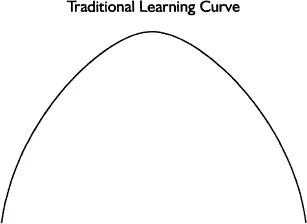
Figure 1.1Traditional Learning Curve
- The third reason why negotiating is difficult to learn is because negotiations are made up of two seemingly paradoxical skill sets: CREATING VALUE and CLAIMING VALUE.
Creating value. We create value by listening very carefully to the other person’s needs and interests. We patiently help our partner to learn what are our needs and interests. We look for ways to integrate and/or link these interests together. We look for and/or invent creative options that meet both parties’ interests. We create value by expanding the pie.
Claiming value. We claim value when we get our needs and interests met. We claim value by being well prepared and by being assertive. We can also claim value by being aggressive, by being dishonest, by deceiving, by bullying, and by using dirty tricks. Balancing the negotiating activities of creating value and claiming value is the essential task of all negotiators. Effective negotiators are equally effective at both of these skills. An in-depth examination of creating value and claiming value is the focus of Chapter 3.
If it is true that negotiating and influencing skills are difficult to learn, how can we approach this important task? Some fundamental tools can help adults learn more effectively:
- Powerful questions
- Salient feedback
- The ladder of knowledge
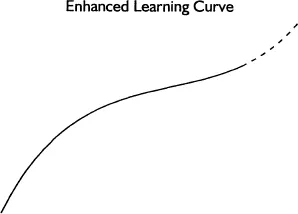
Figure 1.2Enhanced Learning Curve
The learning curve for most courses and for most books looks like the curve in Figure 1.1.
Three months later, the course or the book has made little, if any, difference. By contrast, consider the curve in Figure 1.2, in which the learning continues after the course has finished or after the book has been read.
Two essential factors must be met to produce this type of learning curve: powerful questions and salient feedback.
Powerful Questions
I was introduced to the idea of powerful questions at the Dalhousie University Killiam Lecture Series. The fund for the Killiam Lecture Series, which honors the memory of one of its greatest benefactors, enables the university to bring in three world-class lecturers for three consecutive Thursday evenings each October. Each series has a theme, such as “The Environment,” “Space,” “War,” or “The Women’s Movement.” In 1991, the topic for the series was the USSR, which was most timely, as the Soviet Union was in the process of disintegrating. The second lecturer of the series was a man named Marshall Goldman, who had written a biography of Mikhail Gorbachev. Near the end of his lecture, Mr. Goldman talked about the concept of powerful questions, and he illustrated it with this question: Why did Gorbachev do what he did in initiating perestroika?
Goldberg said that in order to answer that question we have to go back 30 years to a time when, as a young man, Gorbachev was walking on the beach in the Crimea with his buddy Chervenatchki. They talked about their grandfathers and discovered that, although according to family lore their grandfathers were very good and very honorable men, they had been killed in the Stalinist purges. Gorbachev later met and married Raisa, and he learned from her that both of her grandfathers also were killed in the Stalinist purges. At that time, Gorbachev started to ask himself the following powerful question: “How could a moral form of government go around killing off everyone’s grandfathers?” He thought about this question for a very long time and finally realized that it couldn’t—and therefore, the form of government had to change. Many years later, as prime minister of the USSR, he introduced perestroika. From this lecture, the concept that powerful questions bring about powerful results was planted firmly in my mind.
The powerful questions that I ask the students in my negotiation course to think about are the following:
- “What is my style of reaching agreements with others?” To arrive at your answer, you may want to consider this question: “When does my style work for me, and when does it work against me?”
- “How do I have to become more skillful, fluid, and flexible in my negotiating style so that it will work for me in a greater number of situations, thereby increasing my ability to accomplish my personal goals and also the goals of my team or department, and of the company or organization for which I work?”
- “What is my shadow style?” For example, John’s preferred style is to be warm, open, and congenial, but his shadow style may be quite aggressive when he is tired or when he has strong feelings about a particular negotiation. Our shadow style can be responsible for breaking off, giving in, or escalating a conflict. It is important not only to improve our primary style but to better control our shadow or secondary style. More will be said about how to control ourselves during the negotiation process in Chapter 5, “Dealing With Difficult People.”
Salient Feedback
Salient feedback is feedback that is so personally meaningful that it makes it much more likely that we will change our behavior. Medical research conducted in Vancouver helps make clear the idea behind salient feedback.
In this particular study, a group of women, all of whom were three months’ pregnant, were assigned randomly to Group A and Group B, which helped ensure that the two groups were statistically equal before the experiment. All participants in the study filled out an anonymous questionnaire regarding their caffeine and alcohol consumption and their use of nonprescription illegal drugs. Before the experiment, both groups were equal on these measures. Then all participants were given an ultrasound examination, after which a technician told each of them that their fetus was developing normally. (Only women whose fetuses were developing normally were used in the study.) The only difference in treatment of the two groups was that Group A participants were given the information verbally, whereas Group Β participants were also allowed to look at their fetuses on the ultrasound screen for 30 seconds.
Three months later, the women in both groups were again given the anonymous questionnaire. The experimenters were trying to answer the following question: Would the women in the two groups be similar or different?
During the first trimester of their pregnancy, these women already had received a great deal of feedback that things were different than before pregnancy. Building a placenta during the first trimester is like climbing a mountain 24 hours a day; added to that are hormonal changes and morning sickness. This amounts to a great deal of feedback that things in these women’s lives were radically different than they had been previous to pregnancy. Would 30 seconds of visual feedback make a difference? The answer is yes. The women who saw their babies significantly reduced their intake of caffeine, alcohol, and drugs. Why was this 30 seconds of visual feedback so powerful? The reason was that, as the old saying goes, “seeing is believing!”
To make the idea of salient feedback work for you, ideas will be suggested in this b...
Table of contents
- Cover Page
- Dedication
- Title Page
- Copyright
- Contents
- Preface
- Acknowledgments
- 1. Introduction
- 2. Creating and Claiming Value
- 3. Assessing Your Current Negotiating Style
- 4. Principles and Techniques for Creating and Claiming Value
- 5. Dealing With Difficult People and Difficult Situations
- 6. Developing Higher-Order Skills
- 7. The Power of Commitment
- 8. Conclusion
- Appendix A: Annotated Bibliography
- Appendix B: Exercises and Forms
- References
- Index
- About the Author
Trusted by 375,005 students
Access to over 1.5 million titles for a fair monthly price.
Study more efficiently using our study tools.
Frequently asked questions
Yes, you can cancel anytime from the Subscription tab in your account settings on the Perlego website. Your subscription will stay active until the end of your current billing period. Learn how to cancel your subscription
No, books cannot be downloaded as external files, such as PDFs, for use outside of Perlego. However, you can download books within the Perlego app for offline reading on mobile or tablet. Learn how to download books offline
Perlego offers two plans: Essential and Complete
- Essential is ideal for learners and professionals who enjoy exploring a wide range of subjects. Access the Essential Library with 800,000+ trusted titles and best-sellers across business, personal growth, and the humanities. Includes unlimited reading time and Standard Read Aloud voice.
- Complete: Perfect for advanced learners and researchers needing full, unrestricted access. Unlock 1.5M+ books across hundreds of subjects, including academic and specialized titles. The Complete Plan also includes advanced features like Premium Read Aloud and Research Assistant.
We are an online textbook subscription service, where you can get access to an entire online library for less than the price of a single book per month. With over 1.5 million books across 990+ topics, we’ve got you covered! Learn about our mission
Look out for the read-aloud symbol on your next book to see if you can listen to it. The read-aloud tool reads text aloud for you, highlighting the text as it is being read. You can pause it, speed it up and slow it down. Learn more about Read Aloud
Yes! You can use the Perlego app on both iOS and Android devices to read anytime, anywhere — even offline. Perfect for commutes or when you’re on the go.
Please note we cannot support devices running on iOS 13 and Android 7 or earlier. Learn more about using the app
Please note we cannot support devices running on iOS 13 and Android 7 or earlier. Learn more about using the app
Yes, you can access Negotiating and Influencing Skills by Brad McRae in PDF and/or ePUB format, as well as other popular books in Languages & Linguistics & Communication Studies. We have over 1.5 million books available in our catalogue for you to explore.