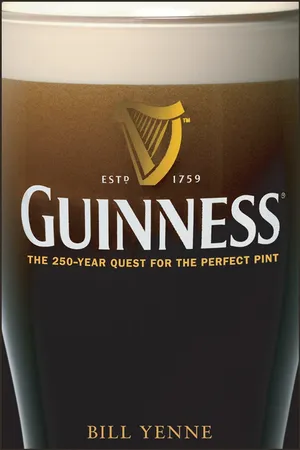
A perfectly poured history of the world's greatest beer.
"Joseph Conrad was wrong. The real journey into the Heart of Darkness is recounted within the pages of Bill Yenne's fine book. Guinness (the beer) is a touchstone for brewers and beer lovers the world over. Guinness (the book) gives beer enthusiasts all the information and education necessary to take beer culture out of the clutches of light lagers and back into the dark ages. Cheers!"
-Sam Calagione, owner, Dogfish Head Craft Brewery and author of Brewing Up a Business, Extreme Brewing, and Beer or Wine?
"Marvelous! As Bill Yenne embarks on his epic quest for the perfect pint, he takes us along on a magical tour into the depths of all things Guinness. Interweaving the tales of the world's greatest beer and the nation that spawned it, Yenne introduces us to a cast of characters worthy of a dozen novels, a brewery literally dripping with history, and-of course-the one-and-only way to properly pour a pint. You can taste the stout porter on every page."
-Dan Roam, author of The Back of the Napkin: Solving Problems and Selling Ideas with Pictures
- English
- ePUB (mobile friendly)
- Available on iOS & Android
eBook - ePub
1
Origins
Brewing has been part of civilization since antiquity. Professor Solomon Katz at the University of Pennsylvania has found Sumerian recipes for beer that date back four millennia, and beer is mentioned often in ancient Egyptian literature. As H. F. Lutz points out in Vitaculture and Brewing in the Ancient Orient, published in 1922, Middle Kingdom texts from Beni Hasan “enumerate quite a number of different beers.” Among these a “garnished beer” and a “dark beer.” As David Ryder points out in the Newsletter of the American Society of Brewing Chemists, Egyptian beer “was also used as a medicine, a tonic for building strength . . . a universal cure for coughs and colds, shortness of breath, problems of the stomach and lungs, and a guard against indigestion.”
It has been suggested that the brewing of beer is at least as old as the baking of bread, and certainly both have been practiced since the dawn of recorded history. Indeed, the art and science of the brewer and those of the baker are quite similar, both involving grain, water, and yeast. In fact, the Sumerians baked barley loaves called bappir that could be stored in the dry climate and either eaten as bread of mixed with malted barley to form a mash for brewing.
Beer, by definition, is a beverage originating with grain, in which the flavor of the grain is balanced through the addition of other flavorings. Since the Middle Ages, those other flavorings have principally been hops. Today, a brewer typically starts the process with cereal grains—usually, but not exclusively, barley. The grains are malted, meaning that they are germinated and quickly dried. The extent to which malted grain is then roasted imparts a specific color to the beer, a step in the process that is obviously important to making Guinness what it is. The malt is then mashed, meaning that it is soaked long enough for enzymes to convert starch into fermentable sugar. The mashing takes place in a vessel that is generally called a mash tun, although the old Irish term kieve has always been the word favored at Guinness.
Next, water is added to the mash to dissolve the sugars, resulting in a thick, sweet liquid called wort. The wort is then boiled in what brewers call a brew kettle. At this point, most brewers add hops, the intensely flavored flower of the humulus lupulus plant. Originally a preservative as much as a flavoring, hops have been used by brewers for centuries. Throughout history, brewers have occasionally added seasonings other than hops to their beer. The Egyptians added flavorings such as fruit and honey, and certain modern beers contain fruit and spices.
Finally, the yeast is added to the cooled, hopped wort and the mixture is set aside to ferment into beer. During the fermentation process, the yeast converts the sugars into alcohol and carbon dioxide.
Having been brewed at the birth of civilization in the regions surrounding the Mediterranean, the beverage grew up with that civilization. Beer is mentioned by Xenophon and Aristotle (as quoted by Athenaeus). Among others, the Roman consul and scholar Pliny the Younger estimated that nearly 200 types of beer were being brewed in Europe by the first century. The Latin texts refer to the barley beverages as cerevisia or cerevisium, root words that are still with us in the Spanish and Portuguese words for beer—cerveza and cerveja—as well as in the latin name for brewer’s yeast, saccharomyces cerevisiae.
Brewing, like wine making, was practiced in the lands whose shores were washed by the Mediterranean, but it was also practiced in Europe’s northern latitudes. Here, cereal grains and brewing flourished, while grapes and viticulture usually did not.
In the British Isles, brewing existed in the misty distant past, long predating the Roman occupation. In the first century, Pedanius Dioscorides, the Greek pharmacologist and botanist traveled extensively throughout the Roman Empire collecting various substances with medicinal properties. He observed that the Britons and the Hiberi, as the Romans called the Irish, used a liquor variously known as “cuirim,” “courm,” or “courmi,” an ale made from barley. Meanwhile, cuirim is also mentioned in the first century, the Táin Bó Cúailnge (The Cattle Raid of Cooley), the central tale in the Ulster Cycle, one of the four great cycles that make up the core of Irish mythology. In these stories, the Irish king Conchobar (Conor) MacNessa spends his day drinking cuirim “until he falls asleep therefrom.”
The beer brewed in the Middle Ages was similar to modern ale, which is fermented at cellar temperatures using saccharomyces cerevisiae, a top-fermenting yeast. Today, such beer styles include porter and stout, as well as ale. These beers are distinct from lager beer, which is fermented at much colder temperatures using saccharomyces carlsbergensis, a bottom-fermenting yeast. Lager, whose cultural importance is described in more detail later, is also fermented for a longer time than top-fermented beers. Perfected in Germany early in the nineteenth century, lager is named for the German word meaning “to store,” a reference to the longer fermentation.
The use of hops to flavor the beer, which is now the universally accepted standard, originated in central Europe, while in the British Isles, bayberries and ivy berries, as well as the flowers of the heath and other bitter herbs, rather than hops, were used as seasonings up through the Middle Ages.
In the fifth century Senchus Mor, the well-known book of the ancient laws of Ireland, there are abundant references to the growing of barley for malt, and to the enjoyment of ale. Later in the fifth century, a man named Mescan is widely described as having been the brewmaster of St. Patrick’s household. In the ancient texts on the life of St. Patrick that were translated by Whitley Stokes in the 1880s, we learn that while the saint was dining with the King of Tara, “The wizard Lucatmael put a drop of poison into Patrick’s cruse, and gave it into Patrick’s hand: but Patrick blessed the cruse and inverted the vessel, and the poison fell thereout, and not even a little of the ale fell. And Patrick afterwards drank the ale.”
Thomas Messingham, the seventeenth century Irish hagiologist who published biographies of many Irish saints, made note of the fact that the celebrated St. Brigid of Kildare (451-525) was, herself, a brewer. Translations from Rawlinson Manuscript B512 in the Bodleian Library at Oxford explain that Brigid was extremely diligent about brewing high quality ale that was filled with nutrients. The Rawlinson papers also note that she once supplied 17 churches with an Easter Ale that she brewed from one sack of malt.
At the beginning of the seventh century, when Irish monks set out to revitalize classical scholarship in Europe by founding monasteries as centers of learning, at least two of them brought the brewer’s art. Saint Columbanus (543-615) and Saint Gall (550-646) traveled into the Frankish and Italian duchys, setting up a number of such cloisters, and legend has it that these places had breweries. This probably contributed to the tradition of European monastic brewing that survives—especially in Belgium—into the twenty-first century. A biography of Columbanus notes that “When the hour of refreshment approached, the minister of the refectory endeavored to serve the ale, which is bruised from the juice of wheat and barley, and which all the nations of the earth—except the Scordiscae and Dardans, who inhabit the borders of the ocean—Gaul, Britain, Ireland and Germany and others who are not unlike them in manners use.”
In Europe during the Middle Ages, each town had numerous breweries and a great deal of beer was consumed. As graphically portrayed in the scenes of daily life painted by Peiter Brueghel, beer was a routine part of life in Northern Europe’s villages and towns. Indeed, beer was a major element in the medieval diet. Boiled during the brewing process, beer was essentially germ-free, which meant that it was a good alternative for the typically unsanitary drinking water. Beer was also high in nutrients and food value.
During the Middle Ages, beer, like bread, was produced at home. The peasant housewife brewed for her family, the baron’s servants brewed in the kitchen of his castle and the monks brewed in their monastery. As taverns and inns sprang up in the towns and along major roads, many of these establishments brewed their own, much in the manner of modern brewpubs. Gradually, small commercial brewers came into being, brewing larger quantities for sale to taverns and individuals. Such establishments remained small by later standards, with a relatively confined distribution radius.
By the end of the twelfth century, a number of breweries existed in Ireland along the Poddle River, which flows into the Liffey in Dublin. In the tradition of St. Brigid, many of the brewers were women. Indeed, female brewers—known in Old English as “brewsters”—were common throughout Northern Europe in the Middle Ages. Barnaby Rich in his New Description of Ireland, published in 1610, gives an account of the brewing industry in Dublin during the reign of James I and Charles II. By that time, he estimated that there were more than 1,100 alehouses and nearly 100 breweries and brewpubs in the city of Dublin, whose population was only 4,000 families. Rich also describes at length the tradition of a certain celebrated Holy Well near St. James’s Gate, where an annual summer festival took place. St. James’s Gate was the ancient entrance to the city from the suburbs to the west. It took its name from the Church and Parish of St. James, which date back to the twelfth century. The gate is mentioned in the thirteenth century, and shown both on Speed’s 1610 map of Dublin and on Brooking’s 1728 map of the city. It was here, more than a century later, that Arthur Guinness would lease his Dublin brewery. The original medieval St. James’s Gate itself deteriorated over time and was pulled down in 1734.
“On the west part of Dublin they have St. James, his Well,” wrote Rich, “And his feast is celebrated the 25th of July, and upon that day, a great mart or fair is kept fast by the Well. The commodity that is there to be vended, is nothing else but ale, no other merchandise but only ale.”
The fair or festival of St. James was also described by Richard Stanihurst in his 1577 “Description of Dublin,” in which he mentioned booths and ale-poles pitched at St. James’s Gate in connection with the event.
Though brewing certainly existed in the vicinity of St. James’s Gate in the sixteenth century, it is not known when the first brewery was established here. We do know that in 1670, a brewer named Giles Mee obtained a lease from the Municipal Corporation that included water rights described as the “Ground called the Pipes in the parish of St. James.” These rights eventually passed into the ownership of Sir Mark Rainsford, a brewer and alderman. Documents preserved in the Public Registry of Deeds in Dublin record that in 1693, Rainsford had a brewhouse at St. James’s Gate where “beer and fine ales” were made. In November 1715, Rainsford leased his brewery to Paul Espinasse for 99 years.
By the turn of the eighteenth century, the brewing of beer in European cities such as Dublin was gradually passing from the hands of small pub brewers and home brewers to those of larger commercial brewers, who had first been incorporated in Dublin by Royal Charter in 1696. Soon there would be an industry consolidation that saw the rise of larger commercial breweries both in Ireland and England.
Among these commercial breweries in Ireland was the St. Francis Abbey Brewery in Kilkenny, which was founded by John Smithwick in 1710 on the site of a Franciscan abbey where monks had brewed ale since the fourteenth century. This brewery is worth singling out because today it survives as Ireland’s oldest operating brewery—and because the brewery, as well as the Smithwick’s brand, have been part of the Guinness portfolio since 1956.
By the eighteenth century, as John Smithwick was brewing his first commercial batch of ale, the culture and economies of England and Ireland had long been inextricably intertwined. English rule had been firmly established in Ireland for centuries. With this, a class system had been imposed which favored Protestants over Catholics, and people with English, rather than Celtic lineage. Had Arthur Guinness not been Protestant, he never would have had the opportunity to buy a brewery in eighteenth century Ireland.
The Gaels, the ancient Celtic people who had lived in Ireland for thousands of years, converted to Christianity around the fifth century, ruled the island politically until the twelfth century except for occasional raids and inroads made by the Vikings after about the ninth century. In 1172, King Henry II of England invaded Ireland. Though England claimed all of Ireland for over five hundred years, the English occupation was mainly confined to a few east coast cities such as Waterford, and the Pale, the area surrounding Dublin. As this foothold expanded in the sixteenth century, it led to the gradual collapse of the old Gaelic social and political structure, and also to the Protestant Ascendancy, the rise of a new English ruling class. Being Protestant (since King Henry VIII had replaced the Catholic church in England with the Protestant Anglican church in 1534), this ruling class was distinct from the Catholic indigenous Irish majority. Catholics, despite their constituting 90 percent of the population, owned less than 10 percent of Irish land, and were barred from the Irish Parliament.
Beginning in the seventeenth century—aside from the decade that England was ruled as a republic—there was a de facto unified monarchy throughout the British Isles. Monarchs were considered to be of England, Scotland, and Ireland. The latter had no monarch of its own, but the two separate kingdoms of Scotland and England had shared the same monarch since James VI, King of Scots, became James I of England in 1603. (In Ireland, the English-dominated Irish Parliament had, in 1542, voted to make the sitting English monarch automatically the monarch of Ireland.) In 1707, the kingdoms of England and Scotland officially merged as the Kingdom of Great Britain, with a single parliament and government, based in Westminster in London, controlled the new kingdom. The Kingdom of Great Britain was superseded by the United Kingdom of Great Britain and Ireland in 1801 when the Kingdom of Ireland was absorbed after the English put down the Irish Rebellion of 1798.
It was against this backdrop of political and social events that Arthur Guinness was born in Celbridge, County Kildare, in 1725. Arthur’s father is known to have been a man named Richard Guinness, but little is known of who he was or where he came from. By various accounts, Richard Guinness was probably born in or around 1690. The names of his parents are not known, although he is believed to have had a brother named William who later became a gunsmith in Dublin.
If true, his having been born in 1690 places Richard’s origin in the same year as one of the milestone moments of Irish history, the Battle of the Boyne. Fought near Drogheda on the River Boyne on July 1, 1690, it was the turning point in the war between the Jacobite armies of the deposed Catholic King James II of England (who had also ruled as James VII of Scotland) and the Williamite armies of his Protestant son-in-law and successor, William III (William of Orange) who had deposed James from his English and Scottish thrones in the previous year. The outcome of the Battle of the Boyne was that William ruled and James ran. For Ireland, this outcome ensured continued English and Protestant rule that would last more than two centuries.
The Battle of the Boyne figures prominently in the various tales of Richard Guinness’s ancestry. One of the more colorful and improbable stories casts Richard Guinness as the illegitimate son of an Irish girl and an English soldier named Gennys, who was stranded in Ireland after the battle.
A more likely story, and one that Arthur Guinness himself believed to be accurate, was that his father was descended from or related to Bryan Viscount Magennis of Iveagh (Uibh Eachach) in County Down. Magennis was a Catholic nobleman who supported James II before and during his failed fight on the Boyne. In the aftermath, Bryan was one of those who fled Ireland as part of the “Flight of the Wild Geese,” the exit of Irish Jacobites from Ireland to France. The story continues that a wing of the Magennis clan dropped the prefix “Ma” (short for Mac, meaning “the family”) from their surname and converted from Catholicism to Protestantism.
What is known for sure about Richard Guinness includes his marriage to a woman named Elizabeth Read, and the fact that he was an administrator and land custodian in the employ of Reverend Dr. Arthur Price, the affluent Protestant vicar of Celbridge in County Kildare. A romantic legend has it that Richard had earlier been a groom for Elizabeth’s father near Oughter Ard, and that he had eloped with her. In fact, their nuptials probably involved much less drama because the vicar would not have hired someone involved in something as scandalous as an elopement, and an eloping couple from Oughter Ard would have traveled farther than the few miles to Celbridge.
As Reverend Price’s career flourished, Richard and Elizabeth Guinness prospered and eventually bought property of their own. The reverend’s fast track to success often took him to Dublin or London, and while he was away, Richard was in charge of his lands and property.
In 1725, when young Arthur Guinness was born, Reverend Price became his godfather and namesake. Arthur was the first of six, the others being Frances, Elizabeth, Benjamin, Richard, and Samuel. Though numerous sources refer to the year of Arthur’s birth, we do not know the day. Records of his birth, such as a birth certificate or church records, have not survived.
Among his other duties in the employ of the vicar, Richard Guinness served as the house brewer at the Price estate. It is recalled that he brewed a delectable dark beer that was said to be immensely popular with the reverend and his guests. Almost ...
Table of contents
- Title Page
- Copyright Page
- Epigraph
- Notes on Measurements and Terminology
- Acknowledgements
- Introduction
- Chapter 1 - Origins
- Chapter 2 - Arthur Guinness, Brewer
- Chapter 3 - A Family Business
- Chapter 4 - Generations and Dynasties
- Chapter 5 - Bottlers and the Export Trade
- Chapter 6 - Building Sales While Building Rails
- Chapter 7 - A Public Company
- Chapter 8 - The Guinness World Travellers
- Chapter 9 - To the Ends of the Earth, and Manchester, Too
- Chapter 10 - War at Home and Abroad
- Chapter 11 - Trouble, Triumph, and the Toucan
- Chapter 12 - Brewed in Britain and America, Too
- Chapter 13 - World War II
- Chapter 14 - The Postwar Years
- Chapter 15 - Great Men and Great Ideas
- Chapter 16 - A Family Business at Two Hundred
- Chapter 17 - Nitrogenation, the Really Great Idea
- Chapter 18 - A Lager Called Harp
- Chapter 19 - Into Africa, Malaysia, and Beyond
- Chapter 20 - Diversification and Expansion
- Chapter 21 - The Watershed Decade
- Chapter 22 - A Widget in the Pint
- Chapter 23 - A Growing Company and the Perfect Pint
- Chapter 24 - Guinness in the Twenty-First Century
- Chapter 25 - Inside the Gate with the Master Brewer
- Appendix A - Generations of the Guinness Family in the Leadership of the Family Business
- Appendix B - Guinness Head Brewers
- Bibliography
- About the Author
- Index
Trusted by 375,005 students
Access to over 1.5 million titles for a fair monthly price.
Study more efficiently using our study tools.
Frequently asked questions
Yes, you can cancel anytime from the Subscription tab in your account settings on the Perlego website. Your subscription will stay active until the end of your current billing period. Learn how to cancel your subscription
No, books cannot be downloaded as external files, such as PDFs, for use outside of Perlego. However, you can download books within the Perlego app for offline reading on mobile or tablet. Learn how to download books offline
Perlego offers two plans: Essential and Complete
- Essential is ideal for learners and professionals who enjoy exploring a wide range of subjects. Access the Essential Library with 800,000+ trusted titles and best-sellers across business, personal growth, and the humanities. Includes unlimited reading time and Standard Read Aloud voice.
- Complete: Perfect for advanced learners and researchers needing full, unrestricted access. Unlock 1.5M+ books across hundreds of subjects, including academic and specialized titles. The Complete Plan also includes advanced features like Premium Read Aloud and Research Assistant.
We are an online textbook subscription service, where you can get access to an entire online library for less than the price of a single book per month. With over 1.5 million books across 990+ topics, we’ve got you covered! Learn about our mission
Look out for the read-aloud symbol on your next book to see if you can listen to it. The read-aloud tool reads text aloud for you, highlighting the text as it is being read. You can pause it, speed it up and slow it down. Learn more about Read Aloud
Yes! You can use the Perlego app on both iOS and Android devices to read anytime, anywhere — even offline. Perfect for commutes or when you’re on the go.
Please note we cannot support devices running on iOS 13 and Android 7 or earlier. Learn more about using the app
Please note we cannot support devices running on iOS 13 and Android 7 or earlier. Learn more about using the app
Yes, you can access Guinness by Bill Yenne in PDF and/or ePUB format, as well as other popular books in Business & Manufacturing. We have over 1.5 million books available in our catalogue for you to explore.