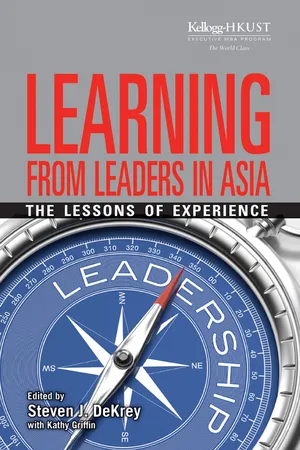
Learning from Leaders in Asia
eBook - ePub

Learning from Leaders in Asia

The Lessons of Experience

  1. English
  2. ePUB (mobile friendly)
  3. Available on iOS & Android
eBook - ePub

Learning from Leaders in Asia

The Lessons of Experience

About this book

More than ever, the world needs strong, effective and ethical leadership. Asia is the world's fastest growing region. Its success in the 21st century will depend largely on the quality of its leaders. Learning from Leaders in Asia captures the rich experiences of leaders operating in the region, identifies the key elements of leadership and offers practical advice on how to make a lasting impact. An important and timely book for all who want to seize the moment.
Anson Chan, Former Chief Secretary for Administration, Hong Kong Special Administrative Region

Learning from Leaders in Asia provides a solid understanding of the challenges faced by leaders in Asia today and tomorrow. It provides real life insights by leaders across various disciplines in overcoming challenges such as talent acquisition and retention, China strategies and globalization to name but a few. An invaluable read.
Chen Shaopeng, President, Lenovo Emerging Market Group, Senior Vice President, Lenovo Group

Learning from Leaders in Asia is a must-read for any business person in the world who wants to gain perspectives from Asia-based multinationals. It offers valuable insights as Asia's importance rises.
William Fung, Group Managing Director, Li & Fung Ltd.

Learning from Leaders in Asia presents a unique opportunity for readers to learn from the insights of the business executives who are part of one of the leading EMBA programs in the world. Having interacted with these talented men and women I can say with full confi dence that they truly understand the issues of building and running a global business. That makes this book well worth reading and I highly recommend it.
Jim Thompson, Chairman, Crown Worldwide Holdings Ltd.

Learning from Leaders in Asia cuts through the data and popular opinions to offer an on-the-ground view of the region's latest developments. Combining the acute perceptions and broad sweep of Leadership Experiences in Asia, this book examines the complex issues and offers fundamental insights into the business cultures of a host of countries. In lucid terms, it spells out the unprecedented opportunities and challenges facing companies wanting to devise a strategy that effectively adapts to the Asian reality.
Marjorie Yang, Chair, Esquel Group

This extraordinary book is the sequel to Leadership Experiences in Asia, Dr. DeKrey's first effort to describe the functioning of leadership in the Asian contexts. There is no-one with better credentials for doing this than DeKrey, an American who has lived and worked in Hong Kong for more than two decades and who has experienced the very best examples of leadership both in the West as well as in Asia. There is no one whose leadership skills cannot be enhanced by the principles and illustrations laid out in this book.
David M. Messick, Morris and Alice Kaplan Professor Emeritus of Ethics and Decision in Management, Kellogg School of Management, Northwestern University

This timely and highly relevant book tackles the critical issues that keep general managers awake at night as they strive to build a sustainable and profitable business in Asia and, in particular, China. The triple challenges of building talent, encouraging breakthrough innovation and ensuring strong governance may be global, but they face added urgency and complexity in Asia given the very high expectations for growth and unique cultural challenges. The blend of theory, strategy and highly practical experience in this book provides invaluable advice for leaders who are determined to build a legacy in Asia.
Ron McEachern, President, PepsiCo Asia

Trusted by 375,005 students

Access to over 1.5 million titles for a fair monthly price.

Study more efficiently using our study tools.

Information

Publisher
Jossey-Bass
Year
2015
Print ISBN
9780470825099
Edition
1
eBook ISBN
9781119191278

Chapter 1
The War for Talent

In the modern-day business environment, competition in the marketplace has intensified from the basis of product and price, to the core of a business organization—what many human resources (HR) professionals describe as “The War For Talent.”
A business organization is by definition a group of people assembled to accomplish common objectives or goals, such as maximizing the profits of investors, catering to new lifestyles and trends, or performing a particular service for customers or society for a fee. The key element no doubt is people. People set out the structure, business model, and governing modus operandi of an organization. People also bring various functions of the organization together and produce synergy. Particularly in the service sector, employees are an organization’s most important asset.
It is therefore logical to conclude that any top-performing company, whether a multinational or local small and midsize enterprise (SME), must have an effective approach and framework for attracting and selecting talent. The result of the “War for Talent” is that businesses must be competitive in attracting and selecting the necessary people, and must ferret out the rare individuals who can eventually take up leadership positions and drive the company forward.
What we present here is a step-by-step framework for talent management and leadership development. We will refer to a few study surveys to illustrate the latest broad trends, and use the example of the Lafarge Cement Company Chinese joint venture to show successful HR in practice. In all of this, we hope to provide some unique and helpful insights into the practice of talent management in Asia.

What is “talent”?

We all want talent, whether it is as individuals looking to make our mark on the world or as companies wanting to hire a body of capable workers. But just what is “talent”? A dictionary definition offers a few clues: 1: A special natural ability or aptitude, 2: a capacity for achievement or success, 3: A talented person, 4: A group of persons with special ability, 5: A power of mind or body considered as given to a person for use and improvement (www.dictionary.com). But in truth talent is something more complex than that. It is partly innate, partly learned, and it can be subject to other dynamic forces. For example, having talent without accompanying moral standards is the equivalent of a walking time bomb because that talent could be deployed, in the worst case, in a way that is harmful to society and the business community.

Attributes of talent

Intelligence is essential to talent and it helps to be aware of its different forms. For instance, IQ (intelligence quotient) measures cognitive capacities, while EQ (emotional quotient) measures our ability to recognize our own feelings and those of others, motivate ourselves and manage emotions well internally and in our relationships.1 The abilities ascribed to emotional intelligence are distinct from, but complementary to, academic intelligence, that is, IQ.
Talent, we would argue, is similarly differentiated by hard and soft qualities. The former (hard) is usually related to learned sciences, such as mathematics, engineering, and physics, while the latter (soft) deals with the softer expressive skills that are harder to learn and relate more to personality, such as painting, music, emotional control, or sociability. The good news is leadership, management, and technical skills can be developed and learned through experience and education, though social skills are more related to personality and a person’s mindset.
In business, the standard approach in developing talent has been to acquire more technical abilities, but current trends show a drift toward endowing our leaders with softer skills, such as being able to adapt to a diversified environment.

Ethical values and talent

Talent is also distinguished by ethical values. Talented managers may be great at management and analytical skills, but this doesn’t necessarily relate to their moral values. For instance, Enron Chairman Kenneth Lay and CEO Jeffrey Skilling are both sophisticated and brilliant businesspeople, yet their unethical business practices overshadowed their talents. Is it desirable to have talent without business ethics, like these Enron executives or those at WorldCom (Nanda 2003)?2 The growing emphasis on business ethics for today’s leaders means that personal integrity has become a major consideration in selecting corporate leaders.
Ethics is the steering wheel, while talent is the vehicle being driven. It really depends on how the leader implements his or her talents and in what direction. With the introduction of the Sarbanes–Oxley Act in 2002 to govern corporate accounting and auditing compliance, the integrity of corporate leaders becomes a significant factor when selecting talent. Findingtherightpeoplewhoalsohavethecorrectpersonal values to fit the company’s culture and mission has become very important.

Attracting talent in Asia

Attracting talent is difficult all over the world, but the situation is even more complicated when the battlefield turns to Asia. This broad geographical region is rich with many distinct histories, cultures, languages, value systems, and people. Furthermore, countries at different stages of economic development are juxtaposed, and external failure issues such as spillover, exploitation, and wage differentials are all a common part of daily operational conflicts that organizations need to resolve. Bribery and reliance on personal relationships to move business forward are prevalent in Asia, particularly in newly developing countries.
Political economy also comes into play, such as the various rules and factors that restrain the mobility of talent across borders. What we can observe today in rapidly growing Asia as a whole is a unique interaction of all these socioeconomic factors, sometimes co-existing perfectly, sometimes clashing with each other. In summary, Asia is nothing like the Western analytical framework that traditional theories have been based on.
Although it is rather risky to make generalized claims about attracting talent in Asia as a whole, there are some commonalities that can be derived from the complex situations that abound. These can help to provide business enterprises in the region with insights into and practical ideas for finding talent.
An interesting place to start is with prospective talents themselves. What qualities in a company attract MBA graduates? This is an interesting question because MBA training provides graduates with sophisticated analytical approaches and tools that can be useful to corporations worldwide.
A survey of MBA graduates from leading international schools was conducted by public relations consulting firm Hill & Knowlton in 2007. It found that “company reputation” was the most important factor for choosing which company to join. Furthermore, the respondents identified the five top drivers defining company reputation—things like the quality of management, the quality of products and services, employee talent, financial performance and investment value, and innovation (see table 1.1). In particular, Asian MBA students ranked corporate social responsibility (CSR) highly, significantly more so than their counterparts in North America and Europe.3
Table 1.1: Hill & Knowlton survey of MBA gra...

Table of contents

  1. Cover
  2. Table of Contents
  3. Series
  4. Title
  5. Copyright
  6. Author
  7. Acknowledgments
  8. Introduction: About Our Asian Leaders
  9. Chapter 1: The War for Talent
  10. Chapter 2: Globalization and Asian Business
  11. Chapter 3: China and the Go West Policy
  12. Chapter 4: Achieving Stability in a Volatile World
  13. Chapter 5: Innovate and Lead
  14. Chapter 6: The Changing Landscape of Corporate Governance
  15. Chapter 7: Building Brands Across Asia
  16. Chapter 8: Corporate Social Responsibility: Enlightened Self-Interest
  17. Chapter 9: Learning from Our Leaders
  18. Appendix 1: Introducing Our Distinguished Speakers
  19. Appendix 2: From Socialized Institution to Privatized Corporation
  20. Index
  21. End User License Agreement

Frequently asked questions

Yes, you can cancel anytime from the Subscription tab in your account settings on the Perlego website. Your subscription will stay active until the end of your current billing period. Learn how to cancel your subscription
No, books cannot be downloaded as external files, such as PDFs, for use outside of Perlego. However, you can download books within the Perlego app for offline reading on mobile or tablet. Learn how to download books offline
Perlego offers two plans: Essential and Complete
  • Essential is ideal for learners and professionals who enjoy exploring a wide range of subjects. Access the Essential Library with 800,000+ trusted titles and best-sellers across business, personal growth, and the humanities. Includes unlimited reading time and Standard Read Aloud voice.
  • Complete: Perfect for advanced learners and researchers needing full, unrestricted access. Unlock 1.5M+ books across hundreds of subjects, including academic and specialized titles. The Complete Plan also includes advanced features like Premium Read Aloud and Research Assistant.
Both plans are available with monthly, semester, or annual billing cycles.
We are an online textbook subscription service, where you can get access to an entire online library for less than the price of a single book per month. With over 1.5 million books across 990+ topics, we’ve got you covered! Learn about our mission
Look out for the read-aloud symbol on your next book to see if you can listen to it. The read-aloud tool reads text aloud for you, highlighting the text as it is being read. You can pause it, speed it up and slow it down. Learn more about Read Aloud
Yes! You can use the Perlego app on both iOS and Android devices to read anytime, anywhere — even offline. Perfect for commutes or when you’re on the go.
Please note we cannot support devices running on iOS 13 and Android 7 or earlier. Learn more about using the app
Yes, you can access Learning from Leaders in Asia by Kathy Griffin, Steven J. DeKrey in PDF and/or ePUB format, as well as other popular books in Business & Nonprofit Organizations & Charities. We have over 1.5 million books available in our catalogue for you to explore.