eBook - ePub
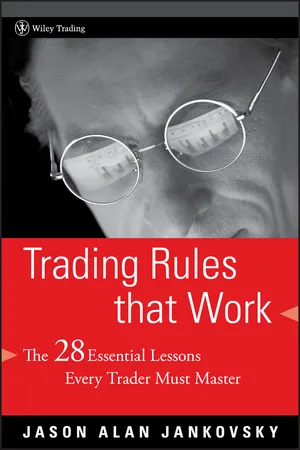
Trading Rules that Work
The 28 Essential Lessons Every Trader Must Master
- English
- ePUB (mobile friendly)
- Available on iOS & Android
eBook - ePub
About this book
Trading Rules that Work introduces you to twenty-eight essential rules that can be shaped to fit any trading approach—whether you're dealing in stocks, commodities, or currencies. Engaging and informative, Trading Rules that Work outlines the deeper psychology behind each of these accepted trading rules and provides you with a better understanding of how to make those rules work for you.
PART I
Getting in the Game
RULE #1
Know Your Game
The longest journey begins with the first step.
—Lao Tzu, in the Tao te Ching
A key to making the rules work is an understanding of the psychology behind the rules, knowing where they work best, and knowing if that is congruent with our personal trading style. The psychology behind the rule is what it is, in part, because the psychology of the market itself is what it is. I don’t think we can make our rules work at their best without a solid understanding of this underlying market psychology.
Critical to that assessment is understanding our own personal psychology. No matter where you personally are on the scale of trader evolution or your application of your developing skills, you will eventually discover that your own personal psychology is by far the single most important variable to your lasting success as a trader. Indeed, only a trader who accepts this point of view about his own psychology will be able to successfully make his trading rules work—because the rules are self-created, self-enforced, and self-defeating. Without a solid grasp of both market psychology and personal psychology, your results will most likely be net losses, even if you have a winning systematic approach and good rules.
Regardless of your current level of sophistication or trading background, there is one indisputable fact about the underlying structure of trading markets that you need to thoroughly understand before you place yourself at risk. Futures, options on futures, and cash foreign exchange (FOREX), the markets most readers will be trading are all zero-sum markets . The price action and cash management take place in an environment where no money is ever made or lost; gains or losses accrue as a cash debit or credit between accounts on deposit after trades are cleared. In other words, a winning trade is paid its cash credit from the exact opposite losing trade. The clearing corporation of the exchange simply assigns a cash credit to the account with the winning trade and assigns a cash debit to the account with the losing trade.
In the final analysis, it is the losers who pay the winners. You cannot accrue a cash credit increase in your trading account unless some other trader (or group of traders) somewhere, trading through the same exchange with you in the same market, has lost the exact same amount. In order for you to make $10,000 from your trading, someone else (or a group of someone elses) had to lose $10,000. You can’t participate in zero-sum trading without accepting that risk.
It is the very nature of zero-sum transaction trading that makes using and applying trade rules so critical to lasting success. If you personally don’t know enough about what you are doing, or the risk you are really taking, you will be the loser who pays some other winning trader. The market does not function any other way.
Let’s take a look at the psychology behind price action. I believe this is much deeper than the simple fact that for every winning trade there is a loser. Zero-sum trading presents some fascinating insights into crowd behavior and what is really needed or required to exploit price action profitably. Let’s start with the basics:
Buyer→ $2.33 ←Seller
You enter a buy order to open a position in corn at $2.33/BU. In order for you to receive a fill on your buy order, it must be matched against a sell order at that price. For the sake of illustration, let’s assume there is also a sell order to open a position. Therefore, two separate traders have put themselves at risk, and a new long position and a new short position are now active. What happens next?
Another set of orders comes in, and those are matched, but if at that moment there is an imbalance in the order flow, the market is requoted to reflect the imbalance. In other words, if there are more buy orders left over after the sell orders are matched, the market ticks higher and is matched with sell orders at higher prices, if they are there. The remaining buy orders are then matched at that new higher price. If there are more buy orders left over again, another tick higher results.
Of course, this illustration is conceptual. As most traders know, those buy and sell orders are constantly coming in and are combinations of stop orders, limit orders, and market orders from both sides; the mix is always changing. What we are concerned with is the pressure on the price as the net order flow is processed from one moment to the next. If the order imbalance remains on the buy side, the market will continue to tick higher until the imbalance is corrected and the buy/sell orders are about evenly matched again. If, at that point, the sell orders overwhelm the buy orders, the market will begin to tick lower and will continue to do so until the buy and sell orders again become about evenly balanced with the sell orders. The ebb and flow of price action comes from these order imbalances, and what we call an uptrend or downtrend is in reality a net imbalance lasting for some period of time.
So let’s assume after a period of time, the net order imbalance for that period of time has resulted in a new price for corn at that point:
→ $2.38/BU ←
Your open-trade long now has a profit of $0.05 per bushel. The open short from your executed order (the other trader speculating) has an open-trade loss of exactly the same $0.05 per bushel. If, at that exact moment, both of you choose to liquidate your positions, and your orders offset each other at that point, your account will be credited and his account will be debited the exact same dollar amount (less any fees, of course).
This is all easily understandable, but there is a completely other world at work in that process. That other world is the psychology of the traders involved and how that creates their urge to action resulting in them placing the orders in the first place.
What is not immediately apparent in price action is perception—how that net credit or debit is affecting the account holder, what that account holder is thinking, and what he must do next. What is certain is that at some point, both traders must liquidate; no one can stay in the market forever. When the losing position is liquidated at some point, the losing trader must do an equal but opposite trade against himself. In other words, if I have bought the market, and prices are moving lower, I must sell to liquidate my loss, adding power to the dominant force in control of the market at that point. My mental and emotional state is in direct conflict with my desire for a profit, and my only choice really is to liquidate now or risk a bigger loss. If I “wait it out” I am trying to anticipate the market will reverse and eventually show a profit on the trade for me (thereby making a loser out of the original short who initially had the open-trade profit).
But all of this thinking or emotion is going on inside my mind and has nothing to do with what is driving the market. In order for prices to advance or decline, there must be more orders on that side of the market. Prices can advance only if there are more buy orders than sell orders at that moment. Prices can decline only if there are more sell orders than buy orders at that moment. How that order flow personally affects my account balance or my emotional state does not concern the net orderprocessing function of the market. In any attempt to profit from any perceived opportunity in a zero-sum transaction market, you simply must be on the right side of the eventual net order flow from that moment forward until you liquidate. If you are on the wrong side of the net order flow, you will have an open trade loss until you liquidate.
None of what happens inside the mind of the trader during that time can affect the market in any way; it can only affect the net balance controlled in some way by the trader in some way. This is why you must have rules and know how to follow them. You cannot know for certain until later, after you enter your position, whether you are on the right side of the net order flow.
The important thing to remember is that there is an emotional pressure at work in most traders that will influence their perception of price action. They all entered their trades expecting to win, but in most cases they will have to consider liquidating at a loss. All of the emotional or psychological stress involved in trading boils down to “When do I get out?” Because the owner of the winning position has a lead on the market, he is under less of this stress than the loser. In most cases, when the pain of holding the losing hand gets too big for the losing trader, he will liquidate in the same direction as the winning position. A simple example is a market slowly advancing higher as more buy orders overwhelm the sell orders, until the market hits the liquidating buy stops above the market placed by the sellers who are holding a losing position. The market now advances further on that buying pressure.
None of the above-described background to price action has anything to do with market study, risk control, trading systems, or technical analysis. It has to do only with the fact that if you are going to be in the market, you run the risk that you will be on the wrong side of the order flow. What does that do to the trader’s emotions? What will he do? What will you do?
Because you cannot profit consistently in a zero-sum market unless you are on the correct side of the order flow, your entire analysis and trade plan must take into consideration some way to identify where the order flow is and what to do if you are on the wrong side of it. The issue of cutting losses is essentially to have some method of negating any emotional conflict created by a losing trade, in such a way that you will not hesitate to get out of the way of the actual order flow if you are on the wrong side of it. Part of how you participate on your trade, regardless of your unique approach to finding a trade opportunity, must always answer the question: “Where is the order flow?”
Most of the studies done on net trader performance come to the inescapable conclusion that around 90% of traders will close their accounts at a net loss. None of those traders expected to lose, and yet they did. Part of their losses came from the emotional conflict created in their minds when the market moved against them, creating pressure on their execution. Every trader has had the frustration of finally throwing in the towel and liquidating his position, only to see the market reverse shortly thereafter and prices move favorably, if only he had stayed in. All that really happened is that the order flow dried up in one direction and then turned the other way. For that particular trader it resulted in a net loss to his account. That particular trader will now be tempted to “just ride it out” on the next trade until prices eventually return. Of course, the one time this doesn’t happen will result in a total loss in the account. It only takes one “just ride it out” to ruin that particular trader.
To avoid being that trader, and to master the game of successful speculation, you must know what you are really capitalizing on when you identify a trade opportunity. You must accept and trade from the point of view: “Where is the order flow?” and you must have a method of getting out of the way when you are not on the right side of the order flow. All the analysis or study you could ever do must answer these two central questions.
One assumption you can make to know your game is that most traders do not know the game they are playing. About 80 to 90% of price action is simply the losers liquidating their losing trades. When you begin each day, and before you place a trade, ask yourself this question: “Where is the loser?”
In the final analysis, the game you are playing is “Beat the Loser.” The great trader J. P. Morgan said it best: “Anyone who is unaware of the fool in the market probably is the fool.”
RULE #2
Have a Trading Plan
If you fail to plan, you plan to fail.
—Old wisdom
I have had the privilege of seeing almost everything there is to see in the business of trading. I have met some very well-known traders, big names in business or finance; I’ve been on several trading floors, visited the trading pits numerous times, worked side-by-side with some tremendously successful market participants, and seen all the catastrophes, mayhem, blowouts, and financial blunders capable of novice traders. I have asked all the right questions and all the wrong questions. In my experience, I have to say that there was very little critical difference between the net winning traders and the net losing traders in most areas. All of them had good understanding of basic market fundamentals, used a solid technical analysis or research of some kind, and exercised a lot of personal discipline.
The one thing that stood out, the one thing that separated the net winner from the net loser, all things being equal, was that the net winner had a trading plan in addition to his other skills. The net winner knew he was up against not just the market and his competitors, but he was up against himself, too. To guard against the possibility that he (the trader) could blow himself out of the water at any time if he wasn’t careful, that trader had a plan.
A trading plan is different from a trading system. A trading system is designed to find an inequality in the market and offer a better buy or sell entry than at some other time. A trading plan takes into account what happens after that. Once we have identified what we think is an opportunity, it is how we participate from that point forward that makes all the difference. A trading plan will address and complement a systemized approach much better if it is seen as an equally important part of a strong market presence.
A trading plan addresses the parts of trading that are most fully in your control. For example, when and where you do your market study or analysis; when and where you place or move a stop-loss order; when you take a trading break—basically anything that involves you taking action or not taking action, independent of the actual market itself, is spelled out in a trading plan.
A trading system is only designed to exploit perceived inequalities in the market, but it can never be 100% accurate or find exactly where every potential “top” or “bottom” is in the time frame you are working with. If a system could do that, no other discussion of rules would be needed. Once you have executed and placed yourself at risk, you have moved into the area of your system’s probabilities and limitations. You as an individual cannot extend control over price action; you can only control how you use price action or how you participate in price action. Once the trade is taken, the “die is cast” so to speak. Whether you win or lose at that point is completely out of your control.
Because your system is not capable of finding each and every turn there is to profit from in real time, a trading plan is needed to prevent you as a trader from getting reckless or from placing yourself in lower-probability trades, and what to do when the unexpected happens. A trading plan needs to address your particular trading strengths and weaknesses; it in no way diminishes the need for a systemized methodology, nor is it designed to replace one.
Your trading plan can be followed 100% of the time because it is an expression of the sum total of what your rules are designed to create; it controls your behavior, which is a function of discipline and willingness to follow those rules. Your trading system may never be more than around 55% predictive in finding winning trades, but you can follow your trading plan’s rules 100% of the time. When your trading system is wrong, your trading plan will help you minimize the loss. When your trading system is right, your trading plan will help you maximize the gains.
A qualified trading plan is both concise and flexible. It adapts to market conditions as needed and is concerned with protecting the trader. You can think of a trading system as strategic and a trading plan as tactical. To use a military illustration, “winning the war” is the goal, strategy involves finding the enemy’s weakness, and tactics are how you e...
Table of contents
- Title Page
- Copyright Page
- Epigraph
- Acknowledgments
- Introduction
- PART I - Getting in the Game
- PART II - Cutting Losses
- PART III - Letting Profits Run
- PART IV - Trader Maxims
- Conclusion
- Recommended Reading
- About the Author
- Index
Trusted by 375,005 students
Access to over 1.5 million titles for a fair monthly price.
Study more efficiently using our study tools.
Frequently asked questions
Yes, you can cancel anytime from the Subscription tab in your account settings on the Perlego website. Your subscription will stay active until the end of your current billing period. Learn how to cancel your subscription
No, books cannot be downloaded as external files, such as PDFs, for use outside of Perlego. However, you can download books within the Perlego app for offline reading on mobile or tablet. Learn how to download books offline
Perlego offers two plans: Essential and Complete
- Essential is ideal for learners and professionals who enjoy exploring a wide range of subjects. Access the Essential Library with 800,000+ trusted titles and best-sellers across business, personal growth, and the humanities. Includes unlimited reading time and Standard Read Aloud voice.
- Complete: Perfect for advanced learners and researchers needing full, unrestricted access. Unlock 1.5M+ books across hundreds of subjects, including academic and specialized titles. The Complete Plan also includes advanced features like Premium Read Aloud and Research Assistant.
We are an online textbook subscription service, where you can get access to an entire online library for less than the price of a single book per month. With over 1.5 million books across 990+ topics, we’ve got you covered! Learn about our mission
Look out for the read-aloud symbol on your next book to see if you can listen to it. The read-aloud tool reads text aloud for you, highlighting the text as it is being read. You can pause it, speed it up and slow it down. Learn more about Read Aloud
Yes! You can use the Perlego app on both iOS and Android devices to read anytime, anywhere — even offline. Perfect for commutes or when you’re on the go.
Please note we cannot support devices running on iOS 13 and Android 7 or earlier. Learn more about using the app
Please note we cannot support devices running on iOS 13 and Android 7 or earlier. Learn more about using the app
Yes, you can access Trading Rules that Work by Jason Alan Jankovsky in PDF and/or ePUB format, as well as other popular books in Business & Finance. We have over 1.5 million books available in our catalogue for you to explore.