eBook - ePub
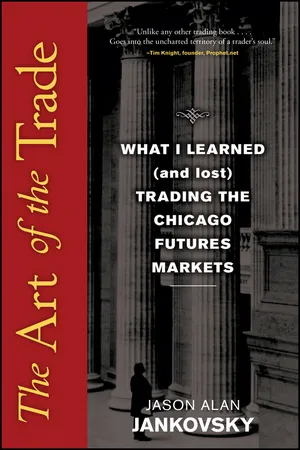
The Art of the Trade
What I Learned (and Lost) Trading the Chicago Futures Markets
- English
- ePUB (mobile friendly)
- Available on iOS & Android
eBook - ePub
The Art of the Trade
What I Learned (and Lost) Trading the Chicago Futures Markets
About this book
The Art of the Trade is a searing portrait of the futures and options industry as seen through the eyes of someone who has participated in this arena for more than twenty years. On one level, it's a brutally honest, no-punches-pulled look at the individuals and institutions that comprise this unique community. On another level, The Art of the Trade is a personal story of the challenges author Alan Jankovsky faced as he battled the markets, the brokerage industry, and his own early penchant for self-destruction.
Chapter 1
The Early Years
Illusion in the midst of Reality
—LONDON CLOCK TOWER MOTTO
When I decided to become a commodity broker, I had no idea what I was eventually getting into. It began in the spring of 1987. I answered an ad in the Chicago Tribune and interviewed with the sales manager1 of a commodity-trading firm. I was very impressed.They had a beautiful office in Oak Brook, Illinois, a very affluent Chicago suburb. Everyone there wore expensive suits, the parking lot was full of German and Italian cars, the whole scene reeked of high finance.
After some discussion of my background and what I thought I could do in the brokerage business, I was hired. The interview was brief. They didn’t ask me for a résumé. They just wanted bodies. I was given a big book to study so I could pass my Series III commodities broker’s test. I was given a start date with the rest of the new hires. I really believed I had scored the job of my life. I was 26 and thought that in no time I would be earning $100K a year, driving a Ferrari, and flying the Concord to spend the weekends in Paris.
It was largely from my initial experience with this brokerage house that I chose to keep trading as a career no matter how it turned out. That first commitment had a lot to due with how my success was measured over the years. If I hadn’t made up my mind that come hell or high water I was going to be a commodity broker, who knows where I would have ended up? Over time, the pressures of the trading world gave me every opportunity to quit and do something else. In fact, my family tried everything to convince me that I was out of my mind for sticking with it during the rough years. No one saw what I saw except for my mother. Moms are like this, aren’t they? One immutable thing was her absolute support of what I wanted to do. Suffice it to say, at that time when I first started, the lure of money was so strong that you could have promised me a ride on the Space Shuttle to quit and I would have turned you down. I wanted it that bad.
To put this in perspective, as an Air Force ROTC student with a good academic history, I earned an Air Force Academy appointment with a good shot at the space program (according to my recruiter). As a side note, there is a commercial space tourism company selling rides right now aboard a privately built spacecraft just for people who want that thrill.2 I was surprised to learn after missing what seemed to me a once-in-a-lifetime shot at the time (I turned the Air Force down), I was able to do it anyway. The concept of “regrets” and “missed opportunity” figures high in this story. Sometimes life gives you a second chance at something.The markets will always give you another chance.
I was totally unprepared for what would become the “normal” process of working in this industry. My first day on the job at a Midwest brokerage office went something like this:
I walk in. The “sales manager” brings me to an empty desk, points to the phone and says, “Here is a phone.” He drops a stack of papers on my desk and says, “Here are some sales leads. Your job is to convince people to send money for trading. Once you have opened a few accounts, we’ll show you what to do with the money.” He then said, “Good luck,” and walked away without saying another word.
Okay, no problem. I was so excited about what I was doing I really thought everyone I called would talk to me. I didn’t see it as telemarketing. I believed that everyone wanted to make big money. I thought everyone would see the wisdom and “common sense” of the particular market opportunity that we were selling. I just watched the “seasoned professionals” sell and did what they did. What made this whole experience intoxicating was that what we were selling actually happened.
We were suggesting that the public buy silver. At the time I started on the phone in 1987, silver was selling for about $5.10 an ounce. The company I worked for was marketing call options. I had scored 100 percent on the part of the Series III that covered option hedging and speculating. I had basically succeeded at everything I had done before; why should this be any different? There was no way you could convince me that I had anything to learn. Besides, the company was making the recommendations; they were telling me what to do. I figured between me and them, “we” knew exactly what “we” were doing. Needless to say, as long as silver kept moving higher, the money rolled in. I ate the phone. I was the top “rookie” in the office. Silver soared to almost $12 an ounce in less than 120 days. I thought it was always that way in this business. I was making more money in a month than some people I knew made in a whole year. I felt like I had arrived in a big way.
Then I got fired.
The company stole my clients (of course). In this business there is a curious concept that companies “own” clients. How can you “own” a client? Aren’t you supposed to be working for him or her? Doesn’t a client have the right to do business with anyone he or she chooses? I was told that if I contacted any of my clients I would be sued. They refused to pay me my remaining commissions—something about being covered in case of potential lawsuits. They never told me when to expect payment if there weren’t any lawsuits. Maybe they just expected them. As you will see, this happens every day. They basically didn’t like me, I guess. As I found out later, the egos of people in this business are beyond belief. Never will you meet people, as a group, with absolutely no justification for what they think they are. Still, I never found out what happened or why I was let go. I certainly wasn’t sleeping with the boss’s wife. (Or his girlfriend for that matter. That’s another thing that happens every day around there.) All I knew was that I no longer had a job and I really wanted to be in this business.
Believe it or not, it never occurred to me that maybe every other commodity company could be this poorly run as well. As any Series III broker can tell you, every retail commodity house is run like an accident waiting to happen.You would be absolutely amazed at the sheer chaos and complete lack of even the most basic business sense. The people working in the markets every day, as a group, I don’t think could run a newsstand without help.
Here’s just one story: At the time of this writing a personal friend of mine just left one brokerage house to go to another. The reason? The owner’s cousin, fresh out of rehab, wanted to get in the business. My friend simply told the owner, “It might not be a good idea to have a recovering heroin addict trading someone’s money and exposing the company to risk.” The owner called him a “Jew bastard” and fired him on the spot. My friend had been there for years and was a top producer. In a split second, my friend’s whole life was turned upside down and his income dropped to zero because some psycho-egomaniac thought a convicted felon with a drug problem would be a good addition to the staff and completely capable of servicing clients. If the boss was that stupid, how well could he manage clients in the first place? How long would a guy like that last as a manager at Microsoft? How long would that guy last in any business? The Equal Opportunity people would have a field day with a racial slur like that. In the case of my friend it really was easier and more cost effective to just find another brokerage house, forget the whole thing, and move on. Not to mention that the “sales manager” at the offending brokerage house told all of my friend’s clients that he was drinking on the job anyway and “we’ll take care of you.” It was an outright lie. But, of course, they “own the client.”
This happens every day in this business. Retail brokerage houses are run without any common sense at all. They come and go faster than GI’s at a nickel whorehouse. The sad thing is that people don’t care since there is so much money in it they can afford to be that reckless. It’s like this: If a thief kills another thief and you are a witness and a thief yourself, what do you do? Tell the cops? Forget it. You’re in a whole other world.The constant lack of integrity really got to me over the years, as you will see. I really believed that people in “high finance” were supposed to be a personally responsible lot. Boy was I wrong.
So I went to work for a new firm, which at the time was a real trading house, but of course it wasn’t what I thought a trading house should be like. My idea of a “professional house” was nothing like this place. They had a tiny office, with steel desks, quote systems everywhere, and they let you do whatever you wanted to do. There was no organized market research, selling effort, nothing. You came and left when you wanted. No sales hype or $2,000 suits. Just a bunch of whackos taking $500 a day out of the markets trading one-lots.3 No one talked about the markets. They didn’t need to. Some of the guys, who were real traders, only had one or two clients and had had them for years. What was wrong with these people? Didn’t they know what kind of money was out there? Looking back, I would give my right arm to be working at a place like that today, but at the time I was so disgusted with that environment, which I perceived as apathetic to real opportunity, that I started looking for a new house. I should mention that that owner was one of the most respected men in the business at that time and had a reputation for fair and equitable treatment of his staff, customers, and support people. But back then, I didn’t know how rare honest and equitable business practices were. I really thought I could find the best of both worlds. I found a new brokerage house about April. My timing to reinforce this misconception was perfect.
Right about then the drought of 1988 hit. My new firm was selling call options on corn and soybeans. Corn went to almost $6/bushel. Everyone was talking “Beans in the teens!” My book of customer equity went to almost a million dollars. A book of equity is the slang term used for the customer list a broker has that includes the current cash balance of each customer. A book can be any size number of customers or account deposits. This is also called money under management or an equity run.
So after my book of equity went to almost a million dollars, I took a few days off. I was in bed flipping through the TV channels when I saw a financial broadcast telling the world that Chicago soybeans had traded to a near-record high of $10.97 that day before closing lower. I think it was around $9.50/bushel. Of course, that was the top. As I had no idea what I was really doing, I was only mildly concerned that the market was below the previous day’s close. I didn’t know what “volume” and “open interest” were, or “reversals.” Nothing. I absolutely believed that commodity trading was huge moves, high profits, lots of sales hype, all that Gordon Gecko stuff.4
I kept selling clients and buying calls until September of that year. Not an easy thing to do when the market is lower every week. As the market kept moving lower, I started asking the boss what was happening. When would the market turn up again? He told me to keep selling. “But it looks like it’s over. What about the clients who are going to lose?” I asked. “They don’t know that. You don’t know that. You want to get paid don’t you?” was his answer. At that time, I just agreed because these guys knew what they were doing, right? One of the bozos working there drove a red Porsche 928. He also brought in a 500-gallon saltwater aquarium into the office. He wore big rings. He didn’t talk much, but he was definitely into the “look at me” type of thinking. He really thought he was the thing. I remember him being called into “the boss’s” office to discuss his lawsuits. No Porsche, no rings, the fish tank sold at auction along with the rest of the company’s stuff.You guessed it; the company went out of business.
There was a huge National Futures Association (NFA) investigation. The NFA is the self-regulatory body authorized to sanction people to work in the industry, mediate arbitrations, and generally harass or intimidate those responsible for providing access to the markets. By the way, the first firm I had worked for was also shut down by the NFA. I had no idea how any of this would later come back to haunt me. Simply put, because I had worked at these two companies, I was on the “watch list” at the NFA (yes—they have a watch list; ask them about the “tainted broker” program if you want to see the constitution completely ignored). It never occurred to me that guilt by association was a real thing that would make it harder to work in the business. My thought was that since I hadn’t done anything wrong, even if there was a problem, I would be cleared. I had this problem more than once. So did many others, honest and crooked alike. The funny thing was, most of the guys who worked at these companies moved on to other firms like rats from a sinking ship.And all the other houses wanted the “big broker” type to work there.They offered these brokers huge deals to play the same show in a different town. Did it ever occur to any of them that if this technique generated lots of lawsuits, it might not be a good idea to hire these brokers? Maybe they all just wanted the money so bad they didn’t care. I found out later why that didn’t matter, but I made the same mistake. I was on the sinking ship too.
So now I was broke, having spent my huge income like a drunken sailor. After all, just get on the phone and wait for the next big haul, right? I went through a succession of companies and repeated this entire scenario over and over again for the next several years. I even “started” a company with a partner. That’s a story in itself; I’ll cover that later. During this time I met some “professional” traders. Because I was beginning to consider that this boom-and-bust cycle might be avoidable, I actually listened to a wheat pit trader explain the concept of overbought to me. I picked up a book or two on market analysis. “Maybe there is something to this,” I said to myself. Over the years I kept buying books, attending seminars, listening to tapes, and subscribing to newsletters. I spent thousands and thousands of dollars doing this. I routinely listened to what pit traders thought and what they read. It never occurred to me that pit traders might be some of the least educated people in the business. This whole process of “analyzing and studying” the markets was another roadblock. I think you will be surprised at how little that whole process can help a trader.
This period became a huge emotional struggle for me. I couldn’t accept that I wanted to do things “right” and yet no one else wanted to. Believe it or not, I never lied to any client about anything. I never misled them or promised they would make money. I sold clean and really wanted them to win. I genuinely liked my clients. I returned phone calls promptly and never asked for more than a reasonable amount of money for my services. I always did what I believed a true professional should do when he has a fiduciary responsibility—and still do to this day. However, the fact was, I was grossly misinformed about the true nature of the markets and the industry. I honestly thought the solution to this problem was more market study and finding the right brokerage house. Although that wheat pit trader and the others all meant well, I actually lost years “studying the markets.” I found that there is no “right” brokerage house and that no book can ever tell you about how to become a trader. You have to live it to understand. Let me finish setting the stage for where and how I finally became the winner.
Someone once told me that all progress in the world depends on the unreasonable man. The reasonable man persists in adapting himself to the world; the unreasonable man persists in adapting the world to himself. Therefore, all progress depends on the unreasonable man. At this point, my career in the commodities markets had been less than spectacular. I had worked at many companies and all of them had gone out of business. All the money (literally millions of dollars) I had raised was also gone. I had spent all my income and was once again without a place to work or a client base of any kind.What was wrong with this picture? Was it me? Was it the industry? I wanted to be reasonable about it, but what was the true answer? I was spending a lot of time dealing with this same problem. I was working for people who couldn’t get a job cleaning toilets in the “real” world, but were operating companies that made tons of money (on commissions—never in market profits). I was attempting to learn the markets to reduce the loss factor but still losing all the time. I got really angry with myself, the markets, and the companies—everyone and everything. What was wrong? Why wasn’t this working? Why wasn’t I a success at this like everything else?
The year was now 1993. I won’t talk about the catastrophe that I created for myself during the first Persian Gulf War except to say this: When it was all over it took from 1991 until 1996 to pay all the debits, unpaid taxes, unpaid debts, and recover from the emotional trauma that an unregenerate mind is capable of inflicting on its owner. But during these previous years, all the raw material for ultimate success were given to me. At the time I saw it as complete and unmitigated adversity. Even filing bankruptcy, and all the embarrassment that goes with it, was a huge stepping-stone to prosperity. When the Department of Justice subpoenaed me while I was working for a company that was doing a Ponzi scam through the legitimate markets; even that was important. By the way, I was never charged due to my phone records showing I wasn’t involved in any way. But at the time, my point of view was: “What is going on? What is wrong? I’m trying to do this right . . .” and so on.The years of frustration, bitterness, and disappointment were beginning to boil over.
Let me draw all this together for you. I’m in my early 30s. I’ve made and lost a million dollars twice. I’m broke, almost homeless, without any income, behind in my bills, and no longer have any credit. I’m too confused to work at my best, angry at life. Feeling like I’ve hurt people. Feeling like I’ve let people down. Embarrassed in front of my family and friends; earning an undeserved bad reputation. To make matters worse, watching everyone I know get on with their lives; getting rich, being in love. The women in my life lost interest in me. And let’s not forget drinking too much; even a brief fling with co...
Table of contents
- Title Page
- Copyright Page
- Epigraph
- Read Me First
- Foreword
- Introduction
- Chapter 1 - The Early Years
- Chapter 2 - The Day I Bought the Low
- Chapter 3 - Technical Analysis
- Chapter 4 - Adversity
- Chapter 5 - The Meaning of Life
- Chapter 6 - The Trading Police
- Chapter 7 - The Last Word
- Chapter 8 - In Conclusion
- Appendix A - For Traders Only
- Appendix B - Insight into the Person of Trader X
- More from the Author
- Postscript
- Notes
- Index
Trusted by 375,005 students
Access to over 1.5 million titles for a fair monthly price.
Study more efficiently using our study tools.
Frequently asked questions
Yes, you can cancel anytime from the Subscription tab in your account settings on the Perlego website. Your subscription will stay active until the end of your current billing period. Learn how to cancel your subscription
No, books cannot be downloaded as external files, such as PDFs, for use outside of Perlego. However, you can download books within the Perlego app for offline reading on mobile or tablet. Learn how to download books offline
Perlego offers two plans: Essential and Complete
- Essential is ideal for learners and professionals who enjoy exploring a wide range of subjects. Access the Essential Library with 800,000+ trusted titles and best-sellers across business, personal growth, and the humanities. Includes unlimited reading time and Standard Read Aloud voice.
- Complete: Perfect for advanced learners and researchers needing full, unrestricted access. Unlock 1.5M+ books across hundreds of subjects, including academic and specialized titles. The Complete Plan also includes advanced features like Premium Read Aloud and Research Assistant.
We are an online textbook subscription service, where you can get access to an entire online library for less than the price of a single book per month. With over 1.5 million books across 990+ topics, we’ve got you covered! Learn about our mission
Look out for the read-aloud symbol on your next book to see if you can listen to it. The read-aloud tool reads text aloud for you, highlighting the text as it is being read. You can pause it, speed it up and slow it down. Learn more about Read Aloud
Yes! You can use the Perlego app on both iOS and Android devices to read anytime, anywhere — even offline. Perfect for commutes or when you’re on the go.
Please note we cannot support devices running on iOS 13 and Android 7 or earlier. Learn more about using the app
Please note we cannot support devices running on iOS 13 and Android 7 or earlier. Learn more about using the app
Yes, you can access The Art of the Trade by Jason Alan Jankovsky in PDF and/or ePUB format, as well as other popular books in Business & Finance. We have over 1.5 million books available in our catalogue for you to explore.