eBook - ePub
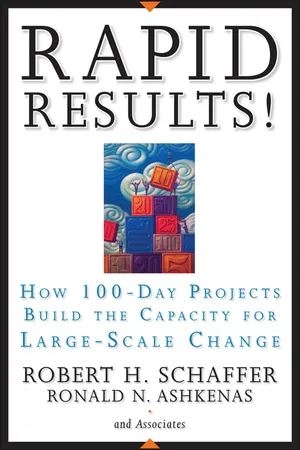
Rapid Results!
How 100-Day Projects Build the Capacity for Large-Scale Change
- English
- ePUB (mobile friendly)
- Available on iOS & Android
eBook - ePub
Rapid Results!
How 100-Day Projects Build the Capacity for Large-Scale Change
About this book
Rapid Results! shows how to make large-scale changes succeed by using 100-day results-producing projects to develop this vital implementation capability. Written by Robert H. Schaffer, Ronald N. Ashkenas, and their associates--leaders in the field of change management--Rapid Results! describes an approach that has been field-tested by real organizations of every size and description to improve performance and speed the pace of change. Rapid results projects produce results quickly, introduce new work patterns, and enable participants to learn a variety of lessons about managing change. Step by step, the book describes how the use of rapid-cycle, or 100-day, projects will multiply your organization's power to succeed at large-scale change. Schaffer and Ashkenas specifically outline the concept behind 100-day projects and show you how to Set up the architecture to implement rapid results projects Improve operational performance and also attain hard results in the soft areas of management Build rapid results into major organizational change such as reorganization, acquisition integration, and international development Use rapid results to drive leadership development and culture change
Information
Part One
IMPLEMENTATION CAPABILITY
Strengthening the Weakest Link
Part One sheds a spotlight on the importance of implementation capacity—the ability to make the hundreds or thousands of changes at the grassroots level that must occur for large-scale change to succeed. It describes the power of projects that achieve rapid results and that simultaneously build the capacity of the organization to achieve even more results.
It describes why these projects not only energize and stimulate people at every level but also develop the organization’s fundamental implementation capacity.
1
A THOUSAND CURES
Which One Is Right?
Like a broken record, business authors, journalists, government leaders, and economists continue to warn that the pace of change is accelerating, and that managers need to move faster, get ahead of the curve, be more proactive, reduce cycle times, speed up production. Speed is everything. Speed is winning. Speed is surviving.
The messages are unrelenting, but they are off-target: the leaders of our corporations and other institutions don’t need this advice. They are acutely aware of the forces reshaping the environment in which they operate. They see what has been happening to the U.S. automobile industry in the forty years since it began responding to the competition from fuel-efficient, high-quality cars from Japan—and then from Europe. They saw what happened to IBM when the personal computer changed the information management model. They see globalization sweeping hundreds of thousands of jobs from one country to another. They see technology rapidly obsolescing the mainstays of traditional economies, like telephony. They see digital imaging driving companies like Kodak and Polaroid into lifeand-death struggles. They watch awestruck as Wal-Mart moves across the landscape leveling virtually everything in its way.
No, those who are leading major organizations today don’t need to be told to wake up to the issue of change. They want to know what they can do about accelerating change. How can they respond to these challenges in ways that will ensure success?
The good news for managers who want more insight into how they can master major change is that tons of advice on that subject have been published in the past twenty years. But the bad news is that consulting the most popular parts of that literature will yield not an answer but a thousand answers. Moreover, the answers generally consist of fragmented elements of change ideas rather than comprehensive, tested change strategies.
Worse, most of the formulas consist of large-scale, go-for-broke change efforts. These titanic programs, mainly consultant-inspired and installed at astronomical fees, carry a high risk of disappointment.
Rapid Results is different. It presents a comprehensive change strategy, but it begins in ways that pay their way almost at once, that require no major investment, and that are very low risk. This chapter introduces the concept and shows how it can serve as the fundamental building block of large-scale change.
Overlooked Opportunity
In our years of work with hundreds of organizations all over the world, we have encountered virtually none where it was not possible to generate fresh, reinforcing, improved results within a very short time—several months at most. And by results we mean real, tangible, bottom-line results: increased sales. Reduced turnaround time. Increased inventory turns. New products marketed more rapidly. Welfare services provided more effectively.
This has been true of large, well-known corporations like General Electric, Avery Dennison, Georgia-Pacific, Siemens AG, GlaxoSmithKline, Citigroup, Motorola, and Zurich Financial Services, as we detail later in the book. It has been true of many smaller companies. It has been true of hospitals and schools. It has been true of city and state governments. It has been true of agricultural and health organizations and government agencies in developing countries.
Not only is it fairly straightforward to generate results quickly, such projects can serve as the foundation and backbone of large-scale, sustained change and improvement. In fact, because of their capacity not only to yield immediate payback but also to lay the foundation for large-scale change, we have found that such rapid results projects are the best way to launch any major change or improvement effort. What is most surprising about this phenomenon is how few managers or consultants use this powerful approach and how few organization researchers have opened their eyes to the possibilities.
The Blurred Road Map
Consider the challenges faced by a senior manager whose company has been losing market share but who has no certain way to turn the situation around. Or one whose company needs to carry out a number of simultaneous large-scale changes in product lines, information systems, and market strategy but is not confident that the plan for making it happen is really soundly based. Or a CEO who, to keep the company in the race, must transform it into a high-performance, rapid change organization. Or the agriculture minister of a Latin American country whose farms must lower costs and raise productivity if they are to compete.
If senior managers like these want to learn how best to organize a comprehensive attack to deal with such challenges, they will have trouble finding the answers in the published literature on change. One reason is that there are so many articles and books. Moreover, while many of them provide interesting perspectives and insights, they don’t provide comprehensive strategies that can serve as strong guides to action. This is true even though many of the writers are top-level thinkers and doers, and many of the experiences about which they write have been bold and highly successful.
The 1982 book In Search of Excellence is the wellspring for much of the improvement literature.1 In it, Tom Peters and Robert Waterman summarized a number of factors that they identified as the keys to success for forty-three companies they regarded as excellent. The authors provided this list of success factors, but they did not convey a workable strategy for becoming excellent.
In the quarter-century since Excellence, well over fifteen hundred other business books have been published about making change—five times the number that had been published in the same period before Excellence. Virtually all the ones we have seen follow the essential pattern set by Excellence, with its strengths but also with its three fundamental limitations:
Backward-looking analysis. All the books describe backwards analyses that offer the authors’ ex post facto explanations of why certain organizations succeeded. For example, in 2001 James Collins and his team examined eleven companies that had made a leap from being “good” companies to being “great” companies. In Good to Great, he and his team name the factors that, after the fact, were found to be statistically more prevalent in the successful companies.2
A large number of the success stories focus on a single company. Jack Welch’s Straight from the Gut, about General Electric, and Larry Bossidy’s Execution, about AlliedSignal (and then about Honeywell, which absorbed it), and Andrew Grove’s Only the Paranoid Survive, about Intel, all exemplify this genre, as, in fact, does Albert (“Chainsaw Al”) Dunlap’s Mean Business. In all these cases the explanations of what contributed to success were constructed after the fact.3
Fragmented theories. Most of the key advice that authors provide consists of fragments rather than of coherent strategies. Each author lists three, five, or eight keys to success rather than outlining an overall implementation strategy. There’s Peters and Waterman’s “seven S’s” and Collins and Porras’s “big, hairy audacious goals” and Jack Welch’s “speed, simplicity, and self-confidence” and Rosabeth Moss Kanter’s “enabling the change masters” and Kotter and Cohen’s helping key players “see and feel” the need for change and Mitchell, Coles, and Metz’s “focus on unblocking stalled thinking,” and so on. By the time you’ve read ten books, never mind fifteen hundred, you are drowning in the “keys to success.”
Untested prescriptions. Perhaps most serious, the authors never take the prescriptions they have formulated on the basis of their backwards looks and test them in new environments to see if they really work. All scientific and medical theory similarly begins with hunches and guesses. But no one publishes about scientific or medical theories until they have been tested experimentally. In contrast, the writers on organization change take their thousands of hunches and hypotheses—derived from their ruminations on the past—and offer them as certified “answers.”
Moreover, most of the studies studiously ignore the other published work on the same subject. Each presents itself as a pioneering effort into a fresh subject.
One of the few scholars actually to have hypothesized a comprehensive model rather than mere fragments is John Kotter.4 He has developed a thoughtful and well-elaborated eight-step process for executing change. But, alas, he fails to present the experience of any single organization that has actually employed the process and succeeded.
All of this is not to deny the benefits of reading the literature on change. Many of the ideas and insights are provocative and interesting. And many books and articles share insights on aspects of change without purporting to provide answers. For example, in the late 1980s Michael Beer headed a team at the Harvard Business School that studied a number of attempted corporate transformations, some successful and others unsuccessful. Their book cited the factors the authors identified as differentiating one from the other.5 Their findings and hypotheses offered novel insights into large-scale change. And the same can be said of Kotter’s work and that of Collins and the others cited earlier.
But because the literature consists of fragmented advice and of hypotheses rather than validated methods, managers cannot find research-based information on
• How an organization can best begin the process of change
• How it can keep the process going once it is begun
• How it can tie all the elements of change into an integrated effort
Big Gaps and Big Gambles
This absence of a reliable methodology for large-scale change and performance improvement leaves many managers in a quandary. And management consulting firms have stepped into the breach with huge, big-bang programs. Senior executives, impatient with the pace of progress and having no alternative strategies, are highly susceptible to the idea of home runs and dramatic game-changers. Having no deliberate, controllable process in which they can have confidence, these impatient senior executives grasp for bigger and bigger solutions. These big-bet programs take a variety of shapes and forms. Here are the most common ones:
• Massive restructuring. Reorganization, reengineering, and large-scale downsizing offer tempting opportunities for dramatic changes that carry the promise of major bottom-line improvement. Instead of the hard work of organization transformation, these can be done in one sweeping change—often by outside consultants. AT&T’s attempt to resolve its problems by spinning itself into three separate businesses is a perfect example. More recently, massive outsourcing and the movement of operations to different countries have become increasingly popular modes of restructuring.
• Radical strategic shifts. Enron, an oil and gas pipeline company, sought market mastery through becoming a financial trading company. Vivendi went from being a water company to a media conglomerate. Seagrams transformed itself from a liquor firm to an entertainment company. Westinghouse went from a power equipment manufacturing firm to a financial services company.
• Large-scale mergers and acquisitions. There’s a plethora of examples: AOL’s merger with Time Warner; Daimler’s acquisition of Chrysler; and Chase’s acquisition of JPMorgan. Acquisitions promise to produce huge growth steps without having to expend energy getting the current organization capable of new achievements. No wonder they are so popular.
• Major technology upgrades. These include huge investments in new technologies, new products, or massive new systems that promise companies the ability to leapfrog the competition. Current examples include customer relationship management systems and the even more comprehensive “enterprise resource systems”—large-scale multimillion-dollar systems projects aimed at bringing together all information about everything into one place.
Unfortunately, the track record of these big-bang strategies is quite dismal. More than half the large-scale mergers and acquisitions of the past decade not only failed to pay off, they actually destroyed shareholder value. Restructurings of troubled companies such as AT&T more often than not created several smaller troubled companies. Massive downsizings and radical reengineering of processes have produced as many downward spirals as uplifting transformations. Moving into totally new business paradigms has been costly for many firms. Many developing countries have adopted programs modeled on the same gigantic big-fix approach as corporations and have created debt burdens that have made their problems even worse.
As if these disappointing results are not bad enough, in many cases the pressure to close the gap has also created ethical and legal issues. Enron, for example, was perpetually pushing the envelope of how fast and how many deals it could create in constantly new areas, even if its people knew little about them. It created a culture where all but the strongest people succumbed to the pressure to do almost anything to succeed, including cooking the books and creating companies that didn’t really exist. The same was ...
Table of contents
- Title Page
- Copyright Page
- Preface
- Part One - IMPLEMENTATION CAPABILITY
- Part Two - RAPID RESULTS
- Part Three - USING ENHANCED IMPLEMENTATION CAPABILITY TO EXECUTE LARGE-SCALE CHANGE
- Part Four - CONCLUSION
- Notes
- Acknowledgments
- The Authors
- Index
Trusted by 375,005 students
Access to over 1.5 million titles for a fair monthly price.
Study more efficiently using our study tools.
Frequently asked questions
Yes, you can cancel anytime from the Subscription tab in your account settings on the Perlego website. Your subscription will stay active until the end of your current billing period. Learn how to cancel your subscription
No, books cannot be downloaded as external files, such as PDFs, for use outside of Perlego. However, you can download books within the Perlego app for offline reading on mobile or tablet. Learn how to download books offline
Perlego offers two plans: Essential and Complete
- Essential is ideal for learners and professionals who enjoy exploring a wide range of subjects. Access the Essential Library with 800,000+ trusted titles and best-sellers across business, personal growth, and the humanities. Includes unlimited reading time and Standard Read Aloud voice.
- Complete: Perfect for advanced learners and researchers needing full, unrestricted access. Unlock 1.5M+ books across hundreds of subjects, including academic and specialized titles. The Complete Plan also includes advanced features like Premium Read Aloud and Research Assistant.
We are an online textbook subscription service, where you can get access to an entire online library for less than the price of a single book per month. With over 1.5 million books across 990+ topics, we’ve got you covered! Learn about our mission
Look out for the read-aloud symbol on your next book to see if you can listen to it. The read-aloud tool reads text aloud for you, highlighting the text as it is being read. You can pause it, speed it up and slow it down. Learn more about Read Aloud
Yes! You can use the Perlego app on both iOS and Android devices to read anytime, anywhere — even offline. Perfect for commutes or when you’re on the go.
Please note we cannot support devices running on iOS 13 and Android 7 or earlier. Learn more about using the app
Please note we cannot support devices running on iOS 13 and Android 7 or earlier. Learn more about using the app
Yes, you can access Rapid Results! by Robert H. Schaffer,Ron Ashkenas,Ronald N. Ashkenas in PDF and/or ePUB format, as well as other popular books in Business & Business General. We have over 1.5 million books available in our catalogue for you to explore.