![]()
1
The Trophy Kids
Larissa Kravanja always believed she could achieve whatever she put her mind to. So far, she hasn’t disappointed herself.
The University of Virginia graduate, now in her mid-20s, has been ascending the corporate ladder at Merrill Lynch & Co. and looking forward to eventually attending one of America’s top law schools. An admittedly obsessive list maker, Kravanja continually sets new objectives for herself. Soon after her college graduation, she made a list of goals she hoped to reach by age 25, including running two half marathons, taking the entrance exams for graduate school and law school, getting promoted at Merrill Lynch, and moving from Brooklyn to Manhattan. She achieved all of them, but just barely; her move to Manhattan took place less than a month before her 25th birthday in 2008. She also reached a significant milestone not on her list: living with her boyfriend.
Kravanja’s to-do list for the next five years is still taking shape, but it already includes starting law school, figuring out her subsequent career plans, embracing a less stressful “day-by-day approach” to life, and learning to cook. “I sometimes get shocked looks from my older colleagues at Merrill when I talk openly about getting ready to go to law school,” she says. “They think I must hate what I’m doing now, but that’s not the case. I just believe in planning ahead.”
Kravanja embodies many of the characteristics of the millennial generation born between 1980 and 2001. Like a quintessential millennial, Kravanja counts both career achievements and community service among her top priorities in life. In fact, she had expected to join a nonprofit organization after college, despite two summer internships at Merrill Lynch as an analyst in the retirement and insurance groups. But she was lured back to Merrill by a full-time job in the multicultural marketing group. She soon was promoted to assistant vice president for global diversity and inclusion, overseeing the brokerage and investment banking firm’s “professional network” groups for minorities and women. “Now, my whole day job is giving back to our employees,” she says. In addition, she does volunteer work for the organization Upwardly Global, mentoring highly skilled immigrants on job-search strategies.
In the workplace, Kravanja shows her millennial stripes in her desire for a flexible schedule and a casual culture. She usually manages to adjust her work hours for personal needs, but in Merrill Lynch’s more formal atmosphere, she must leave her jeans at home and only listen to her iPod as circumstances permit.
Self-confident and impatient, she wishes she could speed up her career progress. “People tell me I need to be more patient, that I will get rewarded in time,” she says. “But at times, it’s hard to be patient for the bigger reinforcement pay-offs like bonuses and promotions.” She also needs regular feedback about how she’s doing. “It’s very millennial of me, I guess,” she says. “I don’t need a daily pat on the back, just a big pat when I finish a big project. I probably need it so much because my mom has been giving me feedback since day one.”
She keeps in touch with her mother on a near daily basis and still welcomes her guidance. “She hasn’t influenced me much about college or Merrill Lynch,” Kravanja says. “As I’m growing up and away from her, the advice is more about domestic things like moving to a new apartment. But she still wants to keep up on everything that’s happening in my life.”
Millennials like Kravanja are truly “trophy kids,” the pride and joy of their parents. They and their parents have placed a high premium on success, filling resumes with not only academic accolades but also a smorgasbord of sports and other extracurricular activities, volunteer work in their local communities, and exotic travels abroad. The trophy kids were lavishly praised when they made the grade—and sometimes even when they didn’t, to avoid damaging their self-esteem.
Since nursery school, the trophy kids have been prepping to get into the best colleges. James Danko, the business school dean at Villanova University in Pennsylvania, even received an Excel spreadsheet that an applicant’s parents had used to record their child’s accomplishments through the years. “It’s a credentials-driven generation, no doubt about it,” Danko says. “I have to give them credit for their drive and ambition, but there’s sometimes almost too much intensity in competing with peers. It gets to the point that they feel they need to take college courses in the summer and have double, even triple majors to keep their edge.”
Now what happens when these trophy kids, who have always felt special, arrive in the workplace with greater expectations than any generation before them? That’s what companies are gradually discovering as they recruit more and more millennials. “This generation of young people is quite serious about reshaping the work environment to conform to their personal goals and lives,” says Daphne Atkinson, a consultant on business schools and management education. “Although their every want and expectation won’t be met, they will definitely make employers sit up and take notice.”
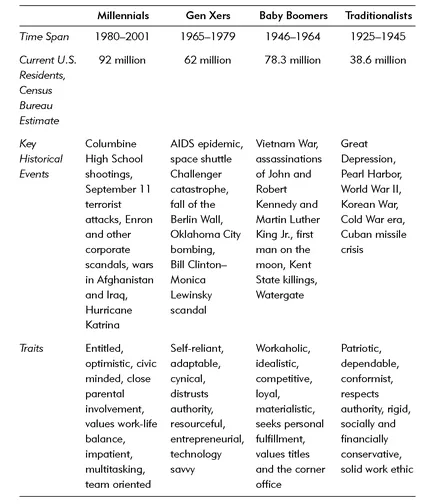
Indeed, employers face some of their biggest management challenges ever as they try to integrate millions of millennials into a workplace with three other very different generations. In addition to the millennials, there are the traditionalists—also referred to as the veteran, mature, or silent generation—born between 1925 and 1945; the baby boomers, 1946 to 1964; and generation Xers, 1965 to 1979. (See the accompanying table for a summary of the characteristics of the four generations in the workplace.) Already, the trophy kids are at odds with some members of the other generations, who perceive them as arrogant and unwilling to adapt to the corporate culture. Their trademark flip-flops and ripped jeans, ubiquitous iPods, and preference for text messages rather than face-to-face communication are driving some older colleagues and managers nuts.
Four Generations in the Workplace
In contrast to the millennials, the traditionalists, many of whom have already retired, respect the status quo and bring a strong sense of loyalty to their jobs. Graying baby boomers, who are on the verge of retirement or at least a switch to part-time status, earned a reputation for being workaholics and consider their careers an integral part of their identity. Resourceful and self-reliant, generation Xers don’t trust institutions and don’t expect job security. Together, the four generations make for an intriguing and potentially explosive brew.
It will take more than a decade for yet another generation to join the workforce. Although it’s a little early to start characterizing the children born after 2001, some researchers already are concocting generational names. Because the millennials are sometimes referred to as generation Y, generation Z is naturally one of the labels being attached to the next cohort. Largely the offspring of generation X, this up-and-coming group is also being called zeds, gamers, the new millennials, and the homeland generation, a reference to homeland security in this age of terrorism.
For now, though, most of the attention is aimed squarely at the millennials. In some ways, educators and employers have found that they exhibit a number of contradictory attitudes and behaviors. “It’s all about me” might seem to be the mantra of these self-absorbed young people who aspire to be financially successful so they can pay off college loans and afford their digital toys, international travels, and other pleasures. But many millennials like Kravanja also demonstrate strong concern about social and environmental issues and tend to be active in community service. In another interesting twist, they want structure and clear direction in their work assignments, but they also expect flexibility to decide when and where they complete the tasks. And although they crave individual praise and recognition, they can also be terrific team players, whether in sports, the classroom, or the workplace.
Millennials also are a polarizing generation. They have many fans who admire their optimism, intelligence, ambition, and commitment to make the world a better place. But they also come in for some stinging criticism for their inflated expectations. Employers, in particular, have mixed feelings about millennials. While respecting their aptitude for technology and their ability to work well in teams, many recruiters and managers find millennials far too demanding when it comes to needing guidance, frequent performance appraisals, rapid career advancement, and work-life balance. Although many of them are well educated, millennials strike employers as being book smart but suffering from a deficit of common sense. How else to explain the job candidate who showed up late for an interview at a public relations agency with chewing gum in her mouth and blue, chipped fingernails?
Some employers even go so far as to call millennials slackers, although they actually can be incredibly efficient, productive workers as long as their job is engaging and will help advance their careers. But if they find work boring and unfulfilling, they’ll be out the door in a snap. Such behavior causes bitterness among many employers, who bemoan such disloyalty and the resulting low retention rates.
Whether they like the millennials or not, farsighted companies know they must try to accommodate them because they are America’s future workforce as the large baby-boom generation moves into its twilight years. According to U.S. Census Bureau population estimates, America’s millennial generation currently numbers about 92 million, compared with 78.3 million baby boomers.
“We have to understand that millennials simply view the world differently from us, and try to adapt to them,” says Rich Garcia, director of enterprise recruiting and retention at State Farm Mutual Automobile Insurance Co. in Bloomington, Illinois. “We can’t let ourselves get bogged down in thinking they’re not loyal. Instead, we need to give them a voice in the organization and learn to work with them, not against them.”
Cam Marston, founder of the consulting firm Generational Insight, has observed heightened interest in understanding the millennials, particularly among technology, health care, consulting, accounting, and other professional services firms that vie aggressively for talent. “With each passing week, it’s becoming clearer that this is a very different generation,” he says. “More companies are trying to understand those differences and make changes to attract these young people. Some are doing it willingly, others more begrudgingly.”
L’Oréal is not only willing but actually quite enthusiastic about welcoming more millennials to its beauty-products business. “The millennial generation is at the top of my agenda of priorities,” declares François de Wazières, director of international recruitment for Paris-based L’Oréal. “We’re very seriously investing in knowing these people’s characteristics and how we can recruit and manage them to the fullest efficiency.” To that end, L’Oréal, together with an organization of European business schools, has launched a study of millennials’ values and attitudes.
“I believe the millennials will be a gold mine of talent for L’Oréal because they are such a good fit with our emphasis on innovation, creativity, open-mindedness, and entrepreneurial spirit,” de Wazières says. “Of course, we will have to explain to middle managers and executives that they will want to wear jeans and T-shirts and have flexibility in their work life. But we will also have to draw a line between what we will accept and what we won’t.”
Certainly not all the characteristics that demographers, educators, and employers ascribe to millennials apply to each and every member of the generation. There are exceptions to any generalization. In fact, the various millennial traits tend to most closely fit college students and graduates, who are of greatest interest to corporate recruiters. Some of the attributes also could describe generation X, which is known for being technology savvy and seeking work-life balance, too. But even those two qualities resound much more strongly with the millennials. Clearly, the trophy kids are emerging as a quite distinctive and fascinating group of young people who will command the world’s attention for many years to come.
A MILLENNIAL PORTRAIT
The millennials are fast on their way to rivaling the baby boomers as the most studied generation. They are sometimes referred to as “echo boomers” because many of them are the offspring of boomers, who have helped shape them and continue to play a major role in their lives. Whether they will affect the world as much as the boomers did remains uncertain, of course, but they are certainly promising to make waves.
The trophy kids have generally enjoyed financial and emotional security in their close, comfortable relationships with their families. But their lives also have been touched by a succession of momentous events, including the Columbine High School shootings; the September 11, 2001, terrorist attacks; the wars in Iraq and Afghanistan; Hurricane Katrina; and the wave of corporate scandals that began with the collapse of Enron Corp.
One of the most avid watchers of millennials has been Northwestern Mutual Life Insurance Co. Between 1997 and 2004, it put millennials under the microscope for five research studies on “America’s emerging leaders.” Some of the earliest surveys detected an unusually optimistic, self-assured generation. But among the findings in Northwestern Mutual’s 2004 survey of 21- to 23-year-olds: heightened anxiety because they’re living in a world in conflict. Indeed, the millennials surveyed consider growing up faster and a lack of innocence as two of the chief disadvantages of their generation. They also were pessimistic about America’s direction and its leadership, but enthusiastic about their connections to family and friends.
Their dissatisfaction with political leaders obviously has motivated the millennials to action. They were quite active during the 2008 presidential primaries, with more young people voting than in recent years and especially strong support for Barack Obama and his campaign theme of “change we can believe in.” In a survey of 18- to 24-year-olds in fall 2007, Harvard University’s Institute of Politics found that 41% definitely planned to vote in a 2008 primary or caucus and 61% intended to vote in the general election.
Although the threat of terrorism has shaken the millennials as it has all the generations, young people still tend to have high self-esteem and plenty of hope and ambition. That’s certainly the case with Steffen Ringelmann, a graduate of Vassar College who is happily pursuing his artistic passions in New York City. After graduation in 2004, he floated around a bit, waiting tables so he could paint and do volunteer work at a free monthly publication in Brooklyn and an art gallery in Manhattan. Feeling a bit exhausted and overwhelmed, he spent three months chilling out on the coast of Maine, then headed to Berlin, Germany, for four months. Now back in New York City, he works as an assistant at a furniture and design gallery and builds furniture in the evenings and on weekends for a major advertising agency and other customers.
“My goal is to be a tastemaker and have an influence on style,” he says. “I have found my path in life in design and can see myself succeeding financially, as well as emotionally and creatively.” He agrees that his generation is self-involved and less willing to join the rat race. “I want to explore, deconstruct, and understand my own sense of self through the act of creation,” he says. Then he adds, laughing, “It’s about me, me, me, me, me!”
Not content to be simply their parents’ trophy kids, many millennials dream of riches and world renown. In a 2006 study of 18- to 25-year-olds labeled “generation next,” the Pew Research Center in Washington, DC, found that they believe that their generation’s top goals in life are being rich and famous. Similarly, in a 2007 Harris Interactive survey, 56% of 13- to 21-year-olds said their dream is to be a millionaire, and about a third aspired to become a famous musician or singer. About 40%, however, envisioned a nobler achievement: curing diseases.
Whether or not stardom is within their reach, this digital generation clearly loves attention and cyberfame. It’s a celebrity-obsessed group that grew up on American Idol, entertainment tabloids, and Internet gossip. The millennials share the most mundane—and most sensational—aspects of their lives on such social networking sites as Facebook and MySpace, opine in blogs, and post their personal video creations on YouTube. They are so casual and indiscreet that much of their life is an open book online, where they display racy photos, boast about their sexual exploits, and try to rack up the most virtual “friends” or connections. Older adults believe they have no sense of privacy and warn them that their exhibitionism could ultimately hurt their careers and personal lives.
Ringelmann finds MySpace and Facebook “guilty pleasures” and incredibly valuable ways to connect with new people and possibly promote his furniture designs. But he also finds the connections rather shallow. “My generation is very social and gets to know a lot of people online, but we don’t have many good friends through our networks,” he says. “I think we’re a very socially distracted generation because of the Internet.”
The avid social networking is but one manifestation of the tremendous influence of technology on the millennials. Always connected to cell phones, iPods, laptops, or video-game players, this generation—sometimes called the MyPod Generation—has mastered multitasking skills better than any other. At the same time, however, educators and employers complain that the informal, shorthand style of text and instant messaging has impaired young people’s writing abilities and interpersonal communication skills. What’s more, the digital generation’s tendency to do multiple things...