![]()
Chapter 1
Multilevel Multidisciplinary Optimization in Airplane Design 1
1.1. Introduction
MDO is the acronym for “multidisciplinary design optimization”. MDO can be defined as how to efficiently organize design, i.e. the art of optimizing the definition of our airplanes in order to find the best compromise between specifications and requirements. Mathematical optimization applied to multidisciplinary design provides an efficient context for researching the best solution, in all disciplines and at all levels of detail in the definition: from the system to the different subsystems and to the smallest components.
Beyond the search for a better response to the traditional needs of performance and competitiveness for our products, this methodology satisfies the need to adapt our design process as well as possible to the emergence of new design requirements for our airplanes (noise in the Falcons’ airport zone, conformance of military planes, etc.) and our ambition to design innovative products such as the supersonic Falcon and different types of UAVs (unmanned aerial vehicles). Finally, we propose a rational approach for design cooperation with our partners and subsystem manufacturers through a detailed process for systematizing and automating the exploration of the solution space, for synthesizing the results for decision support, and for evaluating the cost of a specification for the complete airplane cycle.
We will first present the traditional process of airplane design. The description of the traditional process will highlight the expected contributions of MDO methodology.
1.2. Overview of the traditional airplane design process and expected MDO contributions
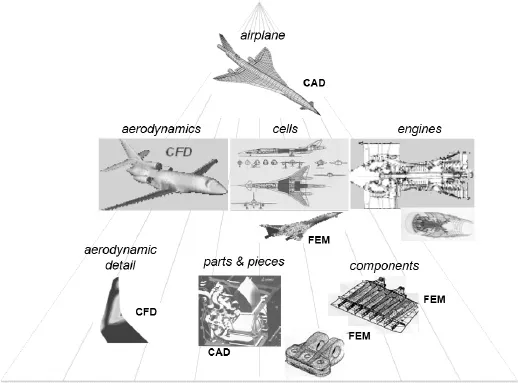
For a very long time, aircraft manufacturers, as did all developers of complex products, implemented a multilevel and multidisciplinary organization for the definition of their products. This methodology is based on a tree structure by discipline (or trade) with increasing refinement of the global airplane definition to the definition of every detail in its components. A numerical modeling tree diagram for this approach in design of a civil airplane is shown in Figure 1.1.
In each discipline and at each level, we are today building two types of paired computer representations:
– a definition model, that is the CATIA definition of the geometry of elements involved;
– computation models, e.g. the finite model elements of resistance and vibrations, the finite model elements of aerodynamics, to show that the product satisfies specifications and good engineering practices of the different trades.
The traditional design process occurs by progressively building the model tree by going down the hierarchy of models, from global definition to detail definitions. The specifications of the different subsystems are generated in the same way. The design loop, in a traditional approach, can then be described in the following manner: after an initial choice of architecture determined by the engineer’s intuition and experience, the components are sized by iterations until the specifications are met.
In practice, for problems with numerous constraints or multidisciplinary coupling, the convergence of the traditional process can be difficult: mathematical optimization can provide optimization algorithms with efficient constraints. Level N + 1 specifications are the level N design parameters, and the verification of specifications can only be done when the level N + 1 system has been completely developed. This can be a drawback, especially for innovative projects for which subsystems cannot come from products already on the market. It is therefore necessary to implement a process of multilevel sensitivity analysis for managing uncertainties in the performance of subsystems and their impact on global product performance. Finally, intuition and experience are key elements in the traditional process. Breakthrough products cannot always rely on experience from previous projects and intuition can be faulty. A design process adapted to innovative products must enable rational comparisons to be made between optimized architectures, and provide decision support in design with the help of advanced visualization for exploration of the design space.
The complexity of the systems being designed makes it increasingly difficult for an engineer to have all the scientific and technical knowledge necessary to carry out the design process successfully. The global design problem is therefore broken down into subsets that can be controlled by experts from the disciplines involved. The two major challenges of MDO are complexity of physical modeling and complexity of the production organization necessary for its development. MDO offers a range of methodologies for coordinating the efforts and efficiently managing the interfaces between expert design groups. These methodologies can be described in the form of algorithms organizing the global design process broken down into subsystems. MDO must be viewed as an approach which integrates the engineer’s experience and intuition, and is based on the power of mathematical analysis and computer models to provide rational conclusions in a decision process.
1.3. First step toward MDO: local dimensioning by mathematical optimization
This was the first design process improvement. It was applied in the mid-1970s to structures, followed by other disciplines at different levels. The method is only applied to a single discipline at a time. Its principle is to reduce the dimensioning process to a mathematical optimization problem, i.e. to find a set of definition parameters that will maximize a performance while satisfying the specs.
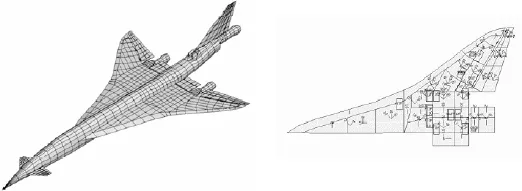
We can cite two examples of optimizations commonly used today: structural dimensioning of an airplane, and aerodynamic dimensioning. Structural dimensioning optimization consists of determining all the zones in the structure – the thickness of panels, stringer sections, the number of folds and their composite material orientations – which minimize the structural mass, while respecting the criteria of mechanical resistance and aeroelastic failures in the flight envelope. An example of this type of optimization is presented for the case of a supersonic business plane in Figure 1.2.
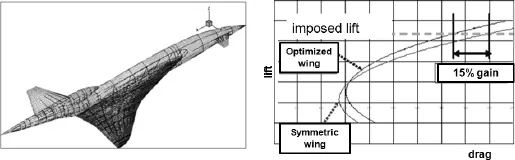
In the case of the optimization of aerodynamic dimensioning, the idea is, for example, to determine the geometric form minimizing cruising drag while ensuring the airplane’s aerodynamic qualities in its flight envelope and respecting global or local geometric constraints for the cell setup. This process is illustrated in Figure 1.3.
1.4. Second step toward MDO: multilevel multidisciplinary dimensioning
This is the step in which we address optimal coupled dimensioning on all or a part of the modeling tree, while remaining within pre-established choices of system architectures and subsystems. Our goal is not only to be able to simultaneously optimize all the definitions of the system and subsystems for a given objective and criteria, but also to provide exchange rates among the different airplane performances (cost, flight radius, take-off field length, noise, pollution emissions, etc.) or between airplane performances and the performances of basic technologies (permissible constraint level for materials, motor turbine inlet temperature, etc.). The purpose is to know how to adjust the component specifications rationally to all description levels.
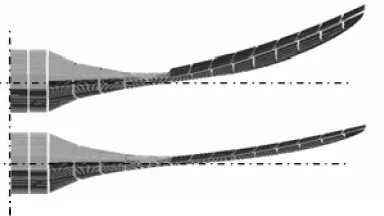
An example of multidisciplinary optimization is to determine the optimal relative wing thickness of a supersonic business plane. The aerodynamicist will tend to choose the thinnest possible wing because, from a purely aerodynamic point of view, the wave drag increases with the relative thickness squared. From the point of view of structure, a too thin thickness can lead to aeroelastic flutter problems caused by the flexibility of the wing. Figure 1.4 illustrates the effects of this flexibility by showing the camber variations between the start of cruising where the airplane has maximum load (upper plate) and end of cruising where the airplane has used up most of its fuel (lower plate).
Multidisciplinary optimization makes it possible to find the relative thickness minimizing the supersonic drag, while respecting aeroelasticity constraints in the flight envelope.
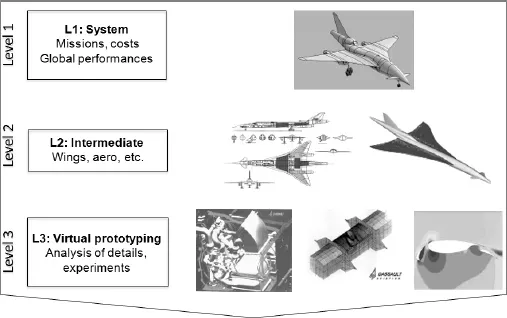
The major challenge is in developing methods providing a good implementation complexity/efficiency compromise that can apply to numerous classifications of design problems. A more detailed analysis of the multilevel breakdown presented in Figure 1.5 reveals important characteristics. Level 1 considers the global system and its global performances in terms of the mission (take-off weight, flight radius, noise in the airport zone, etc.). At this level, the system is described with a limited number of design variables (100) and the models used to calculate global performances are rapid execution (a few seconds to a few minutes of CPU time). At level 2, we enter the field of high performance scientific computation. At this level, the calculation codes used are, for example, sophisticated CFD codes solving Euler or Navier– Stokes equations with a finite element general model (including aeroelasticity) to describe structural behavior. The number of design variables is much greater (a few thousand) and the computation times necessary for analyses are longer, taking hours of CPU time. Level 3 corresponds to the numerical prototype and details analysis. In this schema, the MDO process must be considered mainly as the art of efficiently managing design parameters between disciplines and levels.
1.5. Elements of an MDO process
Each design process is different. Its complexity and hard spots are unknown a priori, therefore the MDO process must be easily reconfigurable. The breakdown must take industrial divisions into account. MDO breakdown strategies can depend on the application, and methods of sophisticated breakdown are not yet totally validated in terms of their scaling for real applications. The use of high reliability analyses in an environment that is easily reconfigurable is still a challenge. That is why the identification of high/low couplings, multilevel breakdown, and surrogate models are central in an efficient MDO process. In addition, ...