- Explores this general proposition in a cross-national study of the austerity protests, or the 'IMF Riots' that have affected so many debtor nations since the mid-1970s
- Argues that modern austerity protests, like the classical "bread riots" in eighteenth-century Europe are political acts aimed at injustice, but acts that are an integral part of the process of international economic and political restructuring
- Evaluates how modern food riots are most important for what they reveal about global economic transformation and its social, and political, consequences
- Provides a general framework (drawing on comparative and historical material) and then trace the cycle of uneven development, debt, neo-liberal reform, and protest in Latin America, Africa, Asia, the Middle East, and Eastern Europe
- Focusses on the role of women in structural adjustment and protest politics and the features of seemingly anomalous cases which qualify the general argument
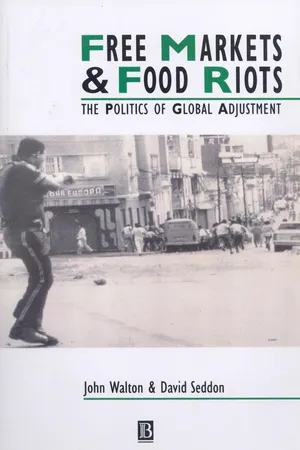
eBook - ePub
Free Markets and Food Riots
The Politics of Global Adjustment
- English
- ePUB (mobile friendly)
- Available on iOS & Android
eBook - ePub
Free Markets and Food Riots
The Politics of Global Adjustment
About this book
This book describes and explains the extraordinary wave of popular protest that swept across the so-called Third World and the countries of the former socialist bloc during the period from the late 1970s to the early 1990s, in response to the mounting debt crisis and the austerity measures widely adopted as part of economic "reform" and "adjustment".
Information
Part I
Introduction
1
Global Adjustment
In this book we examine the relationship between widespread popular unrest in the cities of the developing world (including the “new” developing world of Central and Eastern Europe) and the process of economic and social transformation–associated with a renewed emphasis on liberalization and the promotion of “free markets”–that has taken place on a global scale over the last two decades.
We argue that, despite its roots in the distinctive historical development of the state within which it takes place, popular protest must also be seen as a more general social and political response to the systematic undermining of previous economic and social structures and of an earlier moral order, in the name of “adjustment,” to ensure renewed capitalist development on a world scale. The period of “global adjustment” extends, roughly, from the late 1960s to the present. This period, we would argue, has been characterized by crisis and reconstruction on a world scale.
1 GLOBAL CRISIS
Few disagree that the period under consideration is one of significant change and transformation; but interpretations of the precise significance, and of the economic and political causes and effects, of the changes taking place differ considerably.
Most orthodox economists (including those in the World Bank, at least until very recently) have seen the changes of this period simply as aspects of a process of “transition.” as the emergence of new developing (industrializing) countries (NICs) challenges the old international economic order and the global economy “adjusts” to these new circumstances (e.g. Becnstock 1989). The period of “transition,” however, has been redefined periodically as things have failed to turn out as predicted. In 1979, the World Bank recognized that “the 1970s were a period of turmoil and transition for the world economy,” but predicted that the 1980s would see renewed growth, with the developing countries averaging GDP growth of 5.6 percent between 1980 and 1990 (World Development Report 1979, cited in World Bank 1988: 13–14). In 1985, after the severe recession of 1979–83, and the development of “the debt crisis” in the early 1980s, the World Bank was prepared to argue that “we are now in a period of transition – an essential and intermediate phase before returning to sustained growth and normal relationships between debtors and creditors” (World Bank 1985). For this school of thought, the development of capitalism on a world scale is characterized by a general tendency towards economic development and social improvement, despite occasional “setbacks” and “shocks,” This analysis is remarkably similar in crucial respects to that of the school of neo-classical Marxists (exemplified by Warren 1980; see also Harris 1986: 187–203) who also have seen, in the 1970s and 1980s, a world in transition, characterized by temporary inequalities and difficulties but tending generally towards economic and social development as capitalism progressively integrates every state and society within a single global system. These schools of thought have little to say regarding the wave of social unrest and popular protest that has characterized the last two decades of restructuring and adjustment, seeing them (when they arc considered at all) cither (in the orthodox neo-classical perspective) as reflections of “rigidities” and “constraints” to be overcome, or (in the neo-classical Marxist conception) as misguided “populist” reactions to a painful but generally progressive process of transformation and capitalist development.
For economists more influenced by the theories of Keynes, the evident changes of the period under consideration are in part at least associated with a deepening crisis in international economic and political relations associated with a lack of effective international management of an increasingly interdependent global economy and giving rise to conflict between and within states, growing inequality (both international and national) and mass poverty (cf. Pearson 1969; Brandt et al. 1980; Brandt and Manley 1985, UNIGEF 1987). For this school of thought, deep-seated conflicts of interest between states threaten the process of development but can nevertheless be reconciled, given the political will and a greater degree of coordinated intervention on the part of international institutions and the governments of the more powerful states in particular. This school of thought has seen social unrest and popular protest as an indication of, and reaction to, the pain (real costs) experienced by the most vulnerable sections of the population in the current world crisis.
For others, writing from a more radical perspective (and often referred to as “neo-Marxists”) the crisis is a classical crisis of over-accumulation and is thus intrinsic to the international capitalist economy and its associated political regime. This gives rise to heightened conflict both at the international and at the national level as different interests struggle to resolve the crisis to their own benefit. Mediation in this struggle (class struggle within states, and international competition and conflict at the global level) is likely to be ineffective and based on wishful thinking. In this perspective, popular protest against the austerity measures that have accompanied “structural adjustment” throughout the developing world is an integral part of the struggle around the very process of capital accumulation and in defense of the interests of those suffering most from the process of restructuring and adjustment. Popular struggle is thus linked to class struggle.
While we share much of the analysis of this last body of thinking, we also see the recent growth of popular struggles and protest as a distinctive political development of the last two decades, involving an exceptionally wide range of social forces, both responding to, and itself shaping, the process of global adjustment that has accompanied a global crisis.
The roots of the current crisis lie back in the 1960s, when the industrial capitalist economies began to experience a profits squeeze reflecting a crisis of overaccumulation (Armstrong, Glyn, and Harrison 1984). Measures adopted by western governments to help resolve the crisis included austerity measures directed primarily at reducing real wages, particularly in the public sector. According to this analysis, it was the induced recession and austerity measures of the mid-1960s, designed to restructure and rationalize working processes, which established the conditions for the subsequent crisis (Armstrong, Glyn, and Harrison 1984; 276). The austerity measures introduced as part of the process of restructuring provoked unprecedented popular protest and a wave of strikes swept across Europe between 1968 and 1970, resulting in a rapid increase in money wages. Broadly similar developments took place in north America around the same time (cf. Armstrong, Glyn, and Harrison 1984: 271–90). The clampdown which followed was associated with a “mini-recession” in 1970–1 and succeeded by a “mini-boom” in 1972–3, which proved to be the final phase of the long postwar boom.
The mini-boom effectively marked the end of an era. The US dollar devaluation of 1971, the “oil crisis” of winter 1973–4 and an international “crash” in the summer of 1974 brought the golden years to an abrupt and painful halt. The remainder of the decade fell into two phases: a fragile recovery, followed by a renewed and more serious recession in the wake of the second major oil-price rise of 1979 what some referred to as “the second slump” (Mandel 1980), The two deep recessions (of the mid-1970s and of the early 1980s) experienced by the advanced capitalist countries were followed by a period of uneven recovery (1983–9), but it would appear clear now that another recession, starting around 1989, has begun to affect them once again. Despite periods of recovery, it is possible to see the entire period from the late 1960s to the present as one marked essentially by recession and crisis.
Frank, for example, has written of “a deep and widespread economic, social and political crisis in the world, which seems to be ccntred on a new crisis of overaccumulation of capital in the capitalist West, and on the consequent transformation of its relations with the socialist East and the underdeveloped South” (Frank 1981: ix). Others concur with this view of the last two decades as a period of significant transformation on a world scale, and emphasize that the crisis is associated with a long recession. Thus Frobel remarks that “in the two decades following the Second World War, the capitalist world-economy experienced the greatest boom in its history. This boom came to an end toward the close of the 1960s. Since then the world-economy has been in a phase of decelerated growth, intensified structural change, and heightened political instability” (Frobel 1982: 507). Even the World Bank, with its very different perspective, recognized towards the end of the 1980s that “in some developing countries the severity of this prolonged economic slump already surpasses that of the Great Depression in the industrial countries, and in many countries poverty is on the rise” (World Bank 1988b: 3).
But while some emphasize the similarities between this “contemporary crisis” and previous capitalist crises (in the 1930s and 1870s, for example), others draw attention to the novel features of this latest crisis:
the post-war period, at least up to 1973, saw the greatest boom in economic history. Since then there has been slower growth, marked by two recessions which, some have argued, make this later period rather more like the condition of capitalism prior to 1939. However, in this more recent period, there are signs that a new stage in the development of the political economy has emerged, with conditions which differ considerably from those which prevailed in the 1930s. (Gill and Law 1988: 127)
The distinctive character of the last two decades is associated with the increasing integration of capitalism on a world scale, its “internationalization.”
This has ensured that a crisis of capitalism is, increasingly, and unavoidably, a crisis on a world scale, even if that crisis is experienced unevenly and differently at different moments and in different places. For Gill and Law,
the global political economy has reached an unprecedented stage of development. The present is not like the past. Today, the security, trade, money, direct investment, communications, and cultural dimensions of global interdependence, are such that there is now an integrated global political economy, whereas in the past, there was a less complex international political economy (and before 1500 a series of regional political economies). (Gill and Law 1988: 378)
One of the major consequences of this deepening integration is a greater “synchronicity” or “simultaneity” of events in different parts of the world and in different countries. Evidence suggests that, from the late 1960s onwards, the advanced capitalist countries of the West in particular have become both more closely integrated and mutually interdependent. Consequently, they demonstrate, in recession and in recovery, an increasingly high degree of synchronicity in economic rhythms relative to earlier periods; only Japan stands somewhat apart. By the early 1980s the same was becoming more generally the case for the developing world as a whole, although the unevenness of capitalist development in the Third World and the continuing survival of state socialism in the Second World until the late 1980s ensured that global synchronicity was still not achieved at the beginning of the 1990s. Increasingly, however, the successive booms and recessions of the advanced capitalist West have been “passed on” to the rest of the world in a variety of ways and as a consequence a major process of restructuring on a world scale has taken place.
2 THE END OF THE SECOND WORLD
For some 40 years, analysts tended to accept the distinction between the advanced capitalist countries of the West (First World), the developing countries of the South (Third World) and the “state socialist” countries of the East (Second World) as systematic. With the dramatic transformation of the political economy of Eastern Europe during the 1980s, culminating in the “revolutions” of 1989–90, such a distinction has become more evidently problematic.
In this book, the countries of the Second World are treated not as part of a separate economic and political system, but as countries with their own distinctive heritage experiencing a process of rapid change, in which their progressive integration into the capitalist world and associated domestic economic and political transformation has generated many contradictions and conflicts that resemble those identified with crisis and “economic reform” in the developing Third World.
During the late 1960s and 1970s trade between the state socialist countries and the capitalist world increased significantly. Average annual growth rates of export trade with the West and the South which were 10.9 percent and 11.4 percent respectively in the period 1965 to 1970, increased to an average of 23.5 percent and 21.0 percent in the period 1970 to 1975. But rates of growth in imports accelerated even more dramatically, with imports from the West rising from an annual average of 12.2 percent in 1965–70 to 31.2 percent in the period 1970 to 1975 and imports from the South increasing from 7.5 percent to 26.0 percent. Even if inflation is taken into consideration these figures represent a startling increase in overall trade outside the Council of Mutual Economic Assistance (CMEA) and a significant growth in the balance-of-trade deficit.
The increasing balance-of-trade deficit was associated with a rising balance-of-payments deficit. It is estimated that by 1972 the accumulated combined balance-of-payments deficit of the Soviet Union and Eastern Europe with the West (excluding Japan) reached $7.6 billion; by 1975 the deficit of Eastern Europe alone was calculated at $9 billion–largely through trade with the United States, Japan, France and West Germany (Frank 1980: 188).
As the balance-of-payments deficit grew, so too did foreign borrowing and recourse to drawing on reserves. By 1976 it was estimated that the Soviet Union and Eastern Europe as a whole owed some $45 billion; by the end of 1978 the figure had risen to $58 billion, of which nearly half was owed to western banks. The dramatic increase in foreign debt led to efforts by governments in the Soviet Union and Eastern Europe to introduce drastic measures to reduce the balance-of-payments and balance-of-trade deficit. Frank reported, on the basis of data relating to 1978 and 1979, that
debt service has been eating up a quarter or more of foreign earnings and credits in most of Eastern Europe and over one half in Poland, and it has become necessary to make sharp cuts in imports to keep this burden from growing further. Poland, whose debt is estimated at $15 billion, has been obliged to reduce its investments and to announce increases in food prices again in order to answer its needs for increased imports of equipment and food. (Frank 1980: 231)
The economies of the Soviet Union and Eastern Europe were slowing down seriously during the late 1960s and 1970s. Attempts were made to counter this by foreign borrowing and the pursuit of expansionary strategies, while at the same time trying to reduce the level of state subsidies. These strategies not only served to deepen the economic crisis that was rapidly developing during the 1970s but also increased the level of dissidence and social unrest.
By the end of the 1970s, there were clear indications in many of the “older” state socialist countries of a significant rethinking of socialist theory and practice. In China, the four modernizations, in Vietnam, the economic reforms, in the USSR the beginnings of efforts to streamline and restructure the economy (perestroika), were all significant developments. These developments were driven essentially from above. In other, “younger” state socialist countries also–e.g. Vietnam, Mozambique, Ethiopia–the 1980s saw an increasing preparedness to consider economic reform (involving liberalization) as necessary. During the latter part of the 1980s, the attempt at controlled economic reform gave rise to increasing social discontent and political unrest, which culminated in “the revolution” of 1989 (see chapter 9).
The explanation for the increasing revisionism of “socialist” governments is controversial. For some, ever closer integration with the capitalist West and capitalist South obliged economic restructuring and political compromise (e.g. Frank 1980). For others, the limits of extensive primitive accumulation under early socialism having been reached, a drive for modernization and intensification led to rising imports, especially of advanced technology, from the West. But whether the impulses were initially from outside or inside, the economic reforms of the late 1970s and the 1980s created new tensions and precipitated political as well as economic crises. An essential element in the economic crises was the burgeoning foreign debt and growing pressure for more radical reforms. Since 1989, and the collapse of state socialism in Europe and across the world, what was once referred to as the Second World is now increasingly integrated within the global capitalist political economy and subject to broadly similar forces for change. And, as in other parts of the developing world, the international agencies and developed capitalist states are actively promoting policies of economic reform – of stabilization and structural adjustment – to encourage liberalization and privatization, and the development of market forces.
3 THE END OF THE THIRD WORLD
Towards the end of the 1960s, as the developed capitalist economies began to move into crisis the developing countries as a whole appeared to experience a period of growth. International capital and commodity markets continued to boom and, as the World Bank noted in 1987,
some developing countries liberalized their trade regimes in the mid-1960s, became exporters of manufacturers, and gained directly from the expansion in world trade. Most of the others benefitted from rising demand for raw materials and foods. So, in one way or another, the developing countries that participated in the expansion of world trade experienced high output growth. (World Bank 1987: 14).
In the early 1970s, accumulation in the developing countries as a whole was close to the 5.7 percent rate achieved in the advanced capitalist countries; by the end of the 1970s it was running at about twice the 4 percent a year of the advanced capitalist countries. While real GDP growth in the advanced capitalist countries was 4.7 percent in the period 1965–73, it slumped to 2.8 percent between 1973 and 1980; in the same period the developing countries as a whole recorded GDP growth rates of 6.5 percent and 5.4 percent (Mosley, Harrigan, and Toye 1991: 5), The share of world capitalist investment in developing countries went from 16.5 percent in 1973 to 23.25 in 1979 (Armstrong, Glyn, and Harrison 1984: 353).
It was on the basis of such data that some argued against what they termed “The Illusion of Underdevelopment” (Warren 1980) and for the progressive development of the Third World during the 1960s and 1970s; and indeed, significant rates of growth were recorded mainly by a select group of newly industrializing countries whose performance was taken by “the optimists” as indicative of a general process of development and by “the pessimists” as challenge to the supremacy of the developed world. The NICs and the OPEC countries together certainly experienced a very considerable growth; and discussions of a new international division of labour surfaced in the mid-1970s together with a call for a New International Economic Order (NIEO), at a time when the action of OPEC appeared to hold out the prospect for a real challenge from the developing countries to the prevailing dominance of the developed countries.
But for most developing countries, the 1970s were more difficult than the 1960s. It rapidly became clear during the second part of the 1970s that, not only were the developed countries becoming less prepared than ever to open themselves to a new international order as signs of recession began to increase, but the increase in oil prices achieved by the OPEC countries had generally adverse effects on the majority of non-oil-exporting developing countries. For many developing countries, particularly those strongly committed to a “nationalist” development strategy built around import substitution, foreign exchange was a major constraint; commodity prices held up in the wake of the first oil-price increase and many developing capitalist countries began to borrow heavily (OPEC surpluses channeled through western banks). This created the conditions for what was to emerge rapidly as “the debt crisis,” to which the response of the international financial institutions was “stabilization” and “adjustment.” For a time the high import demand of these countries provided much needed markets for western commodities. But by the end of the decade this was no longer the case. While the OPEC producers and NICs surged ahead during the latter part of the 1970s, most other developing countries began to experience growing indebtedness, declining terms of trade and increased balance-of-payments problems.
This resulted in increasing differentiation within “the Third World” and the beginning of “the end of the Third World” (Harris 1986): different regimes of capital accumulation and different state forms, following different policies and different trajectories. Generally, those countries experiencing strong economic growth were better able to provide the conditions under which “vulnerable” social groups could survive and defend their living standards; those whose economic crisis only deepened during the 1980s experienced the full severity of adjustment.
If, even in the 1970s and 1980s, the developing countries as a whole performed well, in terms of various economic-performance indicators, in comparison with the industrial capitalist West, there was considerable variation within “the Third World.” East Asia and South Asia showed the highest rates of real GDP growth, growth in exports and growth in domestic investment. The poorest performance was that of sub-Saharan Africa, with Latin America and the Caribbean, North Africa, and the Middle East little better. If growth of real per capita GDP is taken as an indicator of economic performance, it is easy to see the difference between the Asian region – particularly East Asia – and the others (see table 1.1).
Table 1.1 Regional patterns of growth, 1965–2000
Source: World Bank 1990: 11, 16

But, increasingly through the period under consideration, it was the size and “burden” of its foreign debt that came to characterize the severity of the crisis for any developing economy. The deepening recession in the West and the effects of increasing oil prices on the economics of oil-importing countries in Africa, Asia, and Latin America began to have their impact, and loans for development turned increasingly into debts. In the 1970s, the global economic crisis was characterized particularly by a financial crisis, with growing international financial instability and international debt. Indeed, one key aspect of the global crisis with which this book will be particularly concerned is that of the so-called “debt crisis,” which developed rapidly during the second part of the 1970s and surfaced in an acute form at the beginning of the 1980s.
It was in large part in response to the growing balance-of-payments problems experienced by an increasing number of countries, that the International Monetary Fund began to intervene more systematically in the fiscal policy of de...
Table of contents
- Cover
- Series Page
- Title page
- Copyright
- Tables
- Acknowledgements
- Part I: Introduction
- Part II: Case Studies
- Part III: Conclusion
- Bibliography
- Index
Trusted by 375,005 students
Access to over 1.5 million titles for a fair monthly price.
Study more efficiently using our study tools.
Frequently asked questions
Yes, you can cancel anytime from the Subscription tab in your account settings on the Perlego website. Your subscription will stay active until the end of your current billing period. Learn how to cancel your subscription
No, books cannot be downloaded as external files, such as PDFs, for use outside of Perlego. However, you can download books within the Perlego app for offline reading on mobile or tablet. Learn how to download books offline
Perlego offers two plans: Essential and Complete
- Essential is ideal for learners and professionals who enjoy exploring a wide range of subjects. Access the Essential Library with 800,000+ trusted titles and best-sellers across business, personal growth, and the humanities. Includes unlimited reading time and Standard Read Aloud voice.
- Complete: Perfect for advanced learners and researchers needing full, unrestricted access. Unlock 1.5M+ books across hundreds of subjects, including academic and specialized titles. The Complete Plan also includes advanced features like Premium Read Aloud and Research Assistant.
We are an online textbook subscription service, where you can get access to an entire online library for less than the price of a single book per month. With over 1.5 million books across 990+ topics, we’ve got you covered! Learn about our mission
Look out for the read-aloud symbol on your next book to see if you can listen to it. The read-aloud tool reads text aloud for you, highlighting the text as it is being read. You can pause it, speed it up and slow it down. Learn more about Read Aloud
Yes! You can use the Perlego app on both iOS and Android devices to read anytime, anywhere — even offline. Perfect for commutes or when you’re on the go.
Please note we cannot support devices running on iOS 13 and Android 7 or earlier. Learn more about using the app
Please note we cannot support devices running on iOS 13 and Android 7 or earlier. Learn more about using the app
Yes, you can access Free Markets and Food Riots by John K. Walton,David Seddon,John K. Walton in PDF and/or ePUB format, as well as other popular books in Social Sciences & Sociology. We have over 1.5 million books available in our catalogue for you to explore.