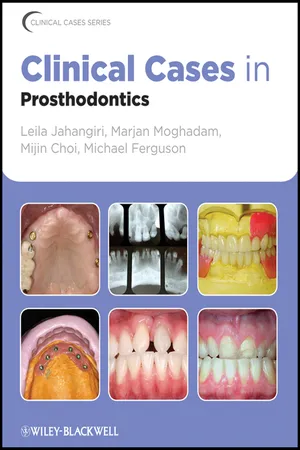
Clinical Cases in Prosthodontics
eBook - ePub

Clinical Cases in Prosthodontics

  1. English
  2. ePUB (mobile friendly)
  3. Available on iOS & Android
eBook - ePub

About this book

Wiley-Blackwell's "Clinical Cases" series is designed to recognize the centrality of clinical cases to the profession by providing actual cases with an academic backbone. Clinical Cases in Prosthodontics grounds itself in core principles of this rehabilitative specialty and demonstrates their practical, every-day application through range of case presentations building from simple to complex and from common to rare. This unique approach supports the new trend in case-based and problem-based learning, thoroughly covering topics ranging from conventional complete denture prostheses to full mouth rehabilitation using both implant and tooth-supported prostheses.

Each case begins with a short description of the initial patient presentation and the learning objectives and goals the subsequent case discussion will demonstrate. This is accompanied by relevant medical and dental histories, notes on extra-oral and soft tissue examination and a thorough list of clinical findings, all presented in bulleted from to facilitate ease of learning. Clinical decision making factors are then discussed in detail, well illustrated with multiple clinical photos showing progressive stages of treatment. Cases conclude with review questions and relevant literature citations supporting each answer.

Ideal for practitioners and students alike, Clinical Cases in Prosthodontics is the ultimate resource linking evidence-based research to every-day application.

Trusted byĀ 375,005 students

Access to over 1.5 million titles for a fair monthly price.

Study more efficiently using our study tools.

Information

Year
2011
Print ISBN
9780813816647
eBook ISBN
9780470961803
Edition
1
Subtopic
Dentistry
cmp01_image001.webp
Treatment of an edentulous patient with conventional complete denture prostheses
CASE STORY
A 62-year-old completely edentulous Caucasian male presents requiring maxillary and mandibular complete dentures to restore form, function, and aesthetics. He has been edentulous in the maxilla for the past 15 years and had his mandibular anterior incisors extracted about 8 months ago. He presents with a chief complaint of: ā€œI need new teeth (dentures).ā€ The patient states that his present dentures are ill-fitting and they move when he eats and speaks. Intraoral examination reveals moderately inflamed oral tissues, consistent with an ill-fitting denture; however, the amount of alveolar bone present is adequate for denture support.
Figure 1: Preoperative maxilla.
cmp01_image002.webp
Figure 2: Preoperative mandible.
cmp01_image003.webp
LEARNING GOALS AND OBJECTIVES
  • Manage soft tissues prior to prostheses fabrication.
  • Determine and reestablish proper vertical dimension of occlusion (VDO).
  • Assess anterior artificial tooth arrangement.
  • Recognize and treat common postinsertion sequelae.
Medical History
  • Diabetes: diagnosed at the age of 17, well controlled with medication
Dental History
  • Extraction of maxillary teeth 15 years ago and the remaining mandibular anterior teeth 8 months ago; patient states that all extractions were due to ā€œgum disease.ā€
  • The patient soaks his dentures at night in water but does not brush them; however, he does rinse his mouth with mouthwash daily before reinserting the dentures.
  • His diet is described as normal, but lately consisting of softer food.
Medications and Allergies
  • Metformin (Glucophage) 500 mg twice daily
  • Multivitamin daily
Review of Systems
  • Diabetes mellitus type ll
  • Vital signs:
  • Blood pressure: 129/78
  • Heart rate: 72 beats/minute
  • Respiratory rate: 16 breaths/minute
Social History
  • Smoking: cigarettes, one pack per day since the age of 15
  • Alcohol: 2-3 pints of beer daily
  • Recreational drugs: denies having ever used them
Extraoral Examination
  • Head: normocephalic, symmetrical, no masses or scars
  • Neck: within normal limits
  • Muscles: within normal limits
  • Lymph nodes: within normal limits
  • TMJ: no clicks, pops, or tenderness; normal range of motion; no deviation on opening or closing
Soft Tissue Examination
  • Lips: moist; symmetrical; normal shape, size, and color, with mild angular cheilitis present
  • Mucosa: mildly inflamed; patent Stenson’s duct; no masses, scars, or lesions
  • Hard palate: normal size and shape with nicotinic stomatitis present
  • Soft palate: slightly erythematous, normal size and shape
  • Tongue: normal size and shape; no masses, scars, or lesions; candida overgrowth present leaving erythematous palatal mucosa when rubbed off
  • Saliva: appears to be of normal flow and consistency (Examination of soft tissues and salivary flow rate are important considerations when planning for and constructing a new complete denture.)
  • Floor of mouth: Patent Wharton’s duct; no masses, scars, or lesions. (Examination of soft tissues and salivary flow rate are important considerations when planning for and constructing a new complete denture.)
  • Oral cancer screen: negative for clinical signs of oral cancer. (Examination important because of history of smoking and alcohol consumption.)
Clinical Findings/Problem List
  • Complete edentulism
  • Inadequate oral hygiene
  • Inadequate existing complete dentures
  • Poor masticatory function
Diagnosis
  • Complete edentulism
  • Angular cheilitis
  • Candidiasis
  • Nicotinic stomatitis
  • Insufficient vertical dimension of occlusion (VDO)
Clinical Decision-Making Determining Factors
  • Edentulism is defined as having no teeth and is usually the result of dental caries and/or periodontal disease. The remaining residual ridge can undergo remodeling and resorption often with an unpredictable pattern. This can result in the instability of the complete dentures. Adequate ridge height and width must be carefully evaluated in the fabrication of complete dentures (Slagter, Olthoff et al. 1992; Eklund and Burt 1994; Carlsson 2004).
  • Denture retention and comfort are directly related to the supporting tissues of the residual ridge. Sufficient vestibular depth is crucial for a good basal seat of the denture base. An ill-fitting denture can irritate the mucosa and produce redundant soft tissue known as epulis fissuratum or ulcerations. These tissue inflammations should be resolved prior to new denture fabrication and certainly prior to the making of the final impression. This can be achieved by using tissue conditioners and corrective adjustments to the present dentures. In cases where corrective adjustments are not possible, discontinued use of dentures for 48-72 hours prior to final impressions is recommended (Lytle 1957; Klein and Lennon 1984; MacEntee 1985).
  • The proper vertical dimension of occlusion should be verified both in the wax rim and artificial tooth arrangement try-in stages when fabricating complete dentures. Denture base pressure, especially if the occlusal forces are unevenly distributed or if there is excess vertical dimension of occlusion, can cause low-grade inflammation of the supporting mucosa and the underlying alveolar bone. In most cases this inflammation is reversible (Davies, Gray et al. 2001).
  • Insufficient vertical dimension of occlusion can result from improper establishment of vertical dimension of occlusion during the initial denture fabrication, or as a result of teeth wear or physiological changes of alveolar bone over time. Insufficient vertical dimension can present as angular cheilitis, difficulty in mastication, drooling, and pseudo-class III occlusion (Turrell 1972).
  • The position of the maxillary anterior artificial teeth is based on aesthetics and phonetics. These aesthetic parameters include lip support, amount of incisal display, axial inclination, anterior plane of occlusion, and symmetry. The phonetic parameters include but are not limited to pronunciation of fricative (ā€œfā€ and ā€œvā€) sounds and sibilant (ā€œsā€) sounds (Pound 1977).
  • At the time of initial insertion of new dentures, the dentist should focus on adequacy of basal seat adaptation, elimination of overextended denture borders, and presence and adequacy of maxillary posterior palatal seal. Once these are established, the occlusion is best checked with remount procedures (Landa 1977; Ettinger and Scandrett 1980; Shigli, Angadi et al. 2008).
  • Proper daily denture hygiene, in addition to maintenance and follow-up appointments, are critical for long-term health of oral tissues. This helps to ensure quality of life for the edentulous individual. Annual follow-up should be stressed to the edentulous patient, because oral changes are an ongoing biologic process (Chamberlain, Bernier et al. 1985).
Figure 3: Completed denture tooth arrangement.
cmp01_image006.webp
Figure 4: Completed denture tooth arrangement, right side.
cmp01_image004.webp
Figure 5: Complete dentures at delivery.
cmp01_image005.webp
Questions
1. Before making the preliminary impression for complete maxillary and mandibular dentures one should
A. Perform a thorough intraoral exam to evaluate the oral cavity and the health of the soft and hard tissues that will support the dentures
B. Resolve any inflammation or infection present
C. Examine the existing prostheses where applicable
D. All are important.
2. What etiologic factors could be contributing to Mr. Smith’s angular cheilitis?
A. The presence of candida and an ill-fitting denture with loss of vertical dimension of occlusion
B. A dry mouth
C. Adequate oral hygiene practices
D. An ill-fitting denture with excessive vertical dimension of occlusion
3. The major objective of complete denture impressions is to
A. Eliminate epulis fissuratum
B. Achieve retention, stability, and support for the denture and the soft tissues
C. Aid in relining an existing denture
D. Assist in tooth selection for the denture
4. Custom trays made from an adequate diagnostic cast should be
A. Made of a rigid and dimensionally stable tray material and be border molded
B. Cut short 8 mm from the depth of vestibule captured in the diagnostic cast
C. Constructed without a handle
D. Made to create an overextended final cast
5. When considering the reestablishment of the proper vertical dimension of occlusion (VDO), which statement is true?
A. VDO is the vertical length of the face as measured between 2 arbitrary points selected above and below the mouth when natural teeth or wax rims are in contact in centric.
B. The VDO is always greater than vertical dimension of rest VDR.
C. The VDO and the interocclusal distance are not equal to VDR.
D. VDO is also known as freeway space.
6. When establishing occlusion in dentures,
A. Occlusal plane can be established without the patient.
B. Record bases and occlusal rims should be used to determine and establish the vertical dimension of occlusion.
C. Vertical dimension of occlusion equals vertical dimension at rest.
D. In older patients, the vertical dimension of occlusion is greater than the vertical dimension at rest.
7. The purpose of the anterior teeth try-in step during the fabrication of complete dentures includes the following assessment(s):
A. Aesthetics, phonetics, soft tissue support
B. Condylar inclination, vertical dimension of occlusion
C. Centric relation
D. Verification of vertical dimension at rest
8. When creating a bilateral balanced occlusal scheme, the following characteristics should be considered:
A. Compensating curve
B. Excursive jaw movements
C. Mediotrusive and laterotrusive contacts
D. All of the above
9. At the delivery appointment, the patient complains that the ā€œbite doesn’t feel right.ā€ You...

Table of contents

  1. Cover
  2. Title page
  3. Copyright
  4. Dedication
  5. Authors
  6. Preface
  7. Acknowledgments
  8. Introduction to Evidence-Based Practice (EBP)
  9. Case 1 Treatment of an edentulous patient with conventional complete denture prostheses
  10. Case 2 Treatment of an edentulous patient with two-implant-retained mandibular overdenture
  11. Case 3 Treatment of a patient with combination syndrome
  12. Case 4 Treatment of an edentulous patient with a severely atrophic mandible
  13. Case 5 Management of florid cemento-osseous dysplasia (FCOD)
  14. Case 6 Treatment of a partially edentulous patient with implant-retained removable partial denture prosthesis
  15. Case 7 Treatment of a partially edentulous patient with fixed and removable prostheses
  16. Case 8 Management of ectodermal dysplasia I—overdenture prostheses
  17. Case 9 Management of ectodermal dysplasia II—implant-retained removable prostheses
  18. Case 10 Management of ectodermal dysplasia III—a multidisciplinary approach
  19. Case 11 Management of a fractured central incisor I—mild
  20. Case 12 Management of a fractured central incisor II—moderate
  21. Case 13 Management of a fractured central incisor III—severe
  22. Case 14 Rehabilitation of anterior teeth I—combination of complete and partial coverage restorations
  23. Case 15 Rehabilitation of anterior teeth II—partial coverage restorations
  24. Case 16 Rehabilitation of anterior teeth requiring orthodontic extrusion
  25. Case 17 Management of severe crowding—a multidisciplinary approach
  26. Case 18 Management of a patient with maxillary canine transposition
  27. Case 19 Management of a patient with loss of posterior support
  28. Case 20 Management of the consequences of partial edentulism
  29. Case 21 Management of worn dentition I—resulting from dental malocclusion
  30. Case 22 Management of worn dentition II—localized severe wear
  31. Case 23 Management of worn dentition III—generalized severe wear
  32. Case 24 Implant therapy versus endodontic therapy
  33. Case 25 Management of endodontically treated teeth
  34. Case 26 Prognostic indicators for strategic extractions in a full mouth rehabilitation
  35. Case 27 Treatment of a patient with implant-supported fixed complete denture prostheses
  36. Case 28 Full mouth rehabilitation—implant-supported prostheses I
  37. Case 29 Full mouth rehabilitation—implant-supported prostheses II
  38. Case 30 Full mouth rehabilitation—implant-supported, screw-retained prostheses
  39. Case 31 Full mouth rehabilitation—implant-supported, cementable fixed prostheses
  40. Case 32 Full mouth rehabilitation—combination of implant and tooth-supported fixed prostheses
  41. Case 33 Full mouth rehabilitation—combination of implant and tooth-supported fixed and removable prostheses
  42. Case 34 Management of a patient with bulimia
  43. Case 35 Management of oral manifestations of methamphetamine abuse
  44. Case 36 Management of cleidocranial dysplasia I—treatment of an adolescent patient
  45. Case 37 Management of cleidocranial dysplasia II—treatment of an adult patient
  46. Index

Frequently asked questions

Yes, you can cancel anytime from the Subscription tab in your account settings on the Perlego website. Your subscription will stay active until the end of your current billing period. Learn how to cancel your subscription
No, books cannot be downloaded as external files, such as PDFs, for use outside of Perlego. However, you can download books within the Perlego app for offline reading on mobile or tablet. Learn how to download books offline
Perlego offers two plans: Essential and Complete
  • Essential is ideal for learners and professionals who enjoy exploring a wide range of subjects. Access the Essential Library with 800,000+ trusted titles and best-sellers across business, personal growth, and the humanities. Includes unlimited reading time and Standard Read Aloud voice.
  • Complete: Perfect for advanced learners and researchers needing full, unrestricted access. Unlock 1.5M+ books across hundreds of subjects, including academic and specialized titles. The Complete Plan also includes advanced features like Premium Read Aloud and Research Assistant.
Both plans are available with monthly, semester, or annual billing cycles.
We are an online textbook subscription service, where you can get access to an entire online library for less than the price of a single book per month. With over 1.5 million books across 990+ topics, we’ve got you covered! Learn about our mission
Look out for the read-aloud symbol on your next book to see if you can listen to it. The read-aloud tool reads text aloud for you, highlighting the text as it is being read. You can pause it, speed it up and slow it down. Learn more about Read Aloud
Yes! You can use the Perlego app on both iOS and Android devices to read anytime, anywhere — even offline. Perfect for commutes or when you’re on the go.
Please note we cannot support devices running on iOS 13 and Android 7 or earlier. Learn more about using the app
Yes, you can access Clinical Cases in Prosthodontics by Leila Jahangiri,Marjan Moghadam,Mijin Choi,Michael Ferguson in PDF and/or ePUB format, as well as other popular books in Medicine & Dentistry. We have over 1.5 million books available in our catalogue for you to explore.