I ENTERED THE INVESTMENT BUSINESS in 1968 with six hundred dollars in my pocket, and I left it in 1980, at the age of thirty-seven, with enough money to satisfy a lifelong yearning for adventure. As the comanager of an offshore hedge fund, analyzing the worldwide flow of capital, raw materials, goods, and information, I had invested where others did not, exploiting untapped markets around the globe, and it was a significant factor in my success. But what I wanted out of Wall Street, and ultimately out of long-term investing, was not typical of the business. I wanted to buy the freedom to taste as much of life as possible—I wanted to see the world. And I wanted to see the world that other travelers rarely see, the world that can be seen only from the ground up and truly understood only from that vantage point.
I wanted to see what I like to think of as the real world.
I have met people who have traveled to more countries than I, but in almost every case, it seems, they have flown from one place to another. You have not really been to a country, I believe, until you have had to cross the border physically, had to find food on your own, fuel, a place to sleep, until you have experienced it close to the ground.
In the late winter of 1990, I set out on a two-year odyssey to circle the planet on a motorcycle. That 65,000-mile journey took me across six continents and through dozens of countries; it landed me in the Guinness Book of Records and resulted in a best-selling book of my own, Investment Biker: Around the World with Jim Rogers. No sooner had I completed the trip and returned home to New York than I began thinking about something more. I was abetted in my quest to find it by a simple quirk of the calendar: the approaching turn of the millennium. My insatiable thirst to understand firsthand what is going on in the world, to be there, to see it for myself—to dig out the real story—was intensified by the opportunity to capitalize on a historical moment. My plan was to spend three years driving around the globe as the twentieth century came to a close, to take the world’s pulse at the end of one millennium and the start of another.
The trip would be both an adventure and a part of the continuing education I had been engaged in all my life, from rural Demopolis, Alabama, where I grew up, through Yale, Oxford, and the U.S. Army, and eventually to Wall Street, where experience taught me that the “experts” were usually wrong. My travels tended to be characterized by the slaughter of sacred cows, the puncturing of various balloons, and the laying to rest of preconceptions of the world held by certain “authorities,” many of whom rarely left home. My success in the market has been predicated on viewing the world from a different perspective.
While I have never patronized a prostitute, I know that one can learn more about a country from speaking to the madam of a brothel or a black marketeer than from speaking to a government minister. There is nothing like crossing outlying borders for gaining insights into a country.
Finding promising investment opportunities was not a defined aim of the trip, but just because I am who I am, it is something that happens when I travel. As an investor, I would seek to learn about the markets in China, Africa, and South America, and I would visit promising stock exchanges whenever possible. I had made money in the past by investing in sleepy markets, such as Austria, Botswana, Peru, and others, and would no doubt stumble on some again.
If the trip killed me, I would die happy, pursuing my passion. And that was better than dying on Wall Street someday with a few extra dollars in my pocket.
The trip took me through 116 countries, many of which are rarely visited: Saudi Arabia, Myanmar, Angola, Sudan, Congo, Colombia, East Timor, and the like. The journey took me down the west coast and up the east coast of Africa, through thirty-two countries there. (My previous trip had taken me straight down the center, from Tunis to Cape Town.) It took me from Atlantic to Pacific—out of Europe across Central Asia and China—and from the Pacific back to the Atlantic, by way of Siberia. From the northeast coast of Africa I traveled across Arabia and the Indian subcontinent to Indochina, Malaysia, and Indonesia. After touring Australia and New Zealand, I made for the southern tip of South America, driving from there to Alaska before heading home to New York. No one had ever driven overland following this route. The trip took me through approximately half of the world’s thirty civil wars, covered 152,000 miles, 5,030 more than the distance of my previous trip, and resulted in another Guinness World Record.
Studies have shown that traveling around the world is people’s single most popular fantasy; many people in many places around the globe approached and said, “You are living everyone’s dream.”
The trip began on January 1, 1999, in Reykjavík, the capital of Iceland. I did not make the trip alone. I traveled with a beautiful woman, a blue-eyed blonde from Rocky Mount, North Carolina, named Paige Parker. I met Paige in 1996 during a speaking engagement at the Mint Museum in Charlotte. Paige, a fund-raiser at Queens College, had read my book on the recommendation of Billy Wireman, the college president, and come to hear me speak about my motorcycle trip. I tracked her down the next day and invited her to dinner.
“I’m thinking of going around the world again,” I said to her on our first date. “I haven’t told anybody yet. But I’m thinking of doing it at the turn of the millennium.”
She agreed that such a trip could be illuminating.
“Do you want to go with me?” I asked.
She was momentarily dumbstruck.
“Yes,” she said. “Sign me on.”
Of course, we both thought it was idle banter.
Who knew?
Paige and I had been dating for a little over a year when she quit her job in Charlotte and moved to New York, taking her own apartment there in October 1997. As she began working as a director at a marketing firm and she and I began working that much more on our romance, I began seriously searching for an overland alternative to motorcycles.
There is nothing more exhilarating than driving a motorcycle. I have owned several in my life. I first rode a motorcycle across China in 1988, a trip documented by PBS as part of its Travels series, titled “The Long Ride.” More than exhilaration, there is a simplicity to a bike. It is a lot easier, for example, to get a motorcycle across oceans, across deserts, or through jungles. And had Paige been enthusiastic to do so, we might have motorcycled around the globe. It was she who encouraged me to think about making the trip in a car. But I was not going to travel in just any car. It had to be a sports car. And it had to be a convertible. I wanted to put the top down and have the wind in my face.
Of course, I knew nothing about cars. Living in New York City, I had not owned one since 1968. And my ignorance was apparent to everyone when I explained that what I was looking for was a convertible two-seater with four-wheel drive and a lot of clearance off the ground, without which, I could guarantee, no car was going to make it around the world.
Everyone in turn guaranteed me that there was no such car on the market.
Every two years there is a big Four-Wheel-Drive Show in Munich, and in the spring of 1998 I attended it. I did not find the car I was looking for, but I met people there who modified cars—I had looked at many vehicles by now and figured I would use a sporty body on a Toyota chassis—and one of them told me about a fellow in California I should look up. It was typical of the quest that I had to go to Germany to find a guy in California. The guy in California told me about another guy in California (it was very much like trying to get into Cameroon two years later), and that is how I met Gerhard Steinle. It was Steinle and his team at Prisma Design International who would put together the one-of-a-kind Mercedes-Benz in which Paige and I eventually traveled the world.
By then my requirements had become more specific. More than a convertible, the car had to be equipped with a retractable hardtop. I did not want to run the risk of the top’s being slashed, which could prove to be a definite damper on a trip around the world. Furthermore, I decided, it had to have a diesel engine. Trucks, buses, trains, and boats around the world run on diesel fuel, and you can always get it. Gasoline, I had discovered on my previous trip, was often very difficult to find. If you could get it at all, you could not be sure it would be any good.
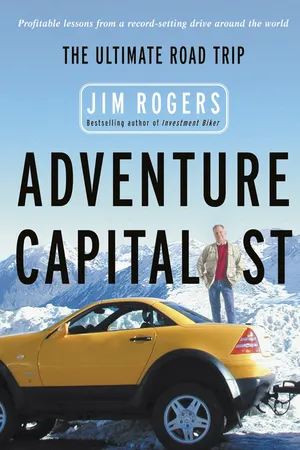
Steinle, a former president of Mercedes-Benz Advanced Design of North America, came up with the notion of merging the body and interior of Mercedes’ SLK roadster with the chassis and diesel engine of the company’s sport-utility vehicle, known in Europe as the G-Class, or der Geländewagen (G-Wagen). The rugged G-Wagen, designed originally for German military and police use, would be unavailable in the United States until three years later, when it would be introduced as the G500. The SLK, which came with a retractable hardtop as standard equipment, was built on the same wheelbase as the shorter of the two G-Class models. The chassis of the two cars were the same. To marry the two, Steinle figured out, we would not have to cut or lengthen anything.
I told Steinle that I needed an extra fuel tank and a secret compartment in which to hide money. He said that because the hardtop retracted into the trunk, I was going to need a trailer, as well. He would design one to match the car. He talked me out of going with a manual transmission, explaining that Mercedes-Benz was a far better driver than I and that the company’s automatic transmission would get me out of predicaments better than I could extricate myself with a stick shift.
“I need everything ready to go by the end of the year,” I said.
Steinle, unbeknownst to me, rather than simply order the cars, called Mercedes of North America, told the people there that he had this crazy guy who wanted to do X, Y, and Z, and asked if they wanted to get involved. Apparently, they liked the story. When I next heard from Steinle, he reported, to my amazement, that he had persuaded Mercedes of North America to provide the vehicles free of charge, as long as I paid for the expensive conversion.
“And of course,” Gerhard said, “they’ll be under warranty.”
“Let’s do it.”
Even in the absence of a warranty, I knew, I would find Mercedes service everywhere in the world. Even in the developing world one is never far from a dealership; every dictator and mafioso in the world drives a Mercedes. Even in countries with no roads to speak of, Mercedes service is available—often to the exclusion of things like food—thanks to all the U.S. foreign aid, the International Monetary Fund, and World Bank money being shipped in. It is no secret that this money is aimed at nourishing only those corrupt enough to get their hands on it, while at the same time fattening the bureaucrats on both sides of the transaction who diligently work the trough. And none of them is driving a Chevy.
I knew much of this from my last trip. The upcoming trip, especially as it took us through Africa, would be an eye-opening education into the workings of the latest foreign aid scam: the nongovernmental organization, or NGO. As an American taxpayer, I would be amazed to discover that a lot of the money we send to these countries goes to support Mercedes and BMW dealers and various Swiss bankers.
But more about that later.
The truth is that had we traveled in a different car, we probably never would have made it around the world; this wacky idea of a car was the perfect choice in every way. One of its more important attributes would prove to be its color. Officially Sunburst Yellow, or, as I saw it, Martian Movie Yellow, it would draw crowds everywhere we went, making us many friends in the process, and in so doing save our lives on several occasions. Showing up by surprise in a car so unusual, so weird, and at the same time so downright unthreatening, would spark immediate curiosity. The bizarre, all-terrain hybrid in explosive color was just goofy enough to throw people off balance, to warm them up long enough to get us through a particular situation before anyone had a chance to say, “Hey, we forgot to rob those people” or “Weren’t we supposed to kidnap them?”
One of the more frequently asked questions one gets about traveling around the world is “How do you pack?” It is worth mentioning here that when we designed the trailer for this trip, we in effect designed it around the supplies with which we intended to fill it. We got everything we wanted to take with us, put it in a pile, and measured the pile, determining how many cubic feet of space we would need, and gave the measurement to the people who were manufacturing the trailer. Among all the things we carried, the jerry cans for extra water and fuel, the sleeping bags, the tent, and whatever else we packed into the trailer, the most important item, and the first to go into the pile, was the kit containing medical supplies. And it was big—n...