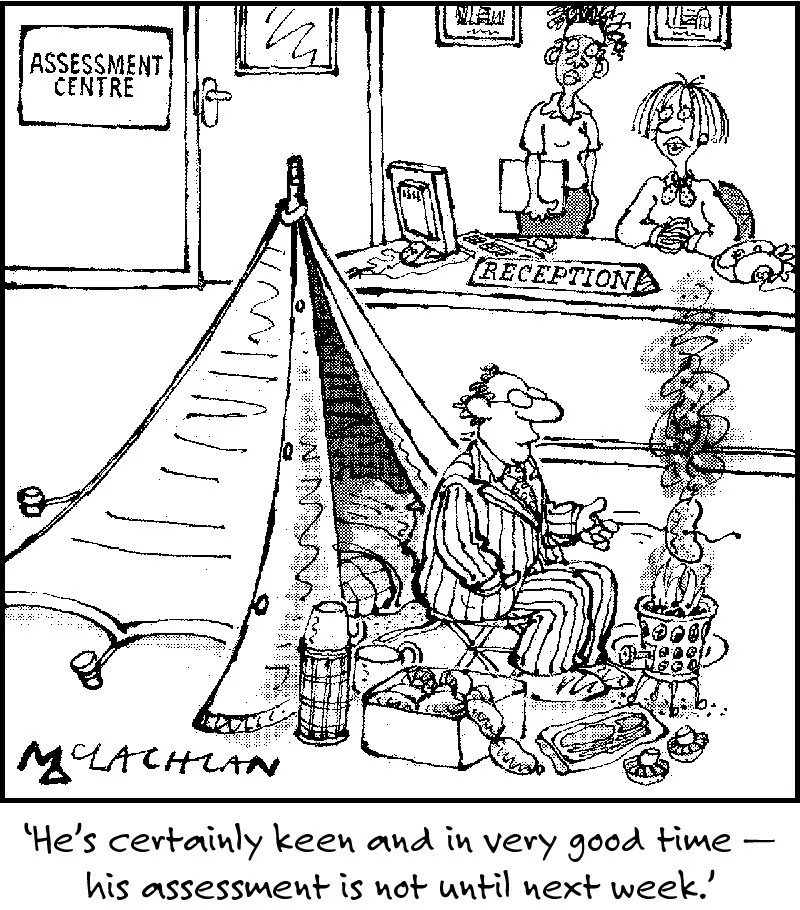
Hearing the term Assessment Centre for the first time, you may naturally assume that an Assessment Centre is a place where assessments are carried out. This popular misconception is based on the fact that the earliest such assessment events were run at a place called the Assessment Centre, so the name stuck. Nowadays, an Assessment Centre is a particular type of assessment process used for selecting the right person for the right job, and which has been steadily growing in popularity since the Second World War. In short, it is a process not a place.
Defining Assessment Centres
No single, universally accepted definition exists for an Assessment Centre, but there are many versions all tending to say much the same thing. Here’s a typical example:
An integrated system of tests and other measures, including simulation exercises designed to generate behaviour similar to that required for success in a target job or job level.
So what does this tell you? Read on to find out.
Activities are relevant to the actual job you’re seeking
First, you can expect the Assessment Centre to include activities relating to the sorts of things you expect to do in the job you’re being assessed for. For example, if you’re applying for a job as a customer service agent in a call centre, then you may well find that you’re asked to handle one or more customer queries over the phone. This type of activity simulates the real job and is an essential principle of an Assessment Centre.
Assessment Centres set out to use realistic tasks serving to give you a useful insight into the nature of the job that you’re applying for, helping both you and the organisation to decide whether there is a good fit.
The process lets you display behaviours you’re actually going to need
Second, an Assessment Centre is designed to let you display the behaviour that’s considered relevant to the job in question. So, unlike an interview, where you have the opportunity to talk about yourself and what you would do or did do in a given situation, at an Assessment Centre you need to show what you can do, the exercise simulations being both practical and realistic.
If you’ve applied for a particular job and you’ve been invited to attend an Assessment Centre as part of the selection process, try to identify what successful performance in that job would look like. What are the sorts of things a successful job performer would do? These behaviours are what the Assessors will be looking for and this can guide you as to how to behave on the Centre.
History of Assessment Centres
The Assessment Centre method was developed during the Second World War when there was an urgent need to find people with the capability to lead under very difficult circumstances. The milestones for Assessment Centres (ACs) are:
1942: German, UK and US Armed Forces use ACs for the selection of officers
1945: UK Civil Service Selection Board (CSSB) – first non-military use of ACs
1956: Telecoms provider AT&T first use ACs for management devel- opment purposes
1960s: Interest grows in the US: IBM, Standard Oil, General Electric
1970s: Interest grows in the UK: ICL (now part of Fujitsu), Post Office, consumer brand giant Grand Metropolitan
1980s: Increasing use of Assessment Centres for development (DCs)
1990s: Growth in use of AC/DCs in US and UK in public and private sectors
2000s: Growing global interest in use of ACs
An integrated system is designed to give a full picture of your abilities
Third, the reference to an ‘integrated system’ highlights the fact that the various parts of the Assessment Centre process all contribute to the assessment of the behaviours needed in the job you’re being assessed for. This shows that Assessment Centres are carefully constructed events and not simply a set of unrelated tasks that have been thrown together.
Your overall performance is determined by how well you did on the assessment as a whole; a less effective performance on one activity can be compensated for by a more than effective performance on another. So give each activity your ‘best shot’ and don’t be discouraged if you feel you’ve slipped up on one, because you may still have the opportunity to recover.
Well-designed Assessment Centres share certain key features, which we describe in ‘Key Features of Assessment Centres’ later in this chapter.