There are an estimated 55 million Americans over the age of 50 who have low bone mass. This easy-to-understand guide helps readers assess their risk and find a practical approach to the diagnosis, treatment, and prevention of osteoporosis. It covers bone density tests and a wide range of treatment options for osteoporosis-from hormone replacement therapy and acupuncture to calcium-rich foods, supplements, and exercise-and offers pointers on preventing broken hips and other common fractures.
- English
- ePUB (mobile friendly)
- Available on iOS & Android
eBook - ePub
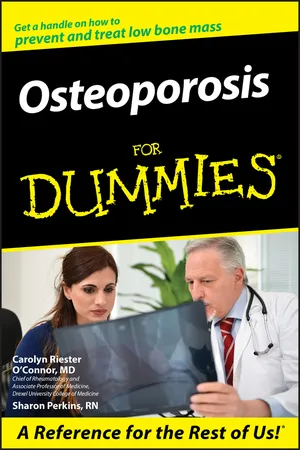
Osteoporosis For Dummies
About this book
Facts and advice to help people understand and prevent osteoporosis
Information
Part I
Understanding Your Bones

In this part . . .
Pssst . . . do you want to know all about your bones? Okay, so maybe understanding your bones doesn’t sound all that alluring or mysterious. But after you dig up a few bony tidbits, we think you’ll agree that bones are complicated and fascinating. In this part, we help you discover where bones come from, what makes them strong, and how you can make yours last a lifetime.
Chapter 1
Boning Up on Osteoporosis
In This Chapter

Years ago, when your authors first started taking care of patients, doctors had no way to diagnosis early osteoporosis. By the time osteoporosis was apparent on a regular X-ray or a fracture had occurred, significant bone loss had already affected the individual. Nor did doctors have any effective drugs to treat or prevent osteoporosis. We’ve come a long way, baby, in the early detection, prevention, and treatment of osteoporosis.
In this chapter, we introduce you to the problems of osteoporosis and explain why it’s an issue affecting everyone. Even if you’re not at risk for developing osteoporosis, you undoubtedly have a younger loved one who is in the process of building bone. We want to help you understand what you can do to make your bones, and those of your loved ones, the best they can be, even if you’ve never had a glass of milk in your adult life.
Defining Osteoporosis
What exactly is osteoporosis? The standard World Health organization (WHO) definition is that osteoporosis is “a skeletal disorder characterized by compromised bone strength predisposing a person to an increased risk of fracture,” which is certainly a mouthful, if not a particularly enlightening one. Osteoporosis is the most common bone disease by far, but it’s a disease many people don’t understand.
Most people think of osteoporosis only in terms of bone fractures or loss of height, but osteoporosis is far more complicated. You’d probably understand osteoporosis most clearly if you could see a bone specimen affected by osteoporosis under the microscope, but you’re not likely to ever be privy to a bone biopsy. Doctors don’t usually perform bone biopsies in their patients to diagnosis osteoporosis, although pathological examination of bone is still the gold standard in diagnosing osteoporosis. Normal bone has a network of strong plates and bands. In osteoporosis the bands become thinner and weakened, and worse yet there are tiny breaks in the plates and bands.


Bone is in a constant state of remodeling; old bone is broken down and replaced with new bone (see Chapter 2 for more on how bone is built). Osteoporosis can occur when you lose more bone than you rebuild, or when more bone than normal is broken down. (See Chapter 3 for risk factors that are responsible for changes in your bone density.)
Bone mass decreases between 1 and 5 percent per year after age 40 in women, and less than 1 percent in men. Women are more likely to develop osteoporosis because they generally have less bone mass to start with than men do. The sudden loss of estrogen, a sex hormone that is instrumental in building healthy bone, in menopause also contributes to women’s increased risk of osteoporosis.
Who, Me? How Osteoporosis May Affect You
If you’re reading this book, you may already be proactive about your bone health. Maybe you already know that you need to change your diet, exercise more, and take that extra calcium supplement. This book can help those of you who want to prevent osteoporosis. If you already have osteoporosis, this book can explain the ways to treat it and to prevent it from worsening.
To emphasize just how common the problem of osteoporosis is, a recent report from the Surgeon General’s office stated that by the year 2020, half of all Americans older than age 50 will be at risk for fractures from osteoporosis. Of women now age 50 or older, 40 percent will suffer a fracture of the hip, wrist, or spine at some point in their lives.
Your co-author Sharon works with a population of patients who are older than 60 years of age. Part of her job includes weighing and measuring each patient. Invariably, nearly every person laments that they used to be taller than they are now. (Thinner too, but that’s another issue!)
Losing height used to be considered an inevitable part of aging, similar to wrinkles and age spots. Most people don’t realize that one cause of height loss is related to fractures in the spinal column called vertebral compression fractures. Between 60 and 70 percent of women older than age 65 have at least one of these fractures.
Even worse, studies show that 20 percent of people with a vertebral fracture will sustain another fracture within a year. And people with compression fractures have a relative risk of death that is nine times higher than their healthy counterparts.
If you’re one of the 28 million Am...
Table of contents
- Title
- Contents
- Introduction
- Part I : Understanding Your Bones
- Chapter 1: Boning Up on Osteoporosis
- Chapter 2: Loving the Living Tissue Called Bone
- Chapter 3: Breaking Down the Risk Factors
- Chapter 4: Men and Kids Get Osteoporosis, Too
- Part II : Keeping Your Bones Healthy
- Chapter 5: Eating Right for Good Bones
- Chapter 6: Exercising for Strong Bones
- Part III : Diagnosing and Treating Osteoporosis
- Chapter 7: Facing the Consequences of Bones Gone Bad
- Chapter 8: Finding (and Paying For) a Doctor to Treat Osteoporosis
- Chapter 9: Testing Your Bones
- Chapter 10: Taking Prescription Drugs for Osteoporosis
- Chapter 11: Keeping Bones Strong with Over-the-Counter Supplements
- Chapter 12: Managing Pain from Osteoporosis
- Chapter 13: Recovering from a Fracture When You Have Osteoporosis
- Chapter 14: Focusing on the Future of Osteoporosis
- Part IV : The Part of Tens
- Chapter 15: Ten Surprising Sources of Calcium
- Chapter 16: Ten Things You Need to Know about Bones
- Chapter 17: Ten Resources for Finding Out More about Osteoporosis
- Chapter 18: Top Ten Questions Dr. O’Connor’s Patients Ask about Osteoporosis
- Chapter 19: Ten (Or So) Parenting Tips to Build Strong Bones
- Appendix: Reviewing Osteoporosis Programs State by State
- Glossary
Trusted by 375,005 students
Access to over 1.5 million titles for a fair monthly price.
Study more efficiently using our study tools.
Frequently asked questions
Yes, you can cancel anytime from the Subscription tab in your account settings on the Perlego website. Your subscription will stay active until the end of your current billing period. Learn how to cancel your subscription
No, books cannot be downloaded as external files, such as PDFs, for use outside of Perlego. However, you can download books within the Perlego app for offline reading on mobile or tablet. Learn how to download books offline
Perlego offers two plans: Essential and Complete
- Essential is ideal for learners and professionals who enjoy exploring a wide range of subjects. Access the Essential Library with 800,000+ trusted titles and best-sellers across business, personal growth, and the humanities. Includes unlimited reading time and Standard Read Aloud voice.
- Complete: Perfect for advanced learners and researchers needing full, unrestricted access. Unlock 1.5M+ books across hundreds of subjects, including academic and specialized titles. The Complete Plan also includes advanced features like Premium Read Aloud and Research Assistant.
We are an online textbook subscription service, where you can get access to an entire online library for less than the price of a single book per month. With over 1.5 million books across 990+ topics, we’ve got you covered! Learn about our mission
Look out for the read-aloud symbol on your next book to see if you can listen to it. The read-aloud tool reads text aloud for you, highlighting the text as it is being read. You can pause it, speed it up and slow it down. Learn more about Read Aloud
Yes! You can use the Perlego app on both iOS and Android devices to read anytime, anywhere — even offline. Perfect for commutes or when you’re on the go.
Please note we cannot support devices running on iOS 13 and Android 7 or earlier. Learn more about using the app
Please note we cannot support devices running on iOS 13 and Android 7 or earlier. Learn more about using the app
Yes, you can access Osteoporosis For Dummies by Carolyn Riester O'Connor,Sharon Perkins in PDF and/or ePUB format, as well as other popular books in Medicine & Diseases & Allergies. We have over 1.5 million books available in our catalogue for you to explore.