- English
- ePUB (mobile friendly)
- Available on iOS & Android
eBook - ePub
About this book
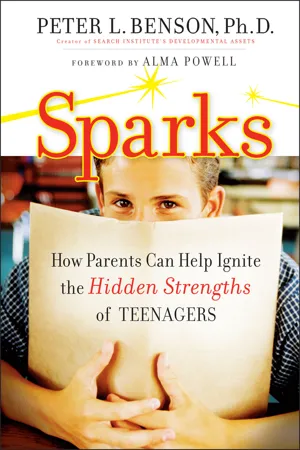
In this practical book, Dr. Peter Benson, a leading authority on childhood and adolescence, describes a simple yet powerful plan for awakening the spark that lives inside each and every young person. Sparks—when illuminated and nurtured—give young people joy, energy, and direction. They have the power to change a young person's life from one of "surviving" to "thriving." Grounded in new research with thousands of teenagers and parents, Sparks offers a step-by-step approach to helping teenagers discover their unique gifts, and works for all families, no matter their economic status, parenting situation, or ethnic background.
Trusted by 375,005 students
Access to over 1.5 million titles for a fair monthly price.
Study more efficiently using our study tools.
Information
Edition
1Topic
Personal DevelopmentPART ONE
Five Steps to Help Ignite Your Teen’s Sparks
STEP ONE
Recognize the Power of Sparks
spark n 1: an incandescent particle 2: a glistening particle 3: a flash of light 4: a vital, animating, or activating factor
Every teenager has a spark—something inside that is good, beautiful, and useful to the world. Sparks illuminate a young person’s life and give it energy and purpose.
Sparks come in many forms. Interviews with thousands of American teenagers tell us that their sparks include writing poetry, making music, helping people, leading, being a peacemaker among friends and peers at school, making one’s community better, and taking care of the earth. When our sparks glow, we feel whole. We feel useful. Life has meaning. It feels good to get up in the morning.
WHAT WE KNOW ABOUT SPARKS
Sparks are akin to the human spirit. The word spirit comes from the Latin spiritas, and is used to convey the concept of breath put into the world with vigor and courage. Spark, spirit, breath. The very essence of a person, put into play with energy and conviction.
As parents, we know when our children have a spark. You can tell by looking in their eyes. You can feel the energy, the electricity. It’s wonderful to be around young people who know their sparks and put them into play.
Sparks: The Keys to Unlocking Our Purpose
So many people—teenagers and adults—live locked-up lives. They meander through life, sometimes checking things off their to-do list, but often not knowing why they are here or why they matter. When you do this too long, you get a nagging sense that something’s missing, and what’s missing is discovering and expressing your spark.
As noted by Stanford psychologist William Damon, one of the most prominent trends of our times is a feeling of emptiness among adolescents and young adults. Commitment and sense of direction are at risk for too many of our young. We even see it now in the burgeoning numbers of twenty-somethings living at home with their parents while they wait for something to commit to. As Damon says, we are raising teens in “a society in which purposefulness among young people is the exception rather than the rule.”
Adults need to know and act on their sparks, and so do teenagers. If we can encourage young people to discover their sparks, they won’t need to go through what too many of us adults go through: that wandering state of longing for something more and yearning to follow what you care about instead of doing what someone else says you should do or care about.
Sparks describes a five-step plan to help ignite your teen’s spark. The plan is based on interviews with thousands of teens and parents from all walks of life: rich and poor, urban and rural, two-parent and one-parent families.
The first step is to recognize the power of sparks. Through our research, we discovered that a spark has these characteristics:
• It gives us energy and joy. We look forward to exploring it.
• When it is expressed, we feel alive. We feel useful. Life has purpose. We feel we are drawing on our best potential.
• When we are in a spark mode, we lose our sense of time. We are in the moment.
• A spark originates from inside a person. It is not imposed from the outside.
• A spark can be a skill, a talent, an interest. For some, it’s a way of being in the world. And when we express it, we’re not worried about how good we are or how it looks to others. Just doing it (or being it) is enough.
• Some people think of their spark as a gift, or as “the reason I am in the world.”
• A spark is not just about things we like to do, like watching movies or going to the beach or working out. It is deeper than this. It is a prime source of meaning, self-directed action, and purpose in our lives.
• This is important: a spark does (or has the potential to) make the world a better place for others.
A Powerful Research Base
Through a variety of major studies of youth and families all across America, we’ve learned a great deal about sparks, their role in helping youth navigate through adolescence, and their impact on the health and well-being of teenagers. We’ve also learned about young people’s spark champions, adults who are there for them. To create this portrait of youth, we sponsored or commissioned the following three national studies, in which we listened to the voices of more than thirty-five hundred teenagers and two thousand parents of teenagers:
• A Gallup Poll of two thousand twelve- to seventeen-year-olds and two thousand of their parents (one per teenager). This is a nationally representative sample of teenagers, with oversamples of African American and Hispanic youth.
• A twelve-question online poll of one thousand eleven-to seventeen-year-olds, conducted with the assistance of the Louis Harris polling firm.
• Interviews with 405 teenagers ages fifteen to seventeen. This was a three-day Internet-based bulletin board conversation on sparks and thriving, during which young people described their sparks, how their environments (such as family, school, and neighborhood) helped or discouraged them, what they sacrificed in order to pursue their sparks, and the ways they could tell when a teenager was thriving.
Our studies document seven major lessons about sparks, lessons that really need to become common knowledge. These lessons have the capacity to energize our families, schools, and neighborhoods to see the potential in each young person. You’ll find these lessons cited throughout this book.

KEY LESSON 1
Kids Understand the Idea of Sparks and Want Them
There’s no question that America’s teens and young adults get the concept of spark. It is as though the idea is hardwired into their very being.
When asking about sparks, we frequently heard something like, “Oh, you mean something I am passionate about,” or “Something about me that I love to do.” These teens also express a desire to have sparks and can identify what having sparks looks like among their peers. The universal ease with the concept of sparks is an important discovery, one that can help generate new ways of helping teenagers grow to their fullest potential.
HOW YOUNG PEOPLE VIEW SPARKS
Young people are articulate about the characteristics of kids with sparks versus those without sparks. They have much to say, and what they say is often insightful and inspiring.
The Rich Vocabulary of Teens
When describing their own sparks, young people frequently use words like “relish,” “love,” “reason to smile,” “passion,” “sacrifice,” “emotion,” “commitment,” “focus,” “lights my fire”—the kind of vocabulary one might expect to hear from someone describing a love interest or another really important relationship. These are right-brain words of emotion more than left-brain words of reason.
There seems to be a palpable level of energy within these words. This energy has a push and a pull. The push is the named and affirmed spark. The pull is the vision of what one can be.
Examples of Teenagers with Sparks
Ask a teenager about his spark, and often he will have a lot to say. Here’s how some teens from across America who have embraced their sparks describe them in an anonymous survey:
“My spark is art. I love to paint and sculpt and make things. I can take junk and make it into art.”
“I love to work with disabled youth. I love seeing them be so happy at the smallest things.”
“My violin is the spark that fires me up. I love music and making music. It brings so much joy to my life.”
“I love helping people with their personal problems. When one of my friends is having trouble with her family, I will sit there and listen to her and help her come up with a solution.”
“I am pursuing my spark by staying focused on going to school every day. Keeping my grades up. Staying away from areas that can get me pulled into trouble. I come home. I practice my music. I write lyrics all the time. I get together with the rest of my music group three to four times a week and we practice four to six hours. This is important to me because this is my spark. This is what I love. What I need to do. This will one day allow me to take care of my brothers and sisters.”
“The one spark in my life that most fires me up is my love for archeology.”
“I actually have more than one spark. I have loved soccer since the moment I touched the ball. It is a great way to make new friends and the thrill of playing it is so amazing to me it makes me want more. My other passion is acting. When I was younger, my dad would follow me around with a camera and I would do the funniest things. To be or to create your own perception or interpretation of a character is something I’ve always loved to do.”
Notice that none of these statements is merely about what young people like to do. Rather, they are about what young people need to do. This highlights a common theme in the way young people think about sparks: a spark isn’t something you go outside yourself to find. It’s something deep inside you.
Teenagers with spark have an enthusiasm and passion that are almost infectious. Once teenagers get started talking about sparks, they often become philosophical and almost evangelical.
“You can try to like something because someone else wants you to, but how can you really love something if it’s not something you want to do? Follow your heart and do what you love. Find your passion and go for it. It’s your life and you only have one life to live.” (Jamie, 14)
“If you have a spark, follow what you love and just don’t give up.” (Ronaldo, 13)
“A spark can be developed by finding one thing you love to do. You begin to put your all into that thing and allow it to motivate you to do bigger and better things.” (Ellie, 15)
“You can find something that you love or that you are good at. Just keep trying different things until you find that spark.” (Max, 17)
How a Spark Opens a New Path
A spark is about developing yourself from the inside out. It’s about discovering what’s deep inside you so that you’re less blown around by external pressures and distractions.
Too many of our teenagers are caught up and mesmerized by what’s going on outside them. They jump with every call on their cell phones. They rush home from school to see what’s new on YouTube. They are dazzled by the glitter of the rich and famous. Too many are wandering aimlessly in search of things that don’t connect with the deepest part of their being.
Our society promotes unrealistic expectations for young people: “You can be anything you want to be.” “Anything is possible.” People say these...
Table of contents
- OTHER BOOKS BY PETER L. BENSON
- Title Page
- Copyright Page
- Dedication
- Foreword
- Introduction
- PART ONE - Five Steps to Help Ignite Your Teen’s Sparks
- PART TWO - What Helps Teens Thrive
- Spark Resources
- Teenage Sparks A Rich National Tapestry
- What Kids Need to Succeed The 40 Developmental Assets (Ages 12 to 18 Years)
- Key Spark Resources
- Acknowledgements
- ABOUT THE AUTHOR
- INDEX
Frequently asked questions
Yes, you can cancel anytime from the Subscription tab in your account settings on the Perlego website. Your subscription will stay active until the end of your current billing period. Learn how to cancel your subscription
No, books cannot be downloaded as external files, such as PDFs, for use outside of Perlego. However, you can download books within the Perlego app for offline reading on mobile or tablet. Learn how to download books offline
Perlego offers two plans: Essential and Complete
- Essential is ideal for learners and professionals who enjoy exploring a wide range of subjects. Access the Essential Library with 800,000+ trusted titles and best-sellers across business, personal growth, and the humanities. Includes unlimited reading time and Standard Read Aloud voice.
- Complete: Perfect for advanced learners and researchers needing full, unrestricted access. Unlock 1.5M+ books across hundreds of subjects, including academic and specialized titles. The Complete Plan also includes advanced features like Premium Read Aloud and Research Assistant.
We are an online textbook subscription service, where you can get access to an entire online library for less than the price of a single book per month. With over 1.5 million books across 990+ topics, we’ve got you covered! Learn about our mission
Look out for the read-aloud symbol on your next book to see if you can listen to it. The read-aloud tool reads text aloud for you, highlighting the text as it is being read. You can pause it, speed it up and slow it down. Learn more about Read Aloud
Yes! You can use the Perlego app on both iOS and Android devices to read anytime, anywhere — even offline. Perfect for commutes or when you’re on the go.
Please note we cannot support devices running on iOS 13 and Android 7 or earlier. Learn more about using the app
Please note we cannot support devices running on iOS 13 and Android 7 or earlier. Learn more about using the app
Yes, you can access Sparks by Peter L. Benson in PDF and/or ePUB format. We have over 1.5 million books available in our catalogue for you to explore.