- English
- ePUB (mobile friendly)
- Available on iOS & Android
eBook - ePub
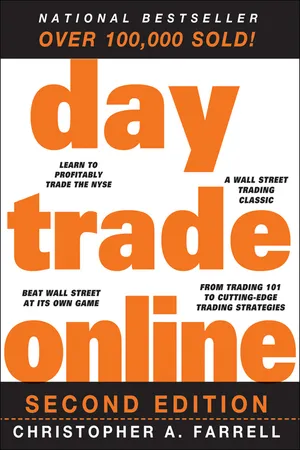
Day Trade Online
About this book
Day trading can be quite lucrative, but only if you know what you are doing. As Farrell points out: "Trading for a living is hard. Trading for a living over the Internet is even harder. There are many challenges and obstacles that confront you. Venturing into this jungle unprepared is a recipe for disaster." This straightforward guide provides the head start and heads up necessary to thrive as a day trader, covering everything from the dangers and pitfalls of trading online to an in-depth analysis of which trading techniques work and which don't. Day Trade Online, Second Edition presents inside information on the strategies of top trading firms, including the most secretive, misunderstood, and profitable function on Wall Street. Most importantly, you will learn to look at ten different stocks and pinpoint which one to trade, when, at what price, and why. With the right know-how, you will be able to apply this knowledge to every single stock that you screen.
SECTION III
How to Beat Wall Street at Its Own Game
Wall Street is in the business of trading against its customers. As a general rule of thumb, the Wall Street trading firms that take the other side of the investing public’s buy and sell orders are buyers on weakness and sellers on strength. They are aggressive buyers into panic selling, and aggressive sellers into panic buying. When the public is fearful, Wall Street is greedy. It exploits the opportunity to accumulate positions at favorable price levels. And when the public is feeling greed and euphoria, Wall Street is cautiously taking profits by liquidating those positions at marked-up prices. To be profitable, the day trader must replicate this, by being on the same side of the supply-and-demand equation as the Wall Street professionals. If not, it will be impossible to make a living as a day trader.
CHAPTER 3
Exploiting Wall Street’s Conflict of Interest
Market Orders versus Limit Orders
Market Orders versus Limit Orders
Whether you are a large brokerage firm, a hedge fund, or a small investor, it is virtually impossible to exit a large trade profitably unless you are able to sell into strength.
UNDERSTANDING WALL STREET’S CONFLICT OF INTEREST
Anyone who has been around Wall Street long enough will come to the conclusion that the work the firms engage in is an inherent conflict of interest. These financial institutions are in the business of advising their clients on the buying and selling of securities, while simultaneously taking the other side of the trades for themselves. Think about this for a moment. When a Wall Street brokerage firm tells its largest clients to buy a stock because it is a great value, who exactly is selling the stock to the clients? The brokerage firm itself. You have to ask yourself: If the stock is such a great buy, why is the brokerage firm not following its own advice? Why would it rather sell it to its clients instead of keeping the stock on its books in the hopes of future price appreciation? Shouldn’t the brokerage firm be putting its own money where its mouth is? You have to believe with their teams of highly paid analysts, investment bankers, and other rocket scientists, these firms are in possession of far more information and knowledge as to the real value of the stock than their customers are.
But the customers don’t see it in such a cynical way. The promise of a high return has a funny way of clouding perception. Investors rely on the brokerage firms for guidance, and depend on the firms’ analysis and insight to steer them toward good investments and away from bad ones. Yet the trading desks at banks and brokerage firms would still rather sell the best stock pick of the year to their customers than keep a long-term position in the stock themselves. Why? It comes down to short-term trading profits. When their customers want to buy the securities, the brokerage firms are making substantial amounts of money on the turnover, by taking the other side of the trade. As the investing public is buying, Wall Street is selling, making money by accumulating an inventory in the stock at lower prices, and “flipping” it to their clients at a marked-up price. This markup is known as the spread.
Think about it in another way. As we’ve said earlier in the book, there is a winner and loser on every trade execution. When Wall Street wins, the investing public usually loses. Whether you are a large brokerage firm, a hedge fund, or a small investor, it is virtually impossible to exit a large trade profitably unless you are able to sell into strength. The brokerage firms know this all too well, using analyst recommendations to create strong buying demand that enables them to liquidate large positions for a profit. If the demand is strong enough, if the buy recommendation is compelling enough, it creates a buying panic as investors trip over each other to grab the stock.
For the public, this is a dangerous way to invest. Remember, as we said in the previous chapter, in the very short run, buying a strong stock on good news is a surefire way to lose money. The panic buying inflates the stock price, creating a short-term top in the stock. When investors are done buying, there is nothing behind them to support the stock price further, which can cause the stock to drop precipitously. When the investing public is greedily buying, Wall Street is cautiously liquidating and taking profits. That is the essence of stock trading, and in part is how Wall Street makes billions of dollars per year.
This is done by the entire gauntlet of Wall Street financial institutions. Big investment banks, full-service brokerage firms, Nasdaq market makers, NYSE member firms, specialists, even the discount and online brokerage firms—they all do it. They all trade against their customers for their own self-serving interests, namely profit. The more trading they can induce their customers to do, the more money they make in the process. That is why, regardless of what the market is doing, these brokerage firms always have an opinion. If the market looks bad, they advise their clients to sell. If the market looks good, they advise their clients to buy. Either way, Wall Street wins, because the firms are skimming small, high-percentage profits off the order flow, regardless of whether their clients make money.
These firms know that as long as customers buy the stock, like a boomerang at some point it will come back out of their accounts as a sell order. And when customers sell, they will immediately be putting the money to work by buying something else, thus generating even more commission revenue and trading profits for the firm that handles the trade. The only way the firms would lose would be if their customers stopped buying and selling. That is why hell would freeze over before these brokerage firms would tell their clients to stop trading, to hold cash for extended periods of time until market conditions improve.
But what about the discount brokers, who, unlike the full-service brokerage firms, aren’t in the business of advising their clients on investment decisions? Naturally, because they make a large percentage of their money on trade commissions and margin interest, they want their clients to trade as much as possible, regardless of whether their customers make or lose money. Their goal is to make their customers feel as comfortable as possible with the trading process, with help desks, trade tutorials, user-friendly trading platforms, and promotions that include free trades. The more comfortable clients are with trading, the more likely they are to trade actively, allowing the online broker to collect a toll on the way in and on the way out.
PRICE MAKERS VERSUS PRICE TAKERS
Now that we have gained some insight into the contrarian trading psychology of the large brokerage firms, let’s switch gears briefly to discuss where the day trader fits into this puzzle. As we discussed, the stock market is nothing more than a collective difference of opinion. For every buyer there is a seller, and for stock to trade, one of two things must happen: Either you agree to the prices of others, or they agree to yours. The advantage, the profit, and the edge lie in getting others to agree to your prices.
I like to call these two types of groups in the market price makers and price takers. The price makers make or set the prices in the stock market, and the price takers take or accept the prices the market gives them. The price makers are the Wall Street trading firms, and the price takers are the investing public. The day trader’s edge—the key to making consistent short-term profits—is to be first and foremost a price maker, allowing participation in Wall Street’s age-old game of making money at the expense of the buying and selling public.
But how does Wall Street do this? If it is taking the other side of your trades, what’s the catch? It’s actually quite simple. Wall Street earns its money when it takes the other side of your trade by dictating or setting the price at which the stock trades. Wall Street forces the investing public into agreeing to the terms and prices it sets, ensuring that Wall Streeters never risk a dime of trading capital unless it is in their best interests to do so. In other words, they are only going to buy stock from you at a price where they are reasonably sure that they can flip it for a quick profit. This is done through the strategic use of limit orders. The use of limit orders is also the key to making consistent short-term profits as a day trader.
THE BARGAINING PROCESS
To understand how limit orders work, let’s look at an analogy. Think of the process of buying a used car. Let’s say you are in the market for a Porsche. You’ve been doing your homework, and you’ve come to the conclusion that the particular year and model that you want, with about 100,000 miles, has a fair-market value of about $37,500. Imagine you are driving along and you see the exact car you are looking for on a neighbor’s lawn with a For Sale sign on the window. To your delight, you find out the car has approximately 100,000 miles on it. You speak to the owner, who says the asking price is $40,000.
What steps do you take to get the best possible deal? Do you just accept the first price that the seller asks? I hope not! Is there better way to buy? Of course there is: Negotiate a better price, bid down, haggle, and make the seller lower the offering price. No one is stupid enough to just take the seller’s first offer, unless it is a phenomenal deal. Why would you pay more money than you have to? The key is that you have a good idea of what the car is worth based on what you have seen and read in the marketplace. You are not going to pay the asking price because you know it is too high.
So, you tell the seller you’ll pay $35,000 for the car, and not a penny more. You are bidding for the car at slightly less that it is worth. The seller now has essentially three choices. First, he or she could agree to your price—hit your bid—and sell you the car at $35,000. Second, he or she could refuse you outright and keep the sale price at $40,000. Or third, he or she could try to meet you halfway by coming back with a lower offering price of, say, $37,500. But you have stated that you are not going to pay any more than $35,000. Your tough stance has put the seller in a real dilemma. If you walk, maybe there are no other buyers and the seller risks never selling the car. You say the offer is only good for 10 minutes, after which you will walk. This puts added pressure on the deal. The beauty of this strategy is that the power is in your hands. You know what the car is worth, and you know you can always shop elsewhere if you can’t agree on a low price right now. The last thing you are going to do is just accept the seller’s terms. In trading terms, by setting the price you bid for the car at $35,000 and no higher, you have used a limit order.
What you have done by bargaining is put yourself in a no-lose situation. Either you buy the car at the price you have set, or you will shop elsewhere. In other words, you are not putting your capital at risk unless the terms are favorable. Your refusal to accept the seller’s terms (of buying the car at $40,000) and determination to buy only at the price you have dictated makes you a price maker. Obviously, the seller would much prefer that you were not savvy enough to negotiate a better price. That way he or she could make a nice profit at your expense.
Imagine what it would be like if you were an active trader of cars and were unaware that you could negotiate a better price than the seller’s first offer. Think of how much money you would leave on the table if you never made any effort to negotiate a better price for yourself. You wouldn’t last in the business, because you would eventually be broke. No sane person would ever do business this way.
Yet, ironically, this is precisely the way most people buy and sell stocks. What the public doesn’t realize is that they are doing precisely the same thing when they buy and sell stocks at the market as when they buy a car by accepting the seller’s first offering price. By buying and selling at the market, these investors are agreeing to the terms of counterparty to the trade without attempting to negotia...
Table of contents
- Title Page
- Copyright Page
- Dedication
- PREFACE
- Acknowledgements
- Introduction
- SECTION I - The World of the Day Trader
- SECTION II - Introduction to Day Trading
- SECTION III - How to Beat Wall Street at Its Own Game
- SECTION IV - Introduction to Scalping the NYSE: Taking Food Out of the ...
- SECTION V - Trading the Market’s Momentum: How to Profit from Volatility
- APPENDIX A - The Day Trader’s Arsenal: Online Brokers, Trade Commissions, ...
- APPENDIX B - Considerations for Trading for a Living: The Allocation of Trading ...
- INDEX
Trusted by 375,005 students
Access to over 1.5 million titles for a fair monthly price.
Study more efficiently using our study tools.
Frequently asked questions
Yes, you can cancel anytime from the Subscription tab in your account settings on the Perlego website. Your subscription will stay active until the end of your current billing period. Learn how to cancel your subscription
No, books cannot be downloaded as external files, such as PDFs, for use outside of Perlego. However, you can download books within the Perlego app for offline reading on mobile or tablet. Learn how to download books offline
Perlego offers two plans: Essential and Complete
- Essential is ideal for learners and professionals who enjoy exploring a wide range of subjects. Access the Essential Library with 800,000+ trusted titles and best-sellers across business, personal growth, and the humanities. Includes unlimited reading time and Standard Read Aloud voice.
- Complete: Perfect for advanced learners and researchers needing full, unrestricted access. Unlock 1.5M+ books across hundreds of subjects, including academic and specialized titles. The Complete Plan also includes advanced features like Premium Read Aloud and Research Assistant.
We are an online textbook subscription service, where you can get access to an entire online library for less than the price of a single book per month. With over 1.5 million books across 990+ topics, we’ve got you covered! Learn about our mission
Look out for the read-aloud symbol on your next book to see if you can listen to it. The read-aloud tool reads text aloud for you, highlighting the text as it is being read. You can pause it, speed it up and slow it down. Learn more about Read Aloud
Yes! You can use the Perlego app on both iOS and Android devices to read anytime, anywhere — even offline. Perfect for commutes or when you’re on the go.
Please note we cannot support devices running on iOS 13 and Android 7 or earlier. Learn more about using the app
Please note we cannot support devices running on iOS 13 and Android 7 or earlier. Learn more about using the app
Yes, you can access Day Trade Online by Christopher A. Farrell in PDF and/or ePUB format, as well as other popular books in Business & Trading. We have over 1.5 million books available in our catalogue for you to explore.