This book provides a pedagogical examination of the way in which stochastic models are encountered in applied sciences and techniques such as physics, engineering, biology and genetics, economics and social sciences. It covers Markov and semi-Markov models, as well as their particular cases: Poisson, renewal processes, branching processes, Ehrenfest models, genetic models, optimal stopping, reliability, reservoir theory, storage models, and queuing systems. Given this comprehensive treatment of the subject, students and researchers in applied sciences, as well as anyone looking for an introduction to stochastic models, will find this title of invaluable use.
In this introductory chapter we present some notions regarding sequences of random variables (r.v.) and the most important classes of random processes.
1.1. Sequences of random variables
Let
be a probability space and (An) a sequence of events in
.
– The set of ω ∈ Ω belonging to an infinity of An, that is,
is called the upper limit of the sequence (An).
– The set of ω ∈ Ω belonging to all An except possibly to a finite number of them, that is,
is called the lower limit of the sequence (An).
THEOREM 1.1.– (Borel-Cantelli lemma)Let(An)be a sequence of events in
.
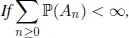
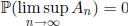
1.
, them
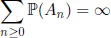
2.
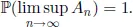
and(An)is a sequence of independent events, then
Let (Xn) be a sequence of r.v. and X an r.v., all of them defined on the same probability space
. The convergence of the sequence (Xn) to X will be defined as follows:
1. Almost sure
2. In probability
if for any ε > 0,
.
3. In distribution(or weekly, or in law)
pointwise in every continuity point of FX, where FXn and FX are the distribution functions of Xn and X, respectively.
4. In mean of order
for all n ∈ N+, and if
. The most commonly used are the cases p = 1 (convergence in mean) and p = 2 (mean square convergence).
The relations between these types of convergence are as follows:
[1.1]
The convergence in distribution of r.v. is a convergence property of their distributions (i.e. of their laws) and it is the most used in probability applications. This con...
Table of contents
Cover
Dedication
Title Page
Copyright
Preface
Chapter 1: Introduction to Stochastic Processes
Chapter 2: Simple Stochastic Models
Chapter 3: Elements of Markov Modeling
Chapter 4: Renewal Models
Chapter 5: Semi-Markov Models
Chapter 6: Branching Models
Chapter 7: Optimal Stopping Models
Bibliography
Notation
Index
Frequently asked questions
Yes, you can cancel anytime from the Subscription tab in your account settings on the Perlego website. Your subscription will stay active until the end of your current billing period. Learn how to cancel your subscription
No, books cannot be downloaded as external files, such as PDFs, for use outside of Perlego. However, you can download books within the Perlego app for offline reading on mobile or tablet. Learn how to download books offline
Perlego offers two plans: Essential and Complete
Essential is ideal for learners and professionals who enjoy exploring a wide range of subjects. Access the Essential Library with 800,000+ trusted titles and best-sellers across business, personal growth, and the humanities. Includes unlimited reading time and Standard Read Aloud voice.
Complete: Perfect for advanced learners and researchers needing full, unrestricted access. Unlock 1.4M+ books across hundreds of subjects, including academic and specialized titles. The Complete Plan also includes advanced features like Premium Read Aloud and Research Assistant.
Both plans are available with monthly, semester, or annual billing cycles.
We are an online textbook subscription service, where you can get access to an entire online library for less than the price of a single book per month. With over 1 million books across 990+ topics, we’ve got you covered! Learn about our mission
Look out for the read-aloud symbol on your next book to see if you can listen to it. The read-aloud tool reads text aloud for you, highlighting the text as it is being read. You can pause it, speed it up and slow it down. Learn more about Read Aloud
Yes! You can use the Perlego app on both iOS and Android devices to read anytime, anywhere — even offline. Perfect for commutes or when you’re on the go. Please note we cannot support devices running on iOS 13 and Android 7 or earlier. Learn more about using the app
Yes, you can access Introduction to Stochastic Models by Marius Iosifescu,Nikolaos Limnios,Gheorghe Oprisan in PDF and/or ePUB format, as well as other popular books in Mathematics & Probability & Statistics. We have over one million books available in our catalogue for you to explore.