- Provides a unifying analytic framework for the study of urban tourism.
- Brings urban tourism into focus as an important political, economic and cultural phenomenon.
- Presents original essays written by established scholars, including studies of Venice, Mexico, Montreal, New York, Los Angeles, London, Barcelona, Berlin, Amsterdam, Paris, and Australia's Gold Coast.
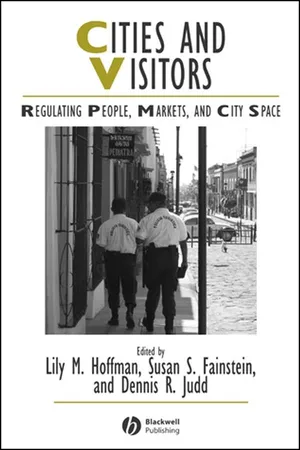
eBook - ePub
Cities and Visitors
Regulating People, Markets, and City Space
- English
- ePUB (mobile friendly)
- Available on iOS & Android
eBook - ePub
Cities and Visitors
Regulating People, Markets, and City Space
About this book
The authors of this book use regulation theory to bring theoretical focus and analytic clarity to the study of urban tourism.
Information
Part I
Regulating Visitors
1 Visitors and the Spatial Ecology of the City
Dennis R. Judd
2 Cities, Security, and Visitors: Managing Mega-Events in France
Sophie Body-Gendrot
3 Sociological Theories of Tourism and Regulation Theory
Nicolò Costa and Guido Martinotti
1
Visitors and the Spatial Ecology of the City
In the post-structuralist urban literature,1 enclaves represent local nodes of international circuits of capital and culture, though each of them may masquerade as a local space: gated communities, through the magic of marketing, become neighborhoods; malls are said to be the new marketplaces; and tourist bubbles offer simulacra of the cities they are replacing. As Michael Sorkin describes it, the “new city replaces the anomaly and delight of [local] places with a universal particular, a generic urbanism inflected only by appliqué” (1992: xiii). In his account, this new city is characterized by “rising levels of manipulation and surveillance” and “new modes of segregation,” all put in the service of a “city of simulations, television city, the city as theme park” (Sorkin 1992: xiii–xiv). David Harvey echoes the frequently expressed concern that cities are being turned into sanitized, monotonous copies of one another, “almost identical from city to city” (1989: 295). Similarly, Chris Rojek describes a “universal cultural space” that “provides the same aesthetic and spatial references wherever one is in the world” (1995: 146).
By now an overwhelming consensus has emerged around the assertion that these enclaves are different from the public spaces of the past. Enclosure, it is said, facilitates new forms of domination. Tim Edensor proposes that the tourist enclave is a “total institution” of regulation that “materializes an ideology of consumption and regulates the performances of tourists” (1998: 52). Edensor echoes Lefebvre’s observation that tourist spaces “are planned with the greatest care: centralized, organized, hierarchized, symbolized and programmed to the nth degree” (1991: 384). Tilling the same ground, John Hannigan asserts that the uniformity of the spaces they inhabit subjects tourists to “a measured, controlled and organized kind of urban experience” (1998: 6) that eliminates the unpredictable quality of everyday street life. Such views seem to inexorably confirm Daniel Boorstin’s complaint, expressed as early as 1961, that tourists have become passive consumers of pleasure “isolated within tourist facilities” whose promoters specialize in sponsoring pseudo-events and performances (1961: 94, 97, 109).
In this chapter I contest the vision that foresees the future city as little more than an assemblage of fortified spaces colonized by global capital and affluent residents and visitors. Predictions of such a dismal urban dystopia seem warranted only if one’s focus is restricted to a few cities. Some older manufacturing and port cities in the United States and England have shared a trajectory that seems to confirm the direst predictions: a steep decline during the deindustrialization of the 1970s and 1980s, followed by a style of revitalization that sharply segmented urban space, to the benefit of the affluent middle class and the detriment of the poor (Judd and Parkinson 1990). Baltimore may be taken as emblematic of this type of redevelopment; its famed Harborplace is a virtual reservation for visitors who rarely experience the rest of a troubled city (Hula 1990; Harvey 2001: 128–57). It makes sense that Los Angeles should inspire the “LA School” of urban geographers to theorize a fragmented and centerless city, because it is one (Dear 2002). Las Vegas has also become an object of fascinated scrutiny because it seems to provide a voyeuristic glimpse into a city that has been constructed as a façade of carnival and spectacle (Rothman and Davis 2002).
But it is hazardous to treat these and cities like them as harbingers of what all cities are destined to become. The fractured character of Baltimore, Los Angeles, and Las Vegas may be exceptional rather than archetypal. Despite the effects of globalization, cities vary significantly from one another, and they are not necessarily converging. Boston, for example, is a walking city for residents and visitors alike, notwithstanding the presence of the world’s first Rouse mall at Faneuil Hall and an interconnected mall and hotel complex at Copley Plaza (Ehrlich and Dreier 1999). The streets outside these enclosures are crowded with local residents and visitors, and visitors spill over into business and residential areas far more freely than a decade ago. Likewise, tourists are not confined within barricaded spaces in New York, San Francisco, or Chicago, despite the presence of tourist bubbles such as South Street Seaport, Ghirardelli Square, and the Magnificent Mile.
Tourist enclaves have become ubiquitous features within cities, but they do not inexorably overwhelm them. In assessing the spatial character of urban tourism, the scale of analysis is fundamental. Within tourist enclaves, a non-democratic, directive, and authoritarian regulation is attempted and generally achieved. But when urban tourism is considered at the scale of the city, enclaves generally capture only some of the visitors some of the time. Urban tourism does not operate, in most cities, as a “total institution” of regulation, and it is not likely that it will do so in the future. I pursue this line of argument in the remainder of this chapter.
The Construction of Tourist Enclaves
Until the rise of mass tourism in the latter half of the nineteenth century, cities held a special status as travel destinations. The cities of the Grand Tour of the fifteenth through the eighteenth centuries – mainly Paris, Geneva, Rome, Florence, Venice, Naples – were visited as a rite of passage by young men of the British upper class, who were expected to come of age by seeing “the ruins of classical Rome as well as the churches and palaces and art collections of the great Continental capitals” (Withey 1997: 7). The Grand Tour cities offered a veneer of high culture as well as abundant worldly diversions, but they were also often reviled. As the historian Lynne Withey has observed, the signs of poverty, social disorder, and physical decay were everywhere apparent in Rome, Naples, and Venice, and Paris was a warren of overcrowded streets filled with careening horses and wagons, strewn with garbage and running with sewage (Withey 1997).
Whatever the drawbacks of the Grand Tour cities, travelers were willing to brave weeks of discomfort to negotiate rutted roads and nearly impassable mountains, if necessary, to get to them. The hazards and inconvenience of travel sharpened a widely shared disdain for nature and the natural. Mountains were considered ugly and forbidding, seacoasts generally inaccessible and dangerous. By the mid-eighteenth century, however, such attitudes began to change. Nature was discovered as a vast repository of sublime views and vistas. The Romantic poets reinterpreted nature as a tamed backdrop of leafy bowers, stately trees, and placid lakes. With the rise of the industrial cities of the nineteenth century, the worship of nature reached full bloom, now interpreted through Thoreau, Wordsworth, and their contemporaries as the repository of the human spirit, as opposed to the meanness and gloom of the cities.
The “American Grand Tour” of the post-Civil War years provided a sharp contrast with its earlier European counterpart, with trips up the Hudson and Connecticut river valleys as “prime examples of the picturesque,” and the Catskill Mountains and Niagara Falls as iconic examples of the “sublime” (Withey 1997: 117). But Europeans also visited such places as St Louis, Cincinnati, and Chicago to see the dramatic evidence of bustling progress and industry. They noted the grand hotels and mansions, riverboats, and steamships; recently arrived immigrants and even sometimes the occasional Indian, all combined into “a curious mixture of the civilized and the primitive” (Withey 1997: 131). Urban elites were convinced that visitors’ perceptions might determine a city’s economic prospects, and so they assiduously promoted (real and imagined) cultural, educational, and artistic accomplishments (Wade 1959).
European cities were reborn as tourist destinations by becoming stops on a democratized version of the Grand Tour. Beginning in the 1850s, Thomas Cook began the age of mass tourism by leading package tours to the continent. Cities promoted themselves as well, but as centers of industry more than of culture. The glorification of technology and progress supplied the common thread running through the fairs and exhibitions of the nineteenth and first decades of the twentieth centuries: London’s Crystal Palace exposition of 1851 and the Paris Exhibition of 1867; across the ocean, the World’s Fairs of Chicago in 1893, St Louis in 1904, and New York in 1938.
But such promotional activities were not sufficient by themselves to transform cities into tourist destinations. The cities of the industrial age were as often noted for their squalid slums and social problems as for their architectural and cultural treasures (Hall 1996: ch. 2). A visitor who chose to travel a city’s streets randomly might well have many adventures, but not all would likely be welcomed. Urban tourism grew in tandem with the signposting of the sites and sights that visitors should seek out. When Thomas Cook began offering package tours to European cities, he took his charges to significant historical sites and to cultural attractions, arranged lodging, and provided essential information and assistance (Urry 1990: 24). By 1869 he was leading the first tourists to Jerusalem and the Holy Land, a business that mushroomed (through Thomas Cook and Son) to 5,000 visitors a year within a decade (Brendon 1991: 120–3).
Package tours demystified the place being visited by breaking it into manageable parts, each of which carried significance and meaning. By the turn of the century most major European cities had been thus interpreted through guidebooks, and guiding services had sprung up to compete with Cook. In the United States, a parallel process evolved, but local tourism entrepreneurs took the lead. Guidebooks, sketches, drawings, and photographs “coached” visitors about what to see and do. The representations and the physical spaces “played a key role in both making cities appealing to tourists and conveying a sense of social unity” (Cocks 2001: 144). Local tour operators translated the descriptions and representations found in guide books into physical reality by providing tourists with fixed itineraries, which reduced the cities they saw to a mélange of monuments, historical sites, and cultural facilities. The tourist experience on mass transportation and guided tours reduced the city to a panorama of a “passing city” seen in a “spectatorial, fascinated manner” (ibid.: 164). World’s Fairs and exhibitions embellished the habit of seeing cities as a collage of stylized urban images and set scenes. As one visitor observed about the World’s Columbian Exposition at the Chicago World’s Fair of 1893, “The Fair is a world... in which ugliness and useless[ness] have been extirpated, and the beautiful and useful alone admitted” (ibid.: 128). The City Beautiful movement derived much of its inspiration from the Chicago World’s Fair, with its focus on monumental architecture, parks, and public spaces.
Half a century later, a similar process of image-making and spatial reconstruction unfolded. By the 1960s in the United States the older industrial cities were faced with the physical dilapidation of downtowns and the spread of blight through miles of neighborhoods surrounding the core. The massive clearance projects financed by urban renewal failed to bring a renaissance, and any improvements from the federal grant programs of the 1960s and 1970s were overshadowed by crime, riots, and social unrest. Republican candidates and the media portrayed cities as outposts of violence and racial problems, so that terms like ghetto, welfare, the underclass, crime, and the inner city became conflated into interchangeable images (Edsall and Edsall 1991). As a result, a narrative of urban decline entered the national consciousness that mostly erased the positive images that cities might have inherited from the past (Beauregard 1993).
A generation of “Messiah mayors” burst onto the American scene in the 1980s, proclaiming a gospel of self-help and renewal (Teaford 1990). By using tax breaks and subsidies and new public/private partnerships, they stimulated a remarkable period of regeneration. Especially in older cities, a tourist bubble took form around a cluster of facilities and amenities (new waterfronts, atrium hotels, festival malls, convention centers, sports stadiums, entertainment districts), a space or series of spaces segregated from the remainder of the city. By building fortress spaces, even the most crime-ridden cities were able to carve out islands and reservations that could comfortably be inhabited by tourists and middle-class city residents.
In the ensuing years, enclavic tourist spaces have multiplied throughout the world. Stephen Graham and Simon Marvin predict the global proliferation of fantasy cities that bundle together retailing, restaurants and bars, performance halls, cinemas and IMAX theatres, hotels, video and virtual reality centers, and other diversions into an all-consuming environment of consumption and entertainment (2001: 265). Even now, a world traveler can find versions of these entertainment complexes scattered all over the globe (Iyer 2000).
Plate 1.1 Times Square, New York, entertainment complex.
Source: Corbis

Tourist Enclaves as “Total Regulation” Regimes
Baudrillard’s analysis of sites of consumption as cultural fields composed of “a sign-consuming totality” is helpful in understanding how the managers of tourist enclaves may attempt to regulate their users. Baudrillard writes that shopping centers are places in which “art and leisure mingle with everyday life” and constitute, in effect, subcultures of their own that establish a perfect context for consumption through “the total conditioning of action and time” (Baudrillard 1998: 28, 29). They allow desire and satiation to be blended into a super-heated mixture in which all sensations become overwhelmed by a pandemonium composed of a “sweeping vista of perpetual shopping” (ibid.: 30). Enclavic tourist spaces may operate similarly, by enveloping visitors within an environment that floods their senses with the signs and symbols of consumption and play.
Such experiences may be conceived as comprising a totalizing environment that filters the tourists’ perceptions, experiences, and desires. This is akin to Bourdieu’s habitus, a constellation of the dispositions and attitudes, practices, and representations that organize everyday life (Bourdieu 1990a), or (in Aboulafia’s excellent summary) “the home of our non-reflexive engagement with the world” (Aboulafia 1999: 166). As a constellation of behaviors, habitus can, in effect, act as an agent protecting itself from change and disruptions, but “it” can also make choices to deflect challenges to its continued existence:
Early experiences have particular weight because the habitus tends to ensure its own constancy and its defence against change through the selection it makes within new information... Through the systematic “choices” it makes among the places, events and people that might be frequented, the habitus tends to protect itself from crises and critical challenges by providing itself with a milieu to which it is as pre-adapted as possible. (Bourdieu 1990b: 60–1)
The tourists who inhabit enclavic spaces are encouraged to act, essentially, like factory workers subjected to “the time-sheet, the timekeeper, the informers, and the fines” (Thompson 1967). Because they are bounded by physical barriers and are designed for specialized activities, venues such as sports stadiums, convention centers, and malls may accomplish an almost total regulation of the body. Sports stadiums and convention centers, for example, are designed for the sole purpose of performance, and users who have other activities in mind are apt to be thrown out. Likewise, shopping malls are built as palaces of consumption; aimless loitering is discouraged or forbidden. Though they sometimes masquerade as public spaces, such confining environments project a “finite, or finished, aspect” that directs everything inward (Lefebvre 1991: 147). As Edensor has noted, these spaces may become as subject to the “remorseless surveillance through panopticon visual monitoring” as the carceral networks described by Foucault (Foucault 1977; Edensor 1998).
Enclavic tourist spaces are designed to regulate their inhabitants through the control of four principal aspects of agency: desire, consumption, movement, and time. Desire and consumption are regulated by promotion and marketing. Time and movement are strictly confined (by corridors, turnstiles, escalators, tunnels and tubes) and monitored (by security cameras and security guards). The use of time is also constrained by the scheduling of staged spectacles and performances and by physical features such as the availability or absence of seating and gathering places. The experiences and products on offer combine homogeneity and heterogeneity – enough of the former to give a sense of comfort and familiarity, enough of the latter to induce a sense of novelty and surprise.
Activities except those encouraged by corporate sponsors are often intercepted or forbidden. Malls routinely prohibit political activities of any kind, and security forces are quick to escort conspicuous non-consumers off the premises. The way that this works can be discerned in the opening of the World Financial Center in New York City in October 1988. The advertising agents for the developer, Olympia & York, staged five days of celebrations, all intended to convey (in the advertising firm’s language) “a progressive understanding of the uses of public space.” As it transpired, the celebrations were tied closely to the marketing needs of the businesses located in the Center. The sponsored activities defined and strictly limited the activities of the participants, who were reduced to the status of passive observers (Boyer 1994: 468).
If cities were composed mainly of archipelagos of enclaves, visitors and local inhabitants would scarcely be able to escape the close surveillance and control that enclavic space facilitates. However, enclaves constitute only one component of an increasingly complex spatiality of urban tourism. The environments inhabited by city visitors run the gamut from spaces built specifically for the production of spectacle and consumption, to public spaces such as waterfronts, parks, and plazas, to business and residential streets. This complex geography provides plenty of opportunity for visitors to escape the confines of enclosure.
The Complex Spatiality of Urban Tourism
Visitors to some cities find it difficult to move freely about. Most visitors to Detroit quickly exhaust the attractions of the Renaissance Center and Greektown, but they walk into the surrounding city at their own peril. Visitors to Baltimore are generally advised to avoid the “other Baltimore” that lies outside the Harborplace development, with its broad marble and stone plazas, Rouse mall, aquarium, restaurants and bars, and luxury hotels (Hula 1990; Harvey 2001: 128–57). In Las Vegas virtually all visitors are confined within casinos, hotels, and malls. But these cities lie at the extreme of a continuum. Typically, enclaves inhabited by visitors coexist with downtown business districts, streets populated with local small businesses and shops, neighborhoods, and public buildings, and public spaces.
Enclaves are generally incorporated into an urban texture which has it...
Table of contents
- Cover
- Series
- Title page
- Copyright
- List of Illustrations
- List of Tables
- List of Contributors
- Series Editors’ Preface
- Preface
- Introduction
- Part I: Regulating Visitors
- Part II: Regulating City Space
- Part III: Regulating Labor Markets
- Part IV: Regulating the Tourism Industry
- Part V: Conclusion
- Index
Trusted by 375,005 students
Access to over 1.5 million titles for a fair monthly price.
Study more efficiently using our study tools.
Frequently asked questions
Yes, you can cancel anytime from the Subscription tab in your account settings on the Perlego website. Your subscription will stay active until the end of your current billing period. Learn how to cancel your subscription
No, books cannot be downloaded as external files, such as PDFs, for use outside of Perlego. However, you can download books within the Perlego app for offline reading on mobile or tablet. Learn how to download books offline
Perlego offers two plans: Essential and Complete
- Essential is ideal for learners and professionals who enjoy exploring a wide range of subjects. Access the Essential Library with 800,000+ trusted titles and best-sellers across business, personal growth, and the humanities. Includes unlimited reading time and Standard Read Aloud voice.
- Complete: Perfect for advanced learners and researchers needing full, unrestricted access. Unlock 1.5M+ books across hundreds of subjects, including academic and specialized titles. The Complete Plan also includes advanced features like Premium Read Aloud and Research Assistant.
We are an online textbook subscription service, where you can get access to an entire online library for less than the price of a single book per month. With over 1.5 million books across 990+ topics, we’ve got you covered! Learn about our mission
Look out for the read-aloud symbol on your next book to see if you can listen to it. The read-aloud tool reads text aloud for you, highlighting the text as it is being read. You can pause it, speed it up and slow it down. Learn more about Read Aloud
Yes! You can use the Perlego app on both iOS and Android devices to read anytime, anywhere — even offline. Perfect for commutes or when you’re on the go.
Please note we cannot support devices running on iOS 13 and Android 7 or earlier. Learn more about using the app
Please note we cannot support devices running on iOS 13 and Android 7 or earlier. Learn more about using the app
Yes, you can access Cities and Visitors by Lily M. Hoffman, Susan S. Fainstein, Dennis R. Judd, Lily M. Hoffman,Susan S. Fainstein,Dennis R. Judd in PDF and/or ePUB format, as well as other popular books in Social Sciences & Urban Sociology. We have over 1.5 million books available in our catalogue for you to explore.