Socks are portable, fun to knit, and quick to complete—and they make great gifts. This step-by-step guide walks you through all the techniques used to knit beautiful socks—from buying yarn to working on double-pointed needles, from turning a heel to grafting a toe. It covers knitting socks top-down, toe-up, and flat, explains how to create various heels and toes, and gives you a dozen original patterns for everything from baby booties to knee socks. Whether you're new to knitting or just new to socks, you'll learn the skills needed for a lifetime of creative sock knitting.
- English
- ePUB (mobile friendly)
- Available on iOS & Android
eBook - ePub
Teach Yourself VISUALLY Sock Knitting
Chapter 1: Sock Yarn and Other Materials
When you go to the yarn store and ask for sock yarn, odds are you will face a huge wall full of yarn. Sock yarn is available in an array of colors, fibers, and textures. Nearly any yarn can be used to knit socks, but some yarns work better than others. Different fiber contents and thicknesses will affect the feel, utility, and care of your socks, so carefully consider what you’ll make when you pick out your yarn. In this chapter, you learn about different yarn types, fibers, and textures, and how to best use each kind of yarn for socks. Matching a yarn to a pattern is sometimes daunting, so here you also learn how to figure out what yarn works best for different types of sock patterns.
In addition to yarn, you need a few more things to get started. First and foremost, you need needles! Depending on what form of sock you decide to knit, you need either double-pointed, circular, or straight needles. You also need a few important notions. For some types of patterns, you might need some extra tools, too.
Yarn Weights
Protein Fibers
Cellulose and Other Fibers
Work with Color
Match Your Yarn to Your Pattern
Needle Materials
Needle Types
Notions
Using Stitch Markers
Yarn Weights
Yarns are categorized according to thickness into eight main categories. Fingering weight is the most common weight marked as sock yarn. Other weights like sport, DK, worsted, and chunky can also make great, fast-knitting socks.
• Lace Weight: Lace weight yarns vary greatly in terms of actual yarn thickness. Thicker lace weight yarns can make comfortable, thin socks if knit on an appropriate needle size—US 0 (2mm) or smaller, with a gauge of 10 stitches per inch or more. Two strands of lace weight yarn held together will approximate the thickness of fingering weight yarn (see below). A thick lace weight yarn will measure about 250–325 yards per 50g skein or ball.
• Fingering Weight: The term fingering weight is often used interchangeably with sock weight and is the thickness most often associated with knitting socks. It usually knits up to approximately 7–10 stitches per inch in stockinette stitch on US 00 to US 3 needles (1.75–3.25mm), depending on the thickness of the yarn and how tightly you knit. Fingering weight yarn is sold in amounts ranging from about 180–220 yards per 50g skein. Socks knit from fingering weight yarn are fairly thin and perfect for everyday wear.
• Sport Weight: Sport weight yarn is slightly heavier than fingering weight and knits up to approximately 6–7 stitches per inch on US 3 to US 5 (3.25 – 3.75) needles for a dense fabric. Socks made with sport weight yarn are often a bit faster to knit than those made with fingering weight yarn and they feel thicker. Sport weight yarn is sold in amounts of 140–200 yards per 50g skein.
• DK and Worsted Weight: Double knitting (DK) and worsted weight yarns are similar in thickness, with worsted weight being thicker than DK. Worsted and DK yarns are labeled as knitting to a gauge of 5–6 stitches per inch. However, to create a sturdy, durable fabric for socks, these yarns should be knit at a slightly tighter gauge—approximately 5.5–7 stitches per inch.
A good rule of thumb is to choose needles two or three sizes smaller than the size suggested on the ball band — rather than a US 7 (4.5mm), try a US 5–7 (3.5–3.75mm) for a good fabric from worsted weight yarn. You need a slightly smaller needle to produce a similar fabric with DK yarn. Worsted weight yarns usually weigh in at 90–100 yards per 50g ball.
• Aran and Chunky Weight: Aran weight yarn is sometimes considered heavy worsted weight and usually knits up to 4.5 stitches per inch. Aran weight yarn weighs in around 85 yards per 50g skein. To get a good sock fabric with Aran weight, try using a US 5 to US 7 (3.75–4.5mm) needle for a gauge of 5–5.5 stitches per inch.
Chunky weight yarn is thicker than Aran weight and knits up to 3.5–4 stitches per inch. It comes in skeins or balls of about 60–80 yards per 50g skein. For a dense sock fabric, try US 6 to US 8 (4 –5mm) needles. Aran and chunky weight yarns make thick socks suited for boots or indoor wear.
• Bulky and Superbulky Weight: Bulky weight yarn knits up to 3–3.5 stitches per inch, while superbulky weight encompasses any yarn thicker than 3 stitches per inch. Since these yarns are rather thick, they are not the best choice for socks—although they work great for cozy slippers!
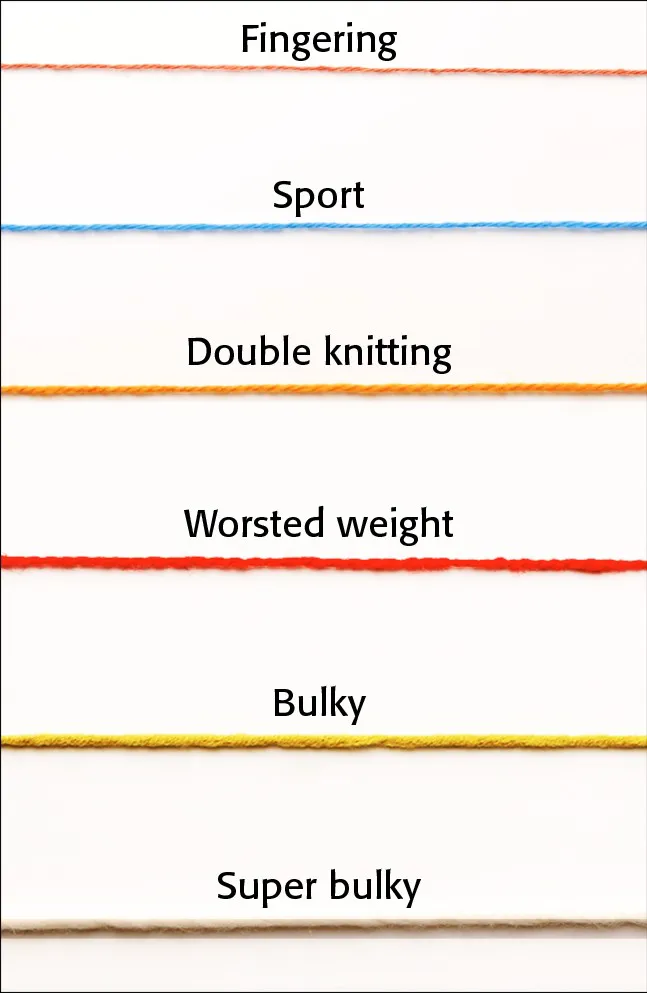

Note: This chart reflects the most commonly used gauges and needle or hook sizes for specific yarn categories. These are only guidelines. Used w...
Table of contents
- Cover
- Table of Contents
- Title Page
- Chapter 1: Sock Yarn and Other Materials
- Chapter 2: Knitting Techniques
- Chapter 3: Get Started
- Chapter 4: Top-Down Socks
- Chapter 5: Flat Socks
- Chapter 6: Toe-Up Socks
- Chapter 7: More Sock Patterns
- Chapter 8: Troubleshooting: Fixing Mistakes
- Chapter 9: Care for Your Socks
- Appendix
Trusted by 375,005 students
Access to over 1.5 million titles for a fair monthly price.
Study more efficiently using our study tools.