- English
- ePUB (mobile friendly)
- Available on iOS & Android
eBook - ePub
About this book
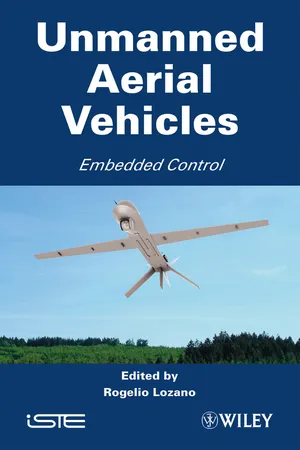
This book presents the basic tools required to obtain the dynamical models for aerial vehicles (in the Newtonian or Lagrangian approach). Several control laws are presented for mini-helicopters, quadrotors, mini-blimps, flapping-wing aerial vehicles, planes, etc. Finally, this book has two chapters devoted to embedded control systems and Kalman filters applied for aerial vehicles control and navigation. This book presents the state of the art in the area of UAVs. The aerodynamical models of different configurations are presented in detail as well as the control strategies which are validated in experimental platforms.
Information
Chapter 1
Aerodynamic Configurations and Dynamic Models 1
1.1. Aerodynamic configurations
In this chapter, we present the aerodynamic configurations commonly used for UAV (unmanned aerial vehicles) control design. Our presentation is focused on mini-vehicles like the airplane (fixed wing models), the flapping wing UAV aircrafts, and the rotorcrafts (rotary wing models). The rotorcrafts will also be classified according to the number of rotors they are equipped with: 1, 2, 3 or 4.
A UAV, also called drone, is a self-descriptive term commonly used to describe military and civil applications of the latest generations of pilotless aircraft. UAVs are defined as aircrafts without the onboard presence of human pilots, used to perform intelligence, surveillance, and reconnaissance missions. The technological objective of UAVs is to serve across the full range of missions cited previously. UAVs present several basic advantages compared to manned systems that include better maneuvrability, lower cost, smaller radar signatures, longer endurance, and minor risk to crew.
Usually, people, and also we ourselves, tend to use the terms airplane and aircraft as synonymous. However, dictionary defines an aircraft as any craft that flies through the air, whether it be an airplane, a helicopter, a missile, a glider, a balloon, a blimp, or any other vehicle that uses the air to generate lift for flight. On the other hand, the term airplane is more specific and refers only to a powered vehicle with fixed wings to generate lift.
Each type of mini-aerial vehicle presents advantages and disadvantages but scenarios are used to represent different types of UAV. For instance, fixed-wing UAVs can easily achieve high efficiency and long flight times compared to other UAVs, consequently they are well suited to operating during required extended loitering times. Nevertheless they are usually unable to enter buildings since they cannot hover or make the tight turns required. In opposition to fixed-wing UAVs, rotary-wing UAVs (like vertical take-off and landing aircrafts — VTOL or short take-off and landing aircrafts — STOL) can easily hover and move in any direction during a shorter flight time [HIR 97]. The last flapping-wing configuration offers the best potential in terms of miniaturization and maneuvrability compared to fixed- and rotary-wing UAVs, but are usually very inferior to fixed- and rotary-wing MAVs (micro air vehicles (MAVs)).
Single rotor configuration
This type of aerodynamic configuration is composed of a single rotor and ailerons to compensate the rotor torque (yaw control input). Si...
Table of contents
- Cover
- Title Page
- Copyright
- Chapter 1: Aerodynamic Configurations and Dynamic Models
- Chapter 2: Nested Saturation Control for Stabilizing the PVTOL Aircraft
- Chapter 3: Two-Rotor VTOL Mini UAV: Design, Modeling and Control
- Chapter 4: Autonomous Hovering of a Two-Rotor UAV
- Chapter 5: Modeling and Control of a Convertible Plane UAV
- Chapter 6: Control of Different UAVs with Tilting Rotors
- Chapter 7: Improving Attitude Stabilization of a Quad-Rotor Using Motor Current Feedback
- Chapter 8: Robust Control Design Techniques Applied to Mini-Rotorcraft UAV: Simulation and Experimental Results
- Chapter 9: Hover Stabilization of a Quad-Rotor Using a Single Camera
- Chapter 10: Vision-Based Position Control of a Two-Rotor VTOL Mini UAV
- Chapter 11: Optic Flow-Based Vision System for Autonomous 3D Localization and Control of Small Aerial Vehicles
- Chapter 12: Real-Time Stabilization of an Eight-Rotor UAV Using Stereo Vision and Optical Flow
- Chapter 13: Three-Dimensional Localization
- Chapter 14: Updated Flight Plan for an Autonomous Aircraft in a Windy Environment
- List of Authors
- Index
Trusted by 375,005 students
Access to over 1.5 million titles for a fair monthly price.
Study more efficiently using our study tools.
Frequently asked questions
Yes, you can cancel anytime from the Subscription tab in your account settings on the Perlego website. Your subscription will stay active until the end of your current billing period. Learn how to cancel your subscription
No, books cannot be downloaded as external files, such as PDFs, for use outside of Perlego. However, you can download books within the Perlego app for offline reading on mobile or tablet. Learn how to download books offline
Perlego offers two plans: Essential and Complete
- Essential is ideal for learners and professionals who enjoy exploring a wide range of subjects. Access the Essential Library with 800,000+ trusted titles and best-sellers across business, personal growth, and the humanities. Includes unlimited reading time and Standard Read Aloud voice.
- Complete: Perfect for advanced learners and researchers needing full, unrestricted access. Unlock 1.5M+ books across hundreds of subjects, including academic and specialized titles. The Complete Plan also includes advanced features like Premium Read Aloud and Research Assistant.
We are an online textbook subscription service, where you can get access to an entire online library for less than the price of a single book per month. With over 1.5 million books across 990+ topics, we’ve got you covered! Learn about our mission
Look out for the read-aloud symbol on your next book to see if you can listen to it. The read-aloud tool reads text aloud for you, highlighting the text as it is being read. You can pause it, speed it up and slow it down. Learn more about Read Aloud
Yes! You can use the Perlego app on both iOS and Android devices to read anytime, anywhere — even offline. Perfect for commutes or when you’re on the go.
Please note we cannot support devices running on iOS 13 and Android 7 or earlier. Learn more about using the app
Please note we cannot support devices running on iOS 13 and Android 7 or earlier. Learn more about using the app
Yes, you can access Unmanned Aerial Vehicles by Rogelio Lozano in PDF and/or ePUB format, as well as other popular books in Biological Sciences & System Theory. We have over 1.5 million books available in our catalogue for you to explore.