eBook - ePub
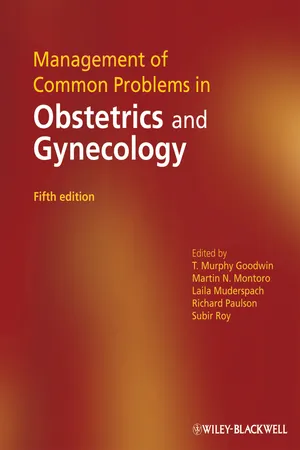
Management of Common Problems in Obstetrics and Gynecology
- English
- ePUB (mobile friendly)
- Available on iOS & Android
eBook - ePub
Management of Common Problems in Obstetrics and Gynecology
About this book
This practical book provides current and effective evaluation and treatment options currently available for the full spectrum of conditions affecting women. In easy to consume, bite-sized chapters, it ranges from diseases occurring during pregnancy and the perinatal period, through general gynecologic conditions from childhood to old age, gynecologic urology, oncology, reproductive medicine and family planning.
Information
Chapter 1
Cervical Insufficiency and Cerclage
Introduction
Primary cervical insufficiency (CI) is the preferred term for the clinical findings of cervical shortening (≤ 25 mm), funneling and/or cervical dilation during the second trimester in the absence of cervical trauma or other abnormality. Secondary CI includes cervical change in the setting of prior trauma, frequently with a history of prior preterm births in the absence of clear clinical preterm labor. CI is a complication which affects up to 1% of all pregnancies and up to 8% of pregnancies with a history of recurrent second-trimester loss. Given a lack of consensus on its diagnostic criteria, its etiology, and its treatment, there is much variation in its reported incidence. CI is a potentially preventable cause of second-trimester loss and extreme prematurity, with associated low birthweight and other sequelae. Preterm birth, regardless of its etiology, remains the leading cause of neonatal morbidity and mortality.
Diagnosis
Unfortunately, there is no clear consensus for the diagnosis of CI despite its relatively common occurrence. Recurrent, relatively painless, second-trimester fetal losses or preterm births in the absence of contractions or vaginal bleeding remains the gold standard for diagnosis. Therefore, it is crucial that a careful and thorough obstetric and gynecologic history is taken at the onset of prenatal care. Although this presentation is classic, it is clearly recognized that cervical competence is a continuous variable and cannot simply be categorized as “competent” or “incompetent.” For example, contractions may be present as a late sign of CI after prolonged exposure of the membranes to the vaginal flora. Furthermore, with the increasing use of transvaginal ultrasound, cervical shortening and dilation of the internal os can be recognized prior to the onset of symptoms and even without digital examination of the cervix.
Transvaginal sonography of the cervix can be easily performed as early as 14–16 weeks of gestation, when the lower segment of the uterus is developed well enough to allow reproducible measurements of cervical length and architecture of the internal os. Ultrasound cervical length screening at 18–22 weeks’ gestation has been proposed. A length of less than 25 mm is generally considered shortened and suggestive of CI, although the probability of preterm delivery at a given cervical length varies according to gestational age. Also important is any dynamic change noted after Valsalva or mild fundal pressure, as well as differences in cervical appearance or length between consecutive measurements. Other changes which have been described include dilation and funneling of the internal os.
In nonpregnant patients, several tests including physical examination and ultrasound or radiographic studies are available to facilitate the diagnosis of CI. On physical examination, the easy passage of a number 8 Hagar dilator or a number 15 Pratt dilator is essentially diagnostic of CI. Hysterosalpingography showing dilation of the internal os to greater than 6 mm is also diagnostic of CI. These tests are both inconvenient and of limited diagnostic utility as they often yield equivocal results in patients with an unclear history.
Etiology
Although there are several postulated causes of CI, it is believed that ascending intrauterine infection with inflammation and cervical trauma are the most common causes. Cervical trauma most commonly results from surgical interventions including conization, loop electrosurgical excision procedures, repetitive or second-trimester therapeutic terminations, and obstetric injuries. More than one first-trimester termination or a single second-trimester termination increases the incidence of CI. Obstetric injuries include compression necrosis of the cervix due to a prolonged second stage of labor, and spontaneous as well as iatrogenic lacerations of the cervix such as Duhrssen’s incisions performed during vaginal delivery. Further obstetric injury may include extension of the uterine incision into the cervix at the time of cesarean section.
Congenital defects including mullerian anomalies, exposure to diethylstilbestrol, maternal deficiencies in elastin or collagen polymorphisms are less common causes of CI. Rarely, acquired anatomic defects such as large polyps or cervical myomata may be associated with CI. Premature signaling of “cervical ripening,” molecular signals from fetal, trophoblast or maternal sources, is increasingly studied and may explain inconsistent CI in consecutive pregnancies in the same mother.
Management
Once a diagnosis of CI has been established or the need for intervention is identified, treatment has traditionally been by surgical correction using an encircling or cerclage suture. The most commonly used technique is the McDonald cerclage, which was described in 1957. With this, a purse-string suture of four or five bites is placed around the cervix. The material most commonly used is 5 mm Mersilene tape. Mersilene provides better tensile strength and is less likely to pull through the cervix in later gestation. Prolene and nylon are both more easily passed through the cervical tissue but are also more likely to pull through the tissues, given their smaller calibers. The suture is placed below the level of the internal os and must be placed deep into the substance of the cervix to prevent lacerations. The lateral blood supply should be left outside the purse-string suture. The knot is then placed anteriorly and one end left long enough to facilitate removal at 36–37 weeks’ gestation. The McDonald technique differs from the modified Shirodkar cerclage described below in that more suture is left exposed within the vagina.
The Shirodkar cerclage was described 2 years earlier in 1955, using maternal fascia lata as the suture material. Today, a 5 mm Mersilene tape is again the suture material most commonly used. The modified Shirodkar has now replaced the original version due to it simplicity. Transverse incisions are made in the cervix anteriorly and posteriorly, and the suture is passed between the fibromuscular substance of the cervix and the lateral blood supply. The knot is again tied anteriorly and some surgeons anchor the tape anteriorly and/or posteriorly to the cervical tissue using a second suture to avoid slippage of the tape. While the originally described Shirodkar cerclage requires increased dissection of both the bladder and rectum superiorly, as well as entailing increased operative time, bleeding, cervical scarring, and cesarean delivery rates, the modified Shirodkar avoids these complications. The Shirodkar is less commonly employed but may still be indicated in cases where a previous McDonald cerclage has failed or when the cervix is significantly shortened due to congenital abnormalities or surgical intervention.
In cases where vaginal cerclage has failed or when there is marked scarring, shortening or deformation of the cervix, precluding vaginal placement, transabdominal cerclage may be employed. Given the inherently more invasive nature of the abdominal route, maternal and fetal risks are significantly increased. An abdominal incision is made and the lower uterine segment exposed. The uterine vessels are located and withdrawn laterally, and a Mersilene tape is placed in the avascular space between the retracted vessels and the uterine isthmus. The suture is passed anteriorly and tied anteriorly and overlies the uterosacral ligaments without penetrating the myometrium. Delivery in these cases must be by cesarean section and the cerclage is usually kept in place for subsequent pregnancies. Fetal salvage is reported to be up to 90%. Several cases of abdominal laparoscopic cerclage placement have been described.
Cerclage placement may be performed on an elective or prophylactic basis, as a therapeutic measure or on an emergency basis, often referred to as a “rescue” cerclage. When the obstetric history is diagnostic for CI, as in the patient with classic repetitive, painless dilation described above, a prophylactic cerclage may be placed in the late first trimester, usually after 10 weeks’ gestation. This usually allows for placement after the gestational age at which most inevitable miscarriages would occur. This timing also allows for documentation of fetal viability and exclusion of major malformations and certain lethal anomalies such as anencephaly, which are usually visible in the late first trimester. In cases where the history is suggestive of CI but not clearly diagnostic, there remains controversy as to the ideal management. Examples of patients at a possibly elevated risk of CI are listed in Box 1.1.
There are differing views as to the specific situations in which elective cerclages should be placed. One view is that of the American College of Obstetricians and Gynecologists which recommends that elective cerclage placement based only on historical factors should be confined to patients with three or more otherwise unexplained second-trimester losses or preterm births. It should be noted that even in women with a history of three or more unexplained second-trimester deliveries, there is still an approximately 50% chance of delivering at term without cerclage placement. Other experts suggest confirmation of cervical change using ultrasound surveillance. Severe restriction of activities or bedrest is less effective but is frequently employed after 24 weeks’ gestation.
Box 1.1 Patients at risk of cervical incompetence without a history of incompetence
- Procedures with no intervening normal pregnancy
- Cone biopsy or loop excision
- More than one first-trimester abortion
- A single second-trimester abortion
- Spontaneous preterm premature rupture of membranes or preterm birth less than 28 weeks’ gestation
- Preterm birth at any time in gestation with progress in labor out of proportion to uterine activity
- Congenital uterine anomaly without prior loss
- Multiple gestation
Therapeutic or urgent cerclage is often placed in women with a shortened cervix or evidence of funneling on ultrasound. These women are often being assessed by ultrasound due to a history placing them at risk for CI, or symptoms or findings on physical examination placing them at risk. The randomized studies examining cerclage placement in these situations contain small numbers of subjects and have yielded conflicting results. It appears, however, that cerclage may prolong pregnancy in a woman with a shortened cervix who is at high risk for CI based on history as well. In otherwise low-risk patients with a shortened cervix, cerclage placement has not been shown to significantly prevent preterm birth. Bedrest or a modified version of it is commonly employed for women with a shortened cervix who do not undergo cervical cerclage.
Finally, emergency or “rescue” cerclage is sometimes placed in women with advanced cervical dilation although the supporting data are rather limited. These women must be thoroughly evaluated prior to surgical intervention. Most importantly, chorio-amnionitis must be ruled out. There should also be no vaginal bleeding, no rupture of membranes, and a viable fetus with no major anatomic abnormalities visible. There should be no uterine activity or an excellent response to short-term tocolytics. Evaluation includes but is not necessarily limited to physical examination, cultures of the urine, cervix, and vagina, and a complete blood count. If the patient is deemed to be an appropriate candidate for an emergency cerclage, she should be placed on bedrest and broad-spectrum antibiotics for 12–24 hours prior to the procedure. Adequate uterine relaxation, anesthesia, and visualization of the anatomy are key to the successful placement of an emergency cerclage. This is usually attained by the use of spinal anesthesia as well as with uterine relaxants including terbutaline or nitroglycerine. Other techniques to assist in the reduction of possibly protuberant membranes include placing the patient in the Trendelenburg position, and gentle pressure using a 30 cc Foley catheter balloon and/or moistened gauzes on sponge sticks. Some authors even advocate the use of transabdominal amnioreduction to further reduce the bulging membranes. Postsurgical treatment with up to a 3 week course of broad-spectrum antibiotics and short-term prostaglandin synthase inhibitors for 24–48 hours is also recommended.
Prior to or concurrent to any cerclage, the mother should be screened and treated for common genitourinary tract infections including urinary tract infection, bacteriuria, vaginitis, cervicitis, bacterial vaginosis, and prevalent sexually transmitted infections. Optimal results are obtained with perioperative antibiotic use, tocolytics such as calcium channel blockers, prostaglandin synthase inhibitors, and nitroglycerine, and with serial treatments of progesterone.
Overall success rates with cervical cerclage placement vary widely given the wide variation in studies and controls used. Some authors report no differences with or without cerclage placement, while others report infant viability rates of up to 90% following surgical intervention. For emergency cerclage placement, success rates and neonatal survival vary by both gestational age and cervical dilation, with rates ranging from 33% to 83%.
Finally, the use of rigid pessaries, although not common in the United States, is popular in some European countries. These studies are small with poorly described selection criteria.
Complications
Although not an extremely invasive procedure, the risks with cerclage placement include those related to the operative procedure itself, as well as those related to the prevention of possible subsequent preterm birth. The most commonly encountered complications are chorio-amnionitis and rupture of membranes, both of which have increased rates with advancing gestational age. Rupture of membranes is also greater with emergency cerclage than with elective cerclage and occurs up to 45% of the time in the former situation. In cases where there is subsequent rupture of membranes, we feel that cerclages should generally be removed promptly to avoid chorio-amnionitis and its associated maternal and neonatal morbidity. In the well-counseled patient with rupture of membranes at previable or extremely premature gestational ages, the cerclage may be left in place and the patient closely monitored for any signs of chorio-amnionitis. Other complications include intraoperative bleeding which requires transfusion in 6% of transabdominal procedures. An increased risk of hospitalization for preterm labor, as well as an increased use of tocolytics, has been shown with cerclage use. Cervical lacerations at the time of delivery have been noted in 10% of cases, and chronic fistula formation with long-term cerclage placement has also been reported. Finally, cerclage placement in the setting of twins has been associated with a significantly higher incidence of preterm birth and should therefore be avoided.
Once a cerclage has been placed, a baseline ultrasound should be obtained for cervical length. This allows for accurate assessment of any further changes that may present.
Conclusion
As mentioned above, CI is a complication of pregnancy that is not uncommonly encountered. Despite this, there is not always clear consensus as to its diagnostic criteria and management regimens. A thorough obstetric history is therefore of the utmost importance in these situations. Cerclage placement is commonly employed in patients with a classic history of CI on an elective basis, in the patient with a shortened cervix as a therapeutic measure, or in the patient with advanced dilation on an emergency basis. The most common complications of cerclage placement include rupture of membranes and chorio-amnionitis, both of which should be monitored for, with removal of the suture if necessary.
Suggested reading
Althuisius SM, Dekker GA, Hummel P, Bekedam DJ, van Geijn HP. Final results of the cervical incompetence prevention randomized ce...
Table of contents
- Cover
- Contents
- Title
- Copyright
- Preface
- Abbreviations
- Chapter 1: Cervical Insufficiency and Cerclage
- Chapter 2: Preterm Premature Rupture of the Membranes
- Chapter 3: Preterm Labor: Diagnosis and Management
- Chapter 4: Post-Term Pregnancy
- Chapter 5: Multiple Gestations
- Chapter 6: Fetal Growth Restriction
- Chapter 7: Rhesus Disease and Isoimmunization
- Chapter 8: Diagnosis and Management of Macrosomia
- Chapter 9: Labor Induction
- Chapter 10: Abnormal Labor
- Chapter 11: Operative Vaginal Delivery
- Chapter 12: Shoulder Dystocia
- Chapter 13: Chorio-Amnionitis and Postpartum Endometritis
- Chapter 14: Vaginal Birth After Cesarean
- Chapter 15: Placenta Previa and Abruptio Placentae
- Chapter 16: Placenta Accreta
- Chapter 17: Postpartum Hemorrhage
- Chapter 18: Fetal Death
- Chapter 19: Assessing the Obstetric Role in the Brain-Damaged Newborn
- Chapter 20: Lactation Management
- Chapter 21: Heart Disease in Pregnancy
- Chapter 22: Asthma during Pregnancy
- Chapter 23: Thyroid Disease in Pregnancy: Hyperthyroidism
- Chapter 24: Thyroid Disease in Pregnancy: Hypothyroidism
- Chapter 25: Seizure Disorders and Headaches in Pregnancy
- Chapter 26: Anemia and Thrombocytopenia in Pregnancy
- Chapter 27: Venous Thromboembolism and Inherited Thrombophilias
- Chapter 28: Systemic Lupus Erythematosus and The Antiphospholipid Syndrome
- Chapter 29: Urinary Tract Infections in Pregnancy: from Symptomatic Bacteriuria to Pyelonephritis
- Chapter 30: Diabetes Mellitus in Pregnancy
- Chapter 31: Gastrointestinal Disorders in Pregnancy
- Chapter 32: Viral Exposures During Pregnancy
- Chapter 33: HIV in Pregnancy
- Chapter 34: Trauma in Pregnancy
- Chapter 35: Hypertension in Pregnancy
- Chapter 36: Nausea and Vomiting of Pregnancy Including Hyperemesis Gravidarum
- Chapter 37: The Acute Abdomen During Pregnancy: Ovarian Torsion, Appendicitis
- Chapter 38: Mood and Anxiety Disorders
- Chapter 39: The Older Gravida
- Chapter 40: Obesity in Pregnancy
- Chapter 41: Teratogen Exposure in Pregnancy
- Chapter 42: Electronic Fetal Monitoring: Definitions and Principles
- Chapter 43: Electronic Fetal Monitoring: A Systematic Approach
- Chapter 44: Second- and Third-Trimester Obstetric Ultrasound
- Chapter 45: Prenatal Screening for Genetic Disorders
- Chapter 46: Antepartum Testing
- Chapter 47: Preconception Counseling and Reproductive Life Planning
- Chapter 48: Fetal Lung Maturation, the Respiratory Distress Syndrome, and Antenatal Steroid Therapy
- Chapter 49: Fetal Interventions
- Chapter 50: Vulvovaginitis
- Chapter 51: Sexually Transmitted Diseases
- Chapter 52: Genital Herpes
- Chapter 53: Pelvic Infection
- Chapter 54: Prevention of Postoperative Surgical Site Gynecologic Infections
- Chapter 55: Prepubertal Vulvovaginitis
- Chapter 56: Dysmenorrhea
- Chapter 57: Chronic Pelvic Pain
- Chapter 58: Abnormal and Dysfunctional Bleeding
- Chapter 59: Premenstrual Syndrome
- Chapter 60: Adnexal Masses
- Chapter 61: Ectopic Pregnancy: Diagnosis and Management
- Chapter 62: Endoscopic Surgery
- Chapter 63: Postsurgical Adhesion Formationand Prevention
- Chapter 64: Uterine Leiomyomata
- Chapter 65: Breast Disorders
- Chapter 66: Rectovaginal Injuries
- Chapter 67: Prepubertal Vulvar Lacerations and Hematomas, Labial Adhesions, and Prolapse of the Urethra
- Chapter 68: Female Sexual Function and Dysfunction
- Chapter 69: Endometriosis
- Chapter 70: Urinary Incontinence
- Chapter 71: Urinary Tract Injuries
- Chapter 72: Fistulae
- Chapter 73: Pelvic Organ Prolapse
- Chapter 74: Infections of the Lower Urinary Tract
- Chapter 75: Voiding Dysfunction
- Chapter 76: Painful Bladder Syndrome/Interstitial Cystitis
- Chapter 77: Urethral Disorders
- Chapter 78: Anal Incontinence
- Chapter 79: Preinvasive Disease of the Lower Genital Tract
- Chapter 80: Vulvar Carcinoma
- Chapter 81: Vaginal Carcinoma
- Chapter 82: Cervical Cancer
- Chapter 83: Endometrial Hyperplasia: Diagnosis and Management
- Chapter 84: Endometrial Carcinoma: Evaluation and Management
- Chapter 85: Ovarian Carcinoma: Management
- Chapter 86: Special Tumors of the Ovary
- Chapter 87: Trophoblastic Neoplasia: Diagnosis and Management
- Chapter 88: Precocious Puberty
- Chapter 89: Primary Amenorrhea
- Chapter 90: Secondary Amenorrhea
- Chapter 91: Galactorrhea and Hyperprolactinemia
- Chapter 92: Androgen Excess and Hirsutism
- Chapter 93: Polycystic Ovarian Syndrome
- Chapter 94: Menopause
- Chapter 95: Premature Ovarian Failure
- Chapter 96: Human Chorionic Gonadotropin and the Diagnosis of Early Pregnancy
- Chapter 97: Work-up of Infertility
- Chapter 98: Induction of Ovulation
- Chapter 99: Male Factor Infertility
- Chapter 100: Uterovaginal Anomalies: Diagnosis and Management
- Chapter 101: Tubal Factor in Infertility
- Chapter 102: Unexplained infertility
- Chapter 103: Human In Vitro Fertilization and Related Assisted Reproductive Techniques
- Chapter 104: Oocyte Donation and Third Party Parenting
- Chapter 105: Fertility Preservation and Oocyte Cryopreservation
- Chapter 106: Recurrent Pregnancy Loss
- Chapter 107: Combination Oral Contraceptives, Contraceptive Patch and Vaginal Ring: Indications, Contraindications, Formulations, Monitoring
- Chapter 108: Noncontraceptive Effects of Combination Oral Contraceptives
- Chapter 109: Injectable and Implantable Contraception
- Chapter 110: Intrauterine Devices
- Chapter 111: Barrier Methods of Contraception
- Chapter 112: Fertility Awareness Family Planning Methods
- Chapter 113: Emergency Contraception
- Chapter 114: Medical Abortifacients
- Chapter 115: Complications of Surgical Abortions
- Chapter 116: Tubal Sterilization
- Index
Trusted by 375,005 students
Access to over 1.5 million titles for a fair monthly price.
Study more efficiently using our study tools.
Frequently asked questions
Yes, you can cancel anytime from the Subscription tab in your account settings on the Perlego website. Your subscription will stay active until the end of your current billing period. Learn how to cancel your subscription
No, books cannot be downloaded as external files, such as PDFs, for use outside of Perlego. However, you can download books within the Perlego app for offline reading on mobile or tablet. Learn how to download books offline
Perlego offers two plans: Essential and Complete
- Essential is ideal for learners and professionals who enjoy exploring a wide range of subjects. Access the Essential Library with 800,000+ trusted titles and best-sellers across business, personal growth, and the humanities. Includes unlimited reading time and Standard Read Aloud voice.
- Complete: Perfect for advanced learners and researchers needing full, unrestricted access. Unlock 1.5M+ books across hundreds of subjects, including academic and specialized titles. The Complete Plan also includes advanced features like Premium Read Aloud and Research Assistant.
We are an online textbook subscription service, where you can get access to an entire online library for less than the price of a single book per month. With over 1.5 million books across 990+ topics, we’ve got you covered! Learn about our mission
Look out for the read-aloud symbol on your next book to see if you can listen to it. The read-aloud tool reads text aloud for you, highlighting the text as it is being read. You can pause it, speed it up and slow it down. Learn more about Read Aloud
Yes! You can use the Perlego app on both iOS and Android devices to read anytime, anywhere — even offline. Perfect for commutes or when you’re on the go.
Please note we cannot support devices running on iOS 13 and Android 7 or earlier. Learn more about using the app
Please note we cannot support devices running on iOS 13 and Android 7 or earlier. Learn more about using the app
Yes, you can access Management of Common Problems in Obstetrics and Gynecology by T. Murphy Goodwin, Martin N. Montoro, Laila Muderspach, Richard Paulson, Subir Roy, T. Murphy Goodwin,Martin N. Montoro,Laila Muderspach,Richard Paulson,Subir Roy in PDF and/or ePUB format, as well as other popular books in Medicine & Gynecology, Obstetrics & Midwifery. We have over 1.5 million books available in our catalogue for you to explore.