![]()
Part 1
DECIDE HOW MUCH YOU WANT
It’s no use saying ‘I just want to have loads of money’ – that’s not going to work. Instead, you must build a picture so real that you can almost see it there in front of you. Having done this, you must then take certain actions to convert this picture into the money you want. (If you want a scientific explanation as to why and how this works, you’ll find it in Appendix 1.)
So this part of the book explains in detail how to (a) figure out how much money you want; (b) build the clear and vivid picture and (c) start attracting the money. This part of the book has three chapters.
Chapter 1 begins by explaining why it’s okay to ask for lots of money. You don’t have to make do with little – you can have as much as you like.
Chapter 2 describes how to figure out how much money you want and how to make this desire ‘clear and vivid’.
Chapter 3 describes how to transmit your request for money so that it has the best possible chance of succeeding.
![]()
Chapter 1
Ask Big
You don’t have to settle for
‘just enough’ – nothing is stopping
you from asking for all the
money you want.
Go Do It 1
Make a list of ten things that you want at the moment. Just to give you an example, here is my list:
1. Clear my various debts including overdrafts and credit cards.
2. Buy a house for cash.
3. Have a regular monthly income to cover my outgoings. (Because I’m self-employed my monthly income tends to fluctuate.)
4. Clear my company’s debts.
5. Have money in the bank.
6. Have a pension or equivalent.
7. Buy a really nice drum kit.
8. Have money to give to those I love.
9. Earn a million euros this year.
There – I only want nine! But some of them are pretty big.
Now write yours:
1.
2.
3.
4.
5.
6.
7.
8.
9.
10.
It’s okay to look for the amount of money that you really want. You don’t have to just settle for ‘enough’ or ‘just enough’ or – as I used to do – that ‘just the right amount arrives just when I need it to’ or ‘it’ll do’. You can look for what would really make a difference to your life.
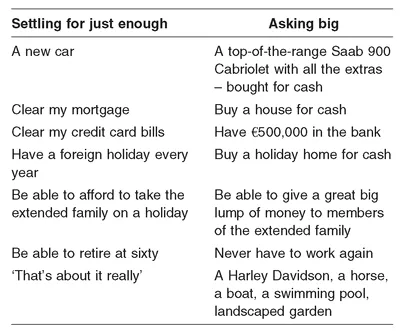
Have a look at Figure 1.1. The left hand column contains examples of what someone might regard as settling for ‘just enough’. The right hand side is a corresponding ‘asking big’ version.
You get the idea.
In some ways, I find it weird that I should have to write a chapter like this at all. One would have thought that if I said to you – as I have – ‘imagine it and then it can be yours’, you would make a large and complete list of all the money you needed. Strangely enough, this is not what happens. A lot of the people in the case studies had to be pushed to come up with their real lists, as opposed to their ‘it’ll do’ lists.
Figure 1.1 ‘Settling for just enough’ versus ‘Asking big’
The reasons for this are worth looking at because some of them may apply to you. It seems to me that there are seven reasons why you might be reluctant to ask big.
1. To ask big you’re going to have to build a list of all that you owe and – because this is so much – you would find the whole exercise too depressing. If this applies to you, then let’s kill it straight away. The reason you have bought this book is to sort out your debt problem. The first step in doing that is to make a list, not just of what you owe, but everything else that you want. So you’re going to have to get over this one or you’re not even going to get off first base.
2.
You don’t believe it’s going to happen. You are sceptical.
You’re not convinced about the subject of this book. You think that if you ask for a modest amount, it might happen, whereas if you ask for everything you truly want, it’s absolutely never going to happen. We’ll deal with this whole issue of belief in Part Three.
3. You don’t see how it’s going to happen. For example, you could be on a fixed salary with a mountain of debt. How are you going to clear that? So again, you ask for something modest because the grander thing couldn’t possibly happen. You’ve heard people begin a sentence with the expression, ‘There’s no way...’. We’ll deal with this issue further in Part Two: Have A Plan.
4.
The thinking – which has been drummed into many of us since we were children – that being rich is bad. The
abuse of riches is bad but having all the money you want is good. It doesn’t guarantee happiness by itself but it certainly helps. And try being happy when you have no money.
Abundance is good. And not only is it good, it happens all the time.
You only have to look around to see the bounty and abundance of the world. Look at a patch of waste ground – say, after builders have left a building site. Then look at it a few months later. All sorts of life has started to grow and live there – flora and fauna. Look at the heavens at night. God/the Universe/Nature – whatever you care to call it or believe in – is massively abundant. It is this abundance we are going to tap into.
5. You feel like you don’t deserve it. This is not the book to go into why people end up feeling this way, but many people do. In some or all aspects of their lives, they feel they are not worthy of love, or respect or – in this case – wealth. But you are. You really, really are. And the best proof of that is to do what it says in this book and find the money coming to you.
6.
You think there is a limit on how much you can earn. For example, if you went for an interview for a new job, you might look for several thousand pounds of a salary jump, but you probably wouldn’t even think to look for twenty thousand or fifty thousand. Or, if you earn money based on a daily rate, you put some kind of ceiling on how much you feel you can realistically charge.
Only a couple of weeks ago, I heard a friend say: ‘I coul...