- English
- ePUB (mobile friendly)
- Available on iOS & Android
eBook - ePub
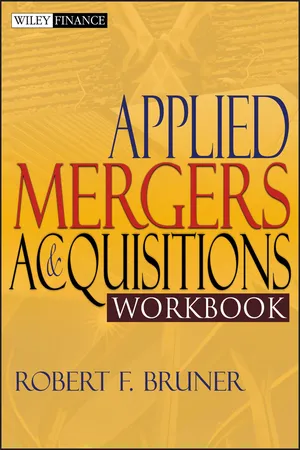
Applied Mergers and Acquisitions Workbook
About this book
The Applied Mergers and Acquisitions Workbook provides a useful self-training study guide for readers of Applied Mergers and Acquisitions who want to review the drivers of M&A success and failure. Useful review questions as well as problems and answers are provided for both professionals and students. Readers will further their knowledge, build practical intuition, and learn the art and science of M&A by using this comprehensive self-study workbook in conjunction with the main text.
PART ONE
Questions
CHAPTER 1
Introduction and Executive Summary
M&A (mergers and acquisitions) is one of the most important means by which companies respond to changing conditions. Many firms have no alternative but to merge, acquire, or be acquired.
Although M&A is often portrayed as a gamble that one cannot win, it is possible to succeed in M&A. However, competitive forces may limit the chances of success.
- M&A is a world of contingencies. There are few universal absolute truths about M&A success. For the M&A professional, therefore, there will always be a market for diligent research, sound judgment, and artful execution.
- Success in M&A is driven by both the structure of the M&A opportunity one faces and the conduct by which one pursues it.
- Elements of structure of the M&A environment include:
- Economics. This refers to quantitative drivers of the attractiveness of the opportunity: revenues, costs (both fixed and variable), risk, and required rates of return—these determine cash flow and the net present value of an M&A transaction. They also drive the financial stability and future growth of Newco. Best practitioners in M&A are rigorous analysts of the economics of an opportunity.
- Strategy. Strategic strengths, weaknesses, opportunities, and threats are part of the structure of the M&A environment. Many M&A transactions are motivated by a need to respond to the strategic environment. Careful strategic planning is crucial to success in M&A.
- Organization. Culture, leadership, talent, and organizational architecture of the merging firms have a major influence on the ability of Newco to achieve benefits of the deal. M&A practitioners must therefore lend careful thought to postmerger organizational structure.
- Brand. Large intangible influences in the setting of the M&A opportunity are the reputations of buyer and target. As a brand name affects the thinking of consumers, reputations can shape the expectations and behavior of participants in a merger. Best practitioners seek to create and preserve brand value, and to understand the sources of the counterparty’s brand.
- Law. Laws and regulations limit the actions of buyer and target firms. M&A practitioners must manage legal risk exposure and to consider opportunities to shape legislation.
- Ethics. Ethical norms surround everything one does in M&A and are often discovered only after they are broken. Best practitioners in M&A consciously address the ethical dimension in deal development.
- Conduct is the behavior of managers in the pursuit of good M&A outcomes and appears in M&A in the form of creativity, interpersonal skills, and elements of personality. Behavior is important because it filters and interacts with the structural elements of a deal. Behavior affects M&A outcomes in areas such as the following:
- Search for partners. Discovery of partners may rely on “networking,” which relies on social skills.
- Due diligence. Success in due diligence is tied to the investigator’s attitude and personal attributes such as stamina, care, and capacity for critical thinking.
- Negotiation and bidding. Psychology and self-discipline affect the outcomes of negotiation and bidding. Attitudes, appetites, and negotiation tactics have a large influence on deal prices and terms.
- Dealing with laws, regulations, and the justice system. Although laws and regulations may seem like constraints on actions, the M&A practitioner can strive to actually shape the structure of the M&A situation.
- Deal design. Deal design entails searching for trade-offs that will result in a win-win deal for both buyer and seller. Often, such a search requires flexibility and creativity from the deal negotiators.
- Postmerger integration. It takes managerial skill to successfully implement postmerger integration.
- Deal development process. Good process is one of the key drivers of good outcomes. Conscientiousness in developing a process mind-set lends discipline to thinking and increases the likelihood of a successful M&A outcome.
- The framework reminds us that successful outcomes have many dimensions. Best practitioners think in terms of the entire range of outcomes rather than narrowly in just one or two dimensions. One can benchmark the success of a deal against at least seven measures: 1. Creation of market value. This is necessarily the first measure of success because of the obligation of managers and directors to serve the welfare of shareholders. But it is rarely sufficient by itself—to take an extreme example, value created unethically or illegally would be unacceptable.2. Financial stability. Another measure of success is whether a deal strengthens the financial structure of the firm. Some deals have been so aggressively financed that they led to bankruptcy shortly after closing.3. Improved strategic position. The deal should serve the mission and strategic objectives of the firm. Best practitioners look for a solid strategic rationale.4. Organizational strength. The acquisition of talent, rejuvenation of a worn-out or defeatist culture, improvement of learning or technology transfer, and transformation of the organizational architecture of a firm are examples of ways in which a deal can strengthen the organization.5. Enhanced brand. A successful deal may strengthen the esteem for the firm in the eyes of competitors, suppliers, customers, and employees.6. Observance of the letter and spirit of ethical norms and laws. Success means more than avoiding criminal indictment: Best practitioners understand that it is important not only to do deals well, but also to do them right.7. Improved process. Every transaction should sharpen a firm’s leadership and business processes. This happens when one conducts a deal with a learning mind-set.
- The practice of M&A is continually changing. The chapter outlines several disruptive ideas that will affect the ongoing development of practice:
- A deal is a system. Internal consistency is important; one must negotiate the pieces of the deal with a view toward the whole. There may be unanticipated side effects; practitioners must look out for these. There may be many attractive structures, rather than a single best structure, that satisfy the objectives of all parties.
- Find and use optionality. Options are pervasive in M&A.
- Study market inefficiency. Where markets are integrated and efficient, decision makers can and should refer to market prices for signals about behavior. However, some markets may be inefficient—where this is true, the best practitioner modifies the tools and concepts to adapt to the market circumstances.
- Good governance pays. Good governance increases the chances of successful M&A outcomes, though the practices of good governance are still evolving.
- A deal is more than price. The practitioner faces a host of choices in designing a transaction, most of which have consequences for the buyer and target company shareholders. Deal design choices can create or destroy value.
- Behaviorism. M&A bidding processes, negotiations, and deal design can influence and be influenced by behavior.
- No silos. The M&A effort will be more successful the more integrated it is across deal design, strategy, and implementation.
CHAPTER 1—WORKBOOK QUESTIONS
Explain why each of the following statements is false:
1. Success in M&A is determined solely by structural factors.
2. In the behavioral realm, success in postmerger integration is influenced more by the conduct and interpersonal skills of managers than by organizational structure.
3. Best practice in the legal area of M&A emphasizes only the avoidance of violating laws or regulations so that the pre- and postmerger firms involved in the M&A transaction are not exposed to any legal jeopardy.
4. Actions in M&A that are not clearly ethical or that even are unethical will not lead to outright failure as long as they do not violate the law.
5. Being able to negotiate and consummate a deal is the hallmark of success in M&A.
6. Planning everythin...
Table of contents
- Cover
- Contents
- Title
- Copyright
- Dedication
- Acknowledgments
- About the Author
- Introduction to the Workbook
- Part One: Questions
- Part Two: Answers
Trusted by 375,005 students
Access to over 1.5 million titles for a fair monthly price.
Study more efficiently using our study tools.
Frequently asked questions
Yes, you can cancel anytime from the Subscription tab in your account settings on the Perlego website. Your subscription will stay active until the end of your current billing period. Learn how to cancel your subscription
No, books cannot be downloaded as external files, such as PDFs, for use outside of Perlego. However, you can download books within the Perlego app for offline reading on mobile or tablet. Learn how to download books offline
Perlego offers two plans: Essential and Complete
- Essential is ideal for learners and professionals who enjoy exploring a wide range of subjects. Access the Essential Library with 800,000+ trusted titles and best-sellers across business, personal growth, and the humanities. Includes unlimited reading time and Standard Read Aloud voice.
- Complete: Perfect for advanced learners and researchers needing full, unrestricted access. Unlock 1.5M+ books across hundreds of subjects, including academic and specialized titles. The Complete Plan also includes advanced features like Premium Read Aloud and Research Assistant.
We are an online textbook subscription service, where you can get access to an entire online library for less than the price of a single book per month. With over 1.5 million books across 990+ topics, we’ve got you covered! Learn about our mission
Look out for the read-aloud symbol on your next book to see if you can listen to it. The read-aloud tool reads text aloud for you, highlighting the text as it is being read. You can pause it, speed it up and slow it down. Learn more about Read Aloud
Yes! You can use the Perlego app on both iOS and Android devices to read anytime, anywhere — even offline. Perfect for commutes or when you’re on the go.
Please note we cannot support devices running on iOS 13 and Android 7 or earlier. Learn more about using the app
Please note we cannot support devices running on iOS 13 and Android 7 or earlier. Learn more about using the app
Yes, you can access Applied Mergers and Acquisitions Workbook by Robert F. Bruner in PDF and/or ePUB format, as well as other popular books in Business & Finance. We have over 1.5 million books available in our catalogue for you to explore.