Industrial Design: Materials and Manufacturing Guide, Second Edition provides the detailed coverage of materials and manufacturing processes that industrial designers need without the in-depth and overly technical discussions commonly directed toward engineers. Author Jim Lesko gives you the practical knowledge you need to develop a real-world understanding of materials and processes and make informed choices for industrial design projects.
In this book, you will find everything from basic terminology to valuable insights on why certain shapes work best for particular applications. You'll learn how to extract the best performance from all of the most commonly used methods and materials.
- English
- ePUB (mobile friendly)
- Available on iOS & Android
eBook - ePub
About this book
Information
Overview Chart
figure 1-1. materials and manufacturing

Chapter 1
Introduction
Need for Materials and Manufacturing
The industrial designer, whether on a design team or acting alone, is responsible for the appearance and form of a product. If the form of a product is to some degree the result of how it was manufactured, it follows that the designer must have a good understanding of all manufacturing processes available, in order to have confidence that the proposed manufacturing process is the most economical and appropriate. If a designer is unaware of certain available processes creative potential is limited. It would be like a composer writing a symphony totally unaware of the color and full range and capability of some instruments.
Design Education
Industrial design students should have an understanding of materials and manufacturing—ideally in the sophomore year. This is important because as projects are assigned, students need to visualize and develop forms that ultimately will be manufactured (even if theoretically). Without a comprehensive knowledge base of materials and manufacturing possibilities, students can only fantasize and flounder along, limited by ignorance of the subject and oblivious to the variety of possibilities available. Conversely, with a good knowledge base students can propose an array of possible design solutions and have some confidence that they can be manufactured.
This guide is specifically designed as a two-semester classroom guide for industrial design students. It should also be useful for other professionals who require an introductory understanding of this information. It is not, and is not intended to be, an alternative to the standard engineering texts on the subject. It would be wise for designers to acquire such a text at some point. Industrial Design: Materials and Manufacturing Guide is intended to give an overview in simple words and visual images and to serve as a guide and introduction to this rather complex field, a necessary part of industrial design education.
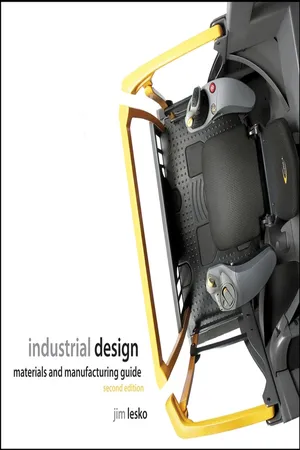
An excellent example of the need for a full understanding of materials and manufacturing is the Crown TSP 6000, especially the cab shown on the cover. While consumer products are challenging from many perspectives, including marketing, industrial products like the TSP require exceptional demands for excellence in design and engineering, such as extreme attention to ergonomics and to cost benefit analysis, as well as the traditional design concerns. The TSP is a perfect example of where the designers clearly demonstrate an understanding of the full range of materials and processes available. This is particularly exemplified in the cab for the TSP. The designers explained that for every single part they considered all the possible materials and related processes available. The best option for each part was selected through a rigorous analysis of the cost–benefit analysis charts that were developed as a normal operating procedure of the Crown design program. The result is a spectacular and aesthetically successful use of materials fulfilling every demand, economically manufactured to meet the production requirements, but more important to anticipate and fulfill the rather extreme operational demands of users.
figure 1-2. Crown TSP 6000 Turret Stockpicker (courtesy Crown Equipment Corporation)

Product Design Sequence
figure 2-1. product design sequence
© Jim Lesko and Edward Eslami

Chapter 2
Overview
Form Is the Resolution of Function
Design is in essence a search for form. “Form follows function” has been on the banner of designers since the Bauhaus. However, this statement suggests that function leads and form follows, relegating form to a subordinate position. Restated, it might read “Form is the resolution of function,” where function has two major components: (1) performance specification demands, including all user-friendly aspects, and (2) cost and manufacturability. The former refers to ergonomics—aspects concerned with the abilities and limitations of the product’s users. The latter refers to the physical aspects of the product, including material selection and manufacturability. “Form is the resolution of function” suggests that form is dynamic and interactive, whereas “Form follows function” implies that form is passive, following behind function as the primary determining factor in a design. If the revised “Form is the resolution of function,” is used, then manufacturability is understood in its rightful place as an equal determinant in the design process.
Form is realized or made visible in a material or a combination of materials, which are shaped by tools. In creating a form, the designer is by default selecting a manufacturing process. Normally the designer creates models to demonstrate a concept in substitute materials—not the actual material—and by so doing is removed from a real understanding of the way the manufacturing process will impact the material and form. If product concepts are created on paper using pencil or on a computer, there is a danger that the designer is not only removed from an understanding of actual manufacturing ramifications, but is also another step removed from dimensional reality and material behavior altogether. It takes a real-world understanding of materials and manufacturing methods to create successful products. This cannot be accomplished alone in a studio: It requires teamwork with materials and manufacturing engineering development and support. The Clinto, by Manuel Saez and his Humanscale team, is an excellent example of a successful product whose form is not only a celebration of materials and manufacturing, but is the essence of function for human need. Each element of this design was chosen to meet all factors involved. The forms seem simple but perform complex functions under the severe demands of cost restraints. The materials and production process selected and the form that evolved were developed inter-dependently, in an optimization process in which the best possible solution was determined after deliberation and exhaustive search and testing.
The violin is the absolute epitome and essence of a product in terms of materials and manufacturing. No other human invention is so perfect in its resolution. If made by Stradivarius, nothing can match it in its ability to reach the sublime. Of course, it takes a master to play it properly. There is no use playing a Stradivarius unless the music is written by a master such as Bach or Beethoven.
Industrial Design Materials and Manufacturing is an overview of the key processes and salient related supporting information intended for (student) industrial designers. It is limited to engineering materials (excluding natural materials). The goal is to distill the key information on the subject, organize it, and present it as simply as possible. One visual representation of full design process is shown on the facing page. This guide is limited to a discussion of some of the objective considerations printed in green text.
figure 2-2. Clinto (courtesy Humanscale Design Studio)

figure 2-3. manufacturing methods chart

Materials and Manufacturing Methods
This guide is an overview of the key materials, processes, and salient related supporting information intended for (student) industrial designers. It is limited to engineering materials (excluding natural materials like wood, stone, etc.). The goal is to distill the key information on the subject, organize it, and present it as simply as possible. Existing engineering-oriented texts on this subject attempt to be inclusive, with extensive technical information geared to engineering.
This guide summarizes the materials and processes important to industrial design. This information is presented simply and graphically. It does not attempt to present all available materials and manufacturing processes; it is intended to be a designer’s guide to materials and manufacturing. The methodology used may help readers organize additional information on these subjects.
figure 2-4. materials chart

figure 3-1. Unisphere, Flushing Meadows Park, New York

Chapter 3
Metals
figure 3-2. metals chart

Pure metals are composed of atoms of the same type. Metal alloys are composed of two or more chemical elements, of which at least one is a metal. This blending of elements gives alloys their greater mechanical properties. The majority of metals used in engineering applications are alloys. Metals are generally divided into ferrous and nonferrous. Each metal alloy has specific mechanical and physical properties that will make it a good fit for a specific application. Fairly recently, metals have become available in a powdered form. This has expanded the opportunities, making it possible to provide totally new ...
Table of contents
- Cover
- Title Page
- Copyright
- Acknowledgments
- Chapter 1: Introduction
- Chapter 2: Overview
- Chapter 3: Metals
- Chapter 4: Metal Forming
- Chapter 5: Metal Cutting
- Chapter 6: Metal Joining
- Chapter 7: Appearance Finishing and Coatings
- Chapter 8: Plastics
- Chapter 9: Plastic Forming Processes
- Chapter 10: Machining Plastics
- Chapter 11: Joining Plastics
- Chapter 12: Finishing Plastics
- Chapter 13: Rubbers and Elastomers
- Chapter 14: Natural Engineering Materials
- Chapter 15: Composites
- Chapter 16: Rapid Prototyping
- Index
Trusted by 375,005 students
Access to over 1.5 million titles for a fair monthly price.
Study more efficiently using our study tools.
Frequently asked questions
Yes, you can cancel anytime from the Subscription tab in your account settings on the Perlego website. Your subscription will stay active until the end of your current billing period. Learn how to cancel your subscription
No, books cannot be downloaded as external files, such as PDFs, for use outside of Perlego. However, you can download books within the Perlego app for offline reading on mobile or tablet. Learn how to download books offline
Perlego offers two plans: Essential and Complete
- Essential is ideal for learners and professionals who enjoy exploring a wide range of subjects. Access the Essential Library with 800,000+ trusted titles and best-sellers across business, personal growth, and the humanities. Includes unlimited reading time and Standard Read Aloud voice.
- Complete: Perfect for advanced learners and researchers needing full, unrestricted access. Unlock 1.5M+ books across hundreds of subjects, including academic and specialized titles. The Complete Plan also includes advanced features like Premium Read Aloud and Research Assistant.
We are an online textbook subscription service, where you can get access to an entire online library for less than the price of a single book per month. With over 1.5 million books across 990+ topics, we’ve got you covered! Learn about our mission
Look out for the read-aloud symbol on your next book to see if you can listen to it. The read-aloud tool reads text aloud for you, highlighting the text as it is being read. You can pause it, speed it up and slow it down. Learn more about Read Aloud
Yes! You can use the Perlego app on both iOS and Android devices to read anytime, anywhere — even offline. Perfect for commutes or when you’re on the go.
Please note we cannot support devices running on iOS 13 and Android 7 or earlier. Learn more about using the app
Please note we cannot support devices running on iOS 13 and Android 7 or earlier. Learn more about using the app
Yes, you can access Industrial Design by Jim Lesko in PDF and/or ePUB format, as well as other popular books in Architecture & Architecture General. We have over 1.5 million books available in our catalogue for you to explore.