![]()
Chapter 1
PROJECT MANAGEMENT PRINCIPLES
THE TRIPLE CONSTRAINT
Effective project management is an attempt to improve the efficiency and effectiveness of an organization by arranging for work to flow multidirectionally through the organization. Project management was developed to focus on organizational activities that had the following characteristics:
- Unique or one-of-a-kind deliverables
- A well-defined objective
- Predetermined constraints regarding time, cost, and performance/technology/quality
- Requires the use of human and nonhuman resources
- Has a multidirectional work flow
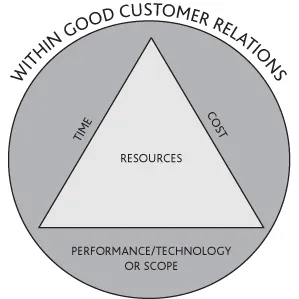
From an executive perspective, the figure illustrates the basic goal of project management, namely, meeting the objectives associated with the triple constraint of time, cost, and performance while maintaining good customer relations. Unfortunately, because most projects have some unique characteristics, highly accurate estimating may not be possible and trade-offs between the triple constraint may be necessary. Executive management must be involved in almost all of the trade-off discussions to make sure that the final decision is made in the best interest of both the project and the company. Project managers may possess sufficient technical knowledge to deal with many day-to-day decisions regarding project performance but may not have sufficient business knowledge to adequately address and care for the higher-level, broader interests of the company.
TYPES OF PROJECT RESOURCES
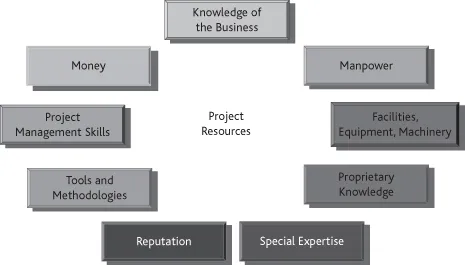
This illustration shows the various project resources that project managers may or may not have under their direct control. Some of these resources require additional comment.
- Money. Once budgets are established and charge numbers are opened, project managers focus more on project monitoring of the budget rather than management of the budget. Once the charge numbers are approved and opened, the respective line managers or functional managers control the budgets for each work package.
- Resources. The human resources required for the project are usually assigned by the line managers, and these resources may be under the direct control of the line managers for the duration of the project. Also, even though the employees are assigned to a project team, their line managers may not authorize them to make decisions that affect the functional group without first obtaining approval from the line managers.
- Business knowledge. Project managers are expected to make decisions that will benefit the business as well as the project. This is why executives must interface with projects—to provide project managers with the necessary business information for decision making.
![]()
Chapter 2
THE EVOLUTION OF PROJECT MANAGEMENT
EVOLUTION
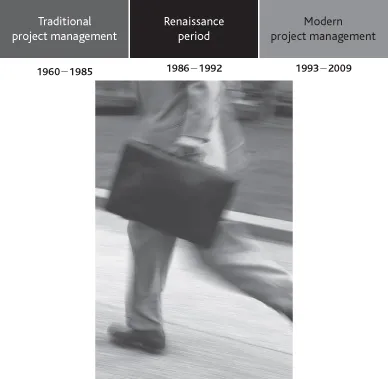
Over the past five decades, there have been rapid evolutionary changes in the way projects are managed. For simplicity’s sake, they will be broken down into three categories as follows:
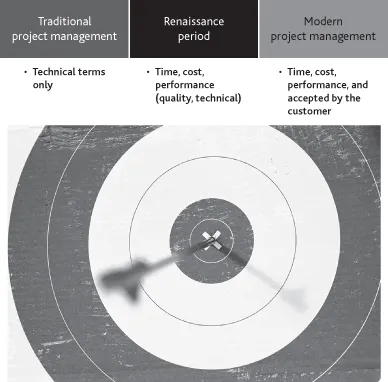
- 1960–1985. This can be referred to as the period of traditional project management. Project management was restricted to aerospace, defense, and heavy construction industries. Project management was used on mega projects only.
- 1986–1992. This was the Renaissance period, or great awakening, where we learned that a project management methodology could be used on a multitude of projects and benefit nearly all industries. Project management became readily accepted in industries such as automotive, information systems, telecommunications, and banking.
- 1993–2009. Project management became readily accepted in all industries and applicable to any size project. Project management was viewed as a career path, and interest in project management certification credentials grew. Companies began to recognize that project management can increase profitability and improve working relationships with customers while increasing competitive edge.
PROJECT OBJECTIVES
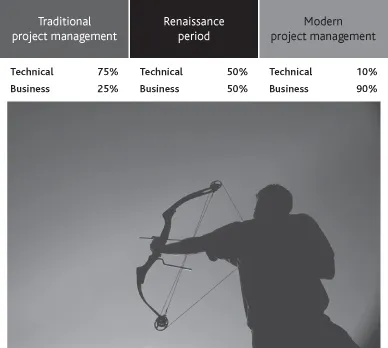
Over the years, project management has matured into a business process as well as an organized product and service delivery process. As such, project objectives are now more closely aligned with business objectives in addition to technical objectives.
Historically, this was due to the fact that people with engineering backgrounds were placed in charge of projects. These people had a command of technology but did not generally understand or were not required to develop a working knowledge about the business. The ultimate objective was to produce a high-technology deliverable regardless of the cost or time required. As long as the deliverable worked, the project was considered to be a success.
Today’s objectives focus more on the necessity to satisfy a business objective rather than merely a technical objective. Executive involvement in establishing business objectives is essential. Many project managers have limited business knowledge (but excellent technical skills) and must rely heavily on senior management to communicate business-related assumptions and constraints. Senior management’s involvement is also necessary to make sure that the project objectives and the business objectives of the project are aligned with the company’s strategic objectives. Developing technology just for technology’s sake is simply not useful for any business.
DEFINITION OF SUCCESS
Over the years, our definition of success has changed from technical success criteria (functionality) to business-related success criteria—specifically, on time, within planned cost, at the desired performance level, and with formal customer acceptance. Today, success for each project undertaken is now defined through a mutual agreement between the customer and the contractor or performing organization. Other definitions of success include:
- Additional business with the client
- The client acts as an advocate for your company
- Increased market share
- Shorter time to market
The definition of project success must be decided upon during the initial discussions and negotiations with the customer. The agreed-upon definition of success must be in alignment with organizational goals, and senior management should clearly and visibly support the agreed-upon success criteria.
VELOCITY OF CHANGE
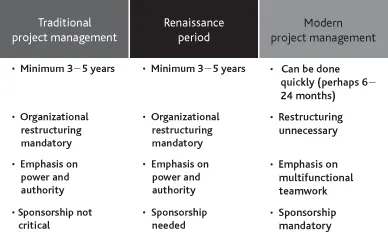
Historically, organizational restructuring became a necessity with the award of each large contract. If the project were large enough, a separate organizational unit would be created just to service this one project. And with each organizational change, some executives increased their level of authority, while others may have experienced a reduction of their authority and power. The profitability of each project had a major impact on the bonus for the executive in control of that project. Each executive would establish a separate and unique culture for his or her project and, when the project was completed, the culture was expected to dissolve. Unfortunately, large companies with a multitude of projects in progress also had several cultures in place at the same time, and many of these cultures experienced conflicts with other cultures. As a result, many executives, especially those who did not have direct involvement with projects, became disenchanted with project management.
As project management evolved, it became apparent that the secret to effective project management was effective communications, cooperation, teamwork, and trust, rather than power and authority. It was determined that project m...