This book examines the opportunities for, and the effects and benefits of, collaborative working practices and their impact on supply chain performance. The book is organized into three main parts; first part focuses on modeling the supply chain using conceptual frameworks to describe the relationship between collaboration and performance. The second part examines the issues around information systems alignment, and ensuring the management and coordination of interactions with suppliers and customers. The final part of the book focuses on the various different formalized approaches (including simulation, game theory, experimental economics, Petri nets and object-oriented design techniques) that may be taken to analyze the impact of any given collaboration process, coordination mechanism, or decision-making behavior on supply chain performance.
Modeling the SC Collaboration—Performance Relationship in Empirical Research1
1.1. Introduction: the SC collaboration—performance relationship in question
In the debate on the conceptualization of supply chain management (SCM) in empirical research, collaboration appears as a core element of the SCM construct (see the critical review on the SCM construct in [HO 02]). Although a dominant rhetoric in SCM claims that increased collaboration among supply chain stakeholders leads to enhanced performance, empirical research does not provide clear support for the hypothesis of a positive relationship between the two [BAG 05, FAW 02, HIN 02, KUL 04, STA 99, SWI 07, VER 06].
From a theoretical point of view, this instability of the effects on performance of collaborative practices in supply chains (denoted “SC collaboration” hereafter), should not come as a surprise. As Corsten and Felde [COR 05] point out, economic theory gives examples of contexts where collaboration has negative outcomes. According to Williamson’s cost transaction theory [WIL 85], when collaboration is based on assets co-specialization, the cost of the co-specialization and the partner’s vulnerability to opportunism can seriously affect the expected long-term performance. Dyer and Singh’s relational view of the firm [DYE 98] likewise claims that inter-firm collaboration can be a source of competitive advantage but may also give rise to precarious collaboration [SIN 96] in some contexts. For instance, in a turbulent environment, a close relationship with one customer limits the opportunities of economies of scale and increases risks. Lastly, apart from these economic explanations related to the context of collaboration, a firm’s behavioral approaches can also explain the unsuccessful implementation of collaboration or insufficient efforts in this respect (see, for instance, references in [FAW 08]).
In this chapter we turn away from theoretical debate on the barriers of inter-firm collaboration to focus on empirical research on the SC collaboration—performance relationship. In order to highlight some critical choices for empirical research, and thereby explain why certain findings are relatively unstable and non-cumulative, we take those models that link SC collaboration to performance, as a unit of analysis in empirical research.
In 2002, Ho et al. [HO 02] addressed the problem of some weaknesses of empirical research on the relationship between SCM practices and performance, and made two main recommendations. First, they proposed to remove all ambiguity from the content domain of the SCM construct by developing conceptual models that encompass the three core elements of SCM, i.e. value creation, integration of key business processes and collaboration. Second, they emphasized differences in terms of research focus and analytical methods. For this purpose they designed a typology distinguishing different approaches to modeling the SCM practice-performance relationship.
A careful examination of these two recommendations offers two research directions for studying the models underlying empirical research on the relationship between SC collaboration and performance. Each of these directions is developed in section 1.1. Together, they are then used as a basis to specify the objectives and structure of this chapter.
1.1.1. How to recognize a model linking SC collaboration to performance
As noted above, we use the term “SC collaboration” to denote the range of collaborative practices. Removing any ambiguity in the content of the SC collaboration construct is essential for empirical research on the link between SC collaboration and performance. However, as Whipple and Russell [WHI 07, p. 177] point out, “collaboration is a very broad and encompassing term and thus requires more specific, in-depth analysis and categorization” (see also [BAR 04]). This remark stresses the need to clarify the range of collaborative practices encompassed in the term SC collaboration, i.e. the range of collaborative practices considered in the measurement scale items of the SC collaboration construct. We provide such clarification in section 1.2.1.
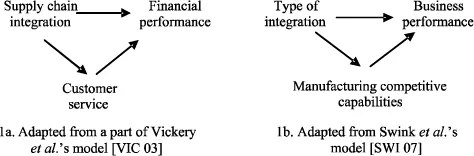
Clarifying the measurement scale of the SC collaboration construct is, however, insufficient in empirical research to recognize a model that actually tests the outcomes of collaborative practices. Consider the following examples: the first is adapted from a study by Vickery et al. [VIC 03] and the second from a study by Swink et al. [SWI 07]. Both test the effects of an integrative supply chain strategy on performance and at first glance neither of them seems to seek empirical evidence for the SC collaboration-performance relationship.
Figure 1.1.Two models testing the effects of supply chain integration on performance
In their model, for the measurement of the “supply-chain integration” construct, Vickery et al. use a “meta-scale” combining items related to supplier partnering, closer customer relations and cross-functional teams. By contrast, Swink et al. keep the four constructs separate (corporate strategy integration, product—process technology integration, strategic customer integration and strategic supplier integration). This choice of conceptualization allows them to separately test the effect of the variables denoted “strategic customer/supplier integration” on performance. Moreover, since the measurement scales of these constructs refer explicitly to collaborative practices, we can consider that Swink et al.’s model contributes to empirical research on the effects of SC collaboration on performance. Conversely, the conceptualization used by Vickery et al. does not isolate hypotheses on the relationship between collaboration and performance, although it also refers to collaborative practices (closer customer relations and cross-functional team).
A first lesson can be learned from these examples: “collaboration” is not the keyword that enables us to recognize an empirical study testing the effect of SC collaboration on performance. In particular, the concept of integration can refer to collaborative practices and, in this case, a careful examination of the measurement scale of constructs used in the model is necessary. In our first approach, provided that we define the range S of collaborative practices (problem addressed below), the following definition can be given:
DEFINITION 1.1: A SC collaboration-performance model is a model in which at least one relationship tested is of the (K
Performance) type, where K is a multidimensional construct such that at least one item in one dimension of K explicitly refers to the range S of collaborative practices.
It is easy to recognize SC collaboration-performance models in the presence of a path diagram and/or a list of hypotheses (see EXAMPLE 1.1 below). It is sufficient to highlight a hypothesis of the (K
Performance) type where the measurement scale of K refers to a set of collaborative practices (for instance, information sharing or structural collaboration). In some cases, however (see EXAMPLE 1.2 below), only the examination of analytical procedures ensures the recognition of an SC collaboration-performance model.
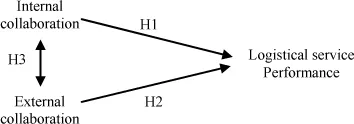
EXAMPLE 1.1: Stank et al. [STA 01] present the following path diagram (see Figure 1.2) where hypothesis H2 posits that: external collaboration has a positive influence on logistical service performance outcomes.
Figure 1.2.Stank et al.’s model [STA 01]
In the questionnaire used to measure external collaboration, some items concern collaborative practices: operational information sharing, performance measure sharing, and common supply chain arrangements under principles of shared risks and rewards. According to DEFINITION 1.1, Stank et al.’s model is obviously a SC collaboration—performance model.
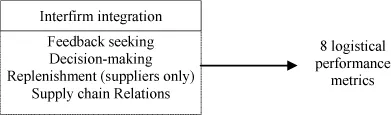
EXAMPLE 1.2: In their European survey, Bagchi et al. [BAG 05] capture the notion of collaboration with key suppliers/carriers or key customers through a construct labeled “inter-firm integration” comprising four dimensions: feedback seeking, decision-making, replenishment (for suppliers only), and supply-chain relations.
In Figure 1.3, the inter-firm integration construct has dimensions that do not directly pertain to information sharing or other collaborative practices. An examination of the operationalization of Bagchi et al.’s model shows that the construct labeled “Feedback seeking” concerns information sharing and that, among items measuring the “Decision-making” construct, one of them refers to the degree of suppliers’ involvement in decisions pertaining to inventory management. However, the authors present neither a diagram, nor a list of hypotheses.
Figure 1.3.Adapted from Bagchi et al.’s model [BAG 05]
In this case, examination of analytical procedures is required to recognize models of (K
Performance) type. In fact, Bagchi et al. carry out multiple regressions with the eight performance metrics as dependent variables and with the predictor variables. Since they select the predictor variables according to their incremental contribution to the coefficient of determination, they prove many significant relationships of the (K
Logistical performance metric) type, where K refers to the use of collaborative practices.
1.1.2. In search of an appropriate perspective for modelin...
Table of contents
Cover
Title Page
Copyright
Introduction
Part I: Focus on Collaborative Practices
Part II: Focus on Strategic Alignment of Information Systems
Part III: Focus on Coordination Mechanisms
List of Authors
Index
Trusted by 375,005 students
Access to over 1.5 million titles for a fair monthly price.
Study more efficiently using our study tools.
Frequently asked questions
Yes, you can cancel anytime from the Subscription tab in your account settings on the Perlego website. Your subscription will stay active until the end of your current billing period. Learn how to cancel your subscription
No, books cannot be downloaded as external files, such as PDFs, for use outside of Perlego. However, you can download books within the Perlego app for offline reading on mobile or tablet. Learn how to download books offline
Perlego offers two plans: Essential and Complete
Essential is ideal for learners and professionals who enjoy exploring a wide range of subjects. Access the Essential Library with 800,000+ trusted titles and best-sellers across business, personal growth, and the humanities. Includes unlimited reading time and Standard Read Aloud voice.
Complete: Perfect for advanced learners and researchers needing full, unrestricted access. Unlock 1.5M+ books across hundreds of subjects, including academic and specialized titles. The Complete Plan also includes advanced features like Premium Read Aloud and Research Assistant.
Both plans are available with monthly, semester, or annual billing cycles.
We are an online textbook subscription service, where you can get access to an entire online library for less than the price of a single book per month. With over 1.5 million books across 990+ topics, we’ve got you covered! Learn about our mission
Look out for the read-aloud symbol on your next book to see if you can listen to it. The read-aloud tool reads text aloud for you, highlighting the text as it is being read. You can pause it, speed it up and slow it down. Learn more about Read Aloud
Yes! You can use the Perlego app on both iOS and Android devices to read anytime, anywhere — even offline. Perfect for commutes or when you’re on the go. Please note we cannot support devices running on iOS 13 and Android 7 or earlier. Learn more about using the app
Yes, you can access Supply Chain Performance by Valérie Botta-Genoulaz, Jean-Pierre Campagne, Daniel Llerena, Claude Pellegrin, Valérie Botta-Genoulaz,Jean-Pierre Campagne,Daniel Llerena,Claude Pellegrin in PDF and/or ePUB format, as well as other popular books in Business & Management. We have over 1.5 million books available in our catalogue for you to explore.