![]()
1
Synthesis of Saturated Five-Membered Nitrogen Heterocycles via Pd-Catalyzed C–N Bond-Forming Reactions
John P. Wolfe, Joshua D. Neukom, and Duy H. Mai
1.1 Introduction
Saturated five-membered nitrogen heterocycles, such as pyrrolidines, indolines, and isoxazolidines, appear as subunits in a broad array of biologically active and medicinally significant molecules [1]. As such, the synthesis of these compounds has been of longstanding interest. Many classical approaches to the construction of these heterocycles involve the use of C–N bond-forming reactions such as reductive amination, nucleophilic substitution, or dipolar cycloaddition for ring closure [2]. Although these methods have proven quite useful, their substrate scope and functional group tolerance is often limited.
In recent years, a number of powerful new transformations have been developed that involve the use of palladium-catalyzed C–N bond-forming reactions for construction of the heterocyclic ring [3]. These transformations frequently occur under mild conditions, tolerate a broad array of functional groups, and proceed with high stereoselectivity. In addition, the use of palladium catalysis allows for highly convergent multicomponent coupling strategies, which generate several bonds and/or stereocenters in a single process. This chapter describes recent approaches to the synthesis of saturated five-membered nitrogen heterocycles via Pd-catalyzed C–N bond forming reactions.
1.2 Pd-Catalyzed Amination of Aryl Halides
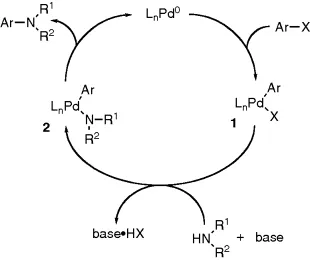
One of the most versatile and widely employed methods for the construction of aryl C–N bonds is the palladium-catalyzed cross coupling of amines with aryl halides and related electrophiles [4]. These reactions are believed to occur as shown in Scheme 1.1, with the coupling initiated by oxidative addition of the aryl halide to a Pd0 complex. The resulting intermediate 1 is converted to a palladium(aryl)(amido) complex 2 through reaction with the amine substrate in the presence of base. Finally, C–N bond-forming reductive elimination affords the desired aniline derivative with concomitant regeneration of the palladium catalyst.
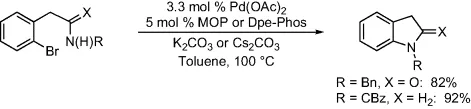
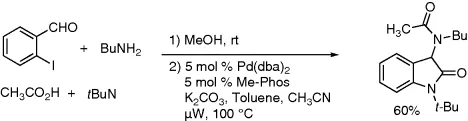
Although these reactions are most commonly used for intermolecular C–N bond formation, intramolecular versions of these reactions have occasionally been employed for the synthesis of saturated nitrogen heterocycles [5]. For example, Buchwald has described the synthesis of oxindoles and indolines through intramolecular reactions of aryl halides bearing pendant amines or amides (Eq. (1.1)) [6]. The conditions are amenable to the generation of indoline derivatives bearing amide, carbamate, or sulfonamide protecting groups. A two-flask sequence involving a four-component Ugi reaction followed by an intramolecular N-arylation that affords 3-amino oxindoles has also been developed (Eq. (1.2)) [7], and a number of other nitrogen heterocycles including ureas [8] and indolo[1,2-b]indazoles [9] have been prepared using this method.
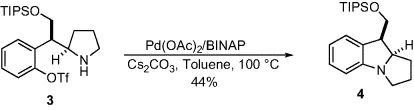
Intramolecular Pd-catalyzed or -mediated N-arylation reactions have been employed in the synthesis of several natural products [5]. For example, pyrroloindoline 4, which represents the mitomycin ring skeleton was generated via the intramolecular N-arylation of 3 (Eq. (1.3)) [10]. Other targets generated using this strategy include asperlicin [11], the cryptocarya alkaloids cryptaustoline and cryptowoline [12], and the CPI subunit of CC-1065 [13].
A number of interesting one-pot or two-pot sequences of Pd-catalyzed reactions have been developed that involve intramolecular N-arylation processes [14]. For example, a two flask sequence of Negishi coupling followed by intramolecular C–N bond formation has been employed for the synthesis of substituted indolines (Eq. (1.4)) [14a]. Lautens has recently described an elegant one-flask sequence of intermolecular C–H bond functionalization followed by intramolecular N-arylation for the preparation of substituted indolines [14b]. As shown below (Eq. (1.5)), the Pd-catalyzed coupling of 2-iodotoluene with 2-bromopropylamine 5 in the presence of norbornene provided indoline 6 in 55% yield.
1.3 Synthesis of Saturated Nitrogen Heterocycles via Alkene, Alkyne, or Allene Aminopalladation Reactions
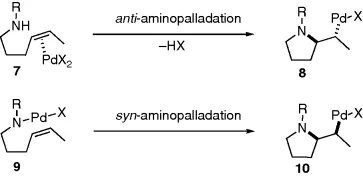
A number of approaches to the synthesis of saturated five-membered nitrogen heterocycles involve alkene, alkyne, or allene aminopalladation as a key step [2b,g]. The aminopalladation step can occur by either outer-sphere anti-aminopalladation or via inner-sphere syn-aminopalladation, and the mechanism can be dependent on substrate structure and reaction conditions. The anti-aminopalladation processes generally involve coordination of the unsaturated moiety to PdII, followed by external attack by a pendant nitrogen nucleophile (e.g., Scheme 1.2, 7 to 8). In contrast, the syn-aminopalladations occur via formation of a palladium amido complex (e.g., 9), which then undergoes migratory insertion of the alkene into the Pd–N bond to provide 10. Heterocycle-forming reactions that proceed via aminopalladation of an unsaturated group can be broadly classified into four categories: (i) oxidative amination reactions of alkenes; (ii) hydroamination reactions of alkenes and alkynes; (iii) carboamination reactions of alkenes, alkynes, and allenes; and (iv) haloamination and diamination reactions of alkenes.
1.3.1 PdII-Catalyzed Oxidative Amination of Alkenes
The first examples of Pd-catalyzed oxidative amination reactions of alkenes were described by Hegedus in 1978 for the construction of indoles [15], and dihydropyrrole derivatives [16]. Although these reactions proceed in good yield with catalytic amounts of palladium, a ...