- English
- ePUB (mobile friendly)
- Available on iOS & Android
eBook - ePub
About this book
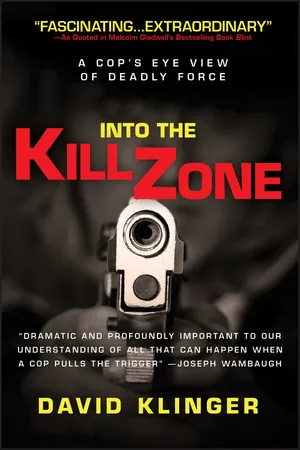
What's it like to have the legal sanction to shoot and kill? This compelling and often startling book answers this, and many other questions about the oft-times violent world inhabited by our nation's police officers. Written by a cop-turned university professor who interviewed scores of officers who have shot people in the course of their duties, Into the Kill Zone presents firsthand accounts of the role that deadly force plays in American police work. This brilliantly written book tells how novice officers are trained to think about and use the power they have over life and death, explains how cops live with the awesome responsibility that comes from the barrels of their guns, reports how officers often hold their fire when they clearly could have shot, presents hair-raising accounts of what it's like to be involved in shoot-outs, and details how shooting someone affects officers who pull the trigger. From academy training to post-shooting reactions, this book tells the compelling story of the role that extreme violence plays in the lives of America's cops.
Trusted by 375,005 students
Access to over 1.5 million titles for a fair monthly price.
Study more efficiently using our study tools.
Information
Chapter One
Choosing the Badge and Gun
Men and women become police officers for many reasons. For some, police work is the realization of a childhood dream born of playing cops and robbers or family tradition. Others become officers because they wish to help people in need, protect innocents from evil, or render justice. I, for example, had a grand plan to save South Central Los Angeles from the persistent gang violence and other crime that had turned the area into a virtual war zone during the 1970s. Less romantic motives for becoming a police officer also abound, as considerations such as the desire for a steady job with benefits, a wish to avoid the drudgery of more traditional occupations, and simple happenstance lead many people into law enforcement. Whatever draws them into police work, most officers come to find that the job they have is quite different from the one they had envisioned. The fact is that most Americans’ image of policing comes primarily from popular myths derived from media depictions of police work, which, as noted in the Introduction, provide at best shallow and at worst wildly inaccurate portrayals of the job.
Before coming on the job, most police officers are not aware that shootings are a rare occurrence. Prior to being hired, most officers are just ordinary folk, whose impressions of police work are shaped by the same media forces that frame those of any other member of the general public. So unless a future officer happens to have learned that shootings are rare events from a source such as a friend or family member already in law enforcement, he or she will likely share the general public’s misperception that police officers shoot people on a regular basis.
Although their impressions of the odds that they will end up shooting someone may differ, all would-be officers know that firearms are a tool of the police trade and that there is some possibility that they might one day find themselves in a situation that calls for them to pull the trigger. The fact that being a police officer means that one might be called upon to shoot—and perhaps kill—another human being raises an important question for all who seek the job: Will they be able to do it?
Rooted in the biblical admonition “Thou shalt not kill,” our American systems of law and civic morality stress the sanctity of human life and condemn the act of taking it. Even though our laws and morals have always provided for killing under certain circumstances—during war and in self-defense, for example—such provisions are narrow exceptions to the sweeping norm that we should not take the life of our fellow human beings. This powerful norm is not so easily overcome. Indeed some have argued that the norm reflects an innate human aversion to killing and, consequently, that police officers—like soldiers and anyone else whose job description includes the prospect of the destruction of fellow humans—must actually be taught to overcome their natural predisposition against shedding blood in order for them to take a life.1
Whatever its source, the sense that one should not kill is strong among Americans, and it can get in the way of doing one’s job if one is a police officer. Men and women contemplating careers in law enforcement deal with the fact that the ability to kill is a job requirement in a variety of ways. Some think long and hard about whether they can take a life. I certainly did, spending countless hours reflecting on the issue and discussing the morality of killing with friends, family, professors, pastors, and police officers who shared my religious faith. Other would-be officers resolve the question in short order, and some don’t really ponder it at all.
None of the officers I interviewed engaged in the degree of preemployment soul searching that I had, but some—such as the former theology student who took a police job after dropping out of seminary—came close. Several of the men and women that I spoke with had quickly put to rest the question about their ability to kill—some almost as soon it came up in their minds—and the majority never really contemplated the question as they were considering police careers. In fact, the only time many of these officers ever thought about the question was when it was put to them during their job interviews. Law enforcement agencies are keenly aware that some people are not capable of killing, so they try to avoid hiring such people. One way they do this is by asking applicants some variant of this simple question: “Do you believe that you could kill someone if you had to?”
Obviously, each of the eighty men and women who spoke with me had answered this question affirmatively. In this chapter we meet twenty-seven of them. Their stories were selected for two related reasons. The first is that the ways they dealt with the question of killing people before they came on the job cover the spectrum of how the officers that I interviewed approached the issue. The second is that the paths these officers took to police work are representative of those taken by the larger group. As a result, the stories in this chapter give the reader some idea of the types of journeys that people who aspire to law enforcement careers undertake on their way to an occupation where the job requirements include the ability to kill people.
The stories are presented in three groups, based on how and why the officers got into police work. This approach provides thematic threads that tie the stories together and allows the reader to see how people with similar motivations and backgrounds can have different ideas, attitudes, and expectations about deadly force. The stories begin with those of a set of officers who had a strong personal connection with law enforcement before they came on the job.
Friends and Family
The most common personal link to policing among officers was a parent or sibling who worked in law enforcement. The other sort of personal connection was through a close friend on the job. Officers who had a personal link to police work before they got into it typically possessed more knowledge about what the job entails than did their less-connected peers. As the stories in this section illustrate, however, officers who share similar backgrounds still can travel different paths to the job and possess substantially different perspectives on deadly force.
• • •
I was pretty young when I started to think seriously about becoming a cop, seventeen or eighteen. The idea came from my brother, who was already in law enforcement. He encouraged me to pursue it, and I did. I didn’t think much about being involved in shootings before I applied for the job. In fact, what first brought the possibility that I might shoot someone to my attention was a question that came up in an oral interview to come on the job. One of the people doing the interviewing asked me, “Do you think you could take somebody’s life if you had to?” It kind of set me back a little bit because the questions prior to that had to do with mundane things like why I wanted to become a police officer and my religious beliefs and whatnot. So when the question about killing someone came up, it kind of threw me back a little bit. I had to really think about it. I told the oral board that if I was placed in a position where I had to shoot to save my life or somebody else’s that I didn’t think I’d have a problem with taking a life, and it was left at that. So that was my first introduction to the idea that I might have to shoot someone.
• • •
I really started to consider becoming a cop when I was in high school. My dad was in law enforcement, but when I was young, he never would talk about things that were going on or things that had happened. When I was older and went to the station with him, the guys were always having fun and the stuff that was going on looked exciting. So police work looked exciting, and that was probably the main reason I got interested in it. When I told my mom I wanted to become a cop, she was concerned and proud at the same time. My dad tried to talk me out of it, but it was kind of a halfhearted attempt. His attitude was like, “It’s a great job. I don’t really want you to do it. But you’ll love it.” I went to a junior college for a couple of years, played some football there, then transferred to Randall State University and after a year there came on the sheriff’s department when I was twenty-one.
The notion that I might have to shoot somebody was always in the back of my mind, from the time I first decided to become a cop. I knew that that was part of the job. I had gone on some ride-alongs with friends that were on the department, and I knew from that that I wanted to work the faster places. Those places had a lot of shootings, so I knew that that was part of the game, that getting in a shooting was a real possibility.
• • •
Probably about a year before I came onto the force was the first time I thought about becoming a police officer. I was working for this import company that was facing a possible bankruptcy. My brother—who’d gotten on the force two years before—said my military background would probably help me get onto the police force if I were interested. I gave it some consideration and got accepted when I eventually applied.
I’d gone to college right out of high school and accumulated about ninety credit hours before I joined the army for a two-year hitch. I was a combat medic. Went overseas for a few months as part of a multinational peacekeeping force south of Beirut, Lebanon, called Operation Bright Star. It was fairly intense duty, but I was never involved in any combat. It was usually several miles away.
When I got out of the army, I came home, worked odd jobs, helped my dad in the family grocery business for a while, then found something that looked more promising at the import company that ended up facing bankruptcy. I decided to go on a ride-along with my brother when he mentioned that I should consider taking a police job. Nothing happened until the end of the shift, when he stopped by on a good shooting that involved a bad drug deal. The guy had half his face blown off. I had thought the ugliness of police work would not appeal to me, but it looked like I could handle the blood and gore, so I said, “This is for me.” I liked the atmosphere, being around a police station, in a police car, the adrenaline involved. Plus I saw that the police department was structured very similar to that of a military environment, and that’s something that I really enjoyed previously. In fact, I’d have stayed in the military for longer than two years, but I wanted to be near my family. I’m of Chinese descent and family is important to us. Besides that, I’m used to Mom’s cooking, and you don’t find much good Chinese food out in the sticks or in another country.
I gave some serious thought to the issue of using deadly force before I came on the department because I was involved in a shooting when I was eighteen years old. It was a hijacking at our family store. I saw the suspect come in, put a gun to my dad’s head, lay him down, and shoot him execution-style. I witnessed the whole thing. I was standing by where my dad hid one of his pistols, and I pulled it out and shot the suspect after he fired a shot at me and missed. He got away, but I know I hit him because they recovered a bullet that had a lot of blood on it in the front door. I figured that round went through his arm because he dropped the money. I chased him out of the store, and when he was about half a block away, I shot him in the back. He actually did a flip before he fell; then the getaway car came and dragged him away.
I thought my dad was dead, but it turned out that the bullet the hijacker fired went through his ribs. The gun was a cheap .22, where the cylinder was misaligned with the barrel. A piece of junk. I swore up and down that the gun was raised over my dad’s head, but he moved or something just when the guy pulled the trigger, and the bullet passed through two ribs, missed all the organs, and exited.
From that experience, I knew I could shoot someone, but I also thought about some other stuff regarding shootings. Besides my brother, I had some friends who came on the department before me, and they always told me about the liabilities involved. They said that every time you pull the trigger, you’ve got the chief’s name on every bullet that comes out of your gun. I also thought about how I would act in a bad situation as a police officer because I’m not really the John Wayne type, the aggressive type. I’m a pretty laid-back person. More importantly, I didn’t want to choke in a situation where I could get somebody else innocent killed, whether it’d be a civilian or my partner. I didn’t have a problem with the notion of hurting someone. I was just concerned about whether I could react the way that I’m supposed to.
• • •
When I was a young kid growing up in the Midwest, my father had a very close friend named Ray Underwood, who was a police officer. He was a childhood hero of mine, so I started thinking about following him and becoming a cop when I was pretty young. He had been in the marines, and when we’d go over to visit, he’d show my brother and me his gun. He even gave us a bayonet he had from the Second World War. When I was nine or ten, he got in a horrendous shooting while handling a disturbance call at a local hospital one night. He took several rounds, but he put the suspects down. He stayed on the job for a long time after that, so I was always impressed with old Ray Underwood.
Even though I’d had a family friend who was shot when I was pretty young, I don’t think that the seriousness of shootings registered when I was a kid. Where it really registered to me was when I was in the Marine Corps overseas in the Vietnam incident. I was in a force reconnaissance unit, a small group that would go out snooping and pooping around in the bush to bring back intelligence so the regular units could kick off a mission. Being in force recon was the best thing that ever happened to me in my life because I got intensive training and discipline. I went through all sorts of schools: guerrilla warfare, SCUBA, jump school, maneuvers over and over again about movement in the bush with a small group of people. I did all sorts of stuff like that for a year before heading overseas.
All that training helped keep me alive in Vietnam. That, plus when you’re in force recon, you’re not just one of the grunts. Those guys got hit terribly over there, but when you’re in force recon, you’re out there calling the shots. We had immediate air on station, immediate on-calls always set up to have artillery coming to our aid, and if we really got into the heat, we could get an emergency extraction. We’d just move to an LZ, a landing zone, and they would get you out of there. So it was a damn good thing as far as survival to be in a recon unit. We had a lot of contacts in the year I spent in Vietnam, but nobody from my unit ever got killed. We did OK, but we also ran missions where we set up as a reactionary force, and sometimes on those we had to go out and pick up the bodies of dead Americans. From that, I learned about what deadly force is all about and what guns can do.
I came back stateside in March of 1970. I put in my application with the police department in May, got released from the corps in late July, and started the academy two weeks later. So six months out of the bush and I was in the police academy.
• • •
Being that I grew up in a police family, I was pretty young when I first thought about becoming a cop, probably ten or eleven. My grandpa started the tradition back in the early ’40s, right around ’42. My dad got in it during the ’60s. Then my sister and I came on the job in the late ’80s. I’d gone away to college, came back from my first year at college, got a job with the Communications Division, and realized that police work was pretty much what I wanted to do. So I went back to school, got three more semesters under my belt, graduated, and came back. Two weeks after I came back from graduation, I started the academy.
When I was growing up, I never really thought about fights or shootings or anything like that. We didn’t have Cops, and we didn’t have Real Stories of the Highway Patrol on TV. That’s something that has been so much more recent. I was a typical kid. I grew up playing cops and robbers and good guy–bad guy, and we had the cap guns and if some guy snuck around the corner of a building, we’d pop one at him. “Bang! You’re dead” kind of thing. So we dealt with it, but we never had to deal with the seriousness of it. It’s like these programs nowadays where they show chases and all this action-type stuff, but you don’t see any of the aftermath of it. You don’t see any report writing, the interviews that take place. You don’t see really any of the investigation stuff. You see all the fun stuff, and that’s what we dealt with as kids, we dealt with the fun stuff. We didn’t have to deal with all the paperwork and stuff afterwards. So even though we did deal with it to an extent, we never really got in-depth with it.
Neither my dad nor my granddad were ever involved in a shooting, and they never talked about shooting people. When Dad would come home from work, I can remember he’d take his belt off and he’d set it on his dresser, and he left his gun in his holster. He very rarely would lock it up unless we left on vacation, and we all knew you don’t touch the gun. If I wanted to touch it, I had to ask him first, and there’d better be a good reason why I wanted ...
Table of contents
- Cover
- Contents
- Title
- Copyright
- Dedication
- Acknowledgments
- Introduction
- Chapter One: Choosing the Badge and Gun
- Chapter Two: Basic Training
- Chapter Three: Holding Fire
- Chapter Four: Pulling the Trigger
- Chapter Five: When the Smoke Clears
- Epilogue
- Glossary
- About the Author
Frequently asked questions
Yes, you can cancel anytime from the Subscription tab in your account settings on the Perlego website. Your subscription will stay active until the end of your current billing period. Learn how to cancel your subscription
No, books cannot be downloaded as external files, such as PDFs, for use outside of Perlego. However, you can download books within the Perlego app for offline reading on mobile or tablet. Learn how to download books offline
Perlego offers two plans: Essential and Complete
- Essential is ideal for learners and professionals who enjoy exploring a wide range of subjects. Access the Essential Library with 800,000+ trusted titles and best-sellers across business, personal growth, and the humanities. Includes unlimited reading time and Standard Read Aloud voice.
- Complete: Perfect for advanced learners and researchers needing full, unrestricted access. Unlock 1.5M+ books across hundreds of subjects, including academic and specialized titles. The Complete Plan also includes advanced features like Premium Read Aloud and Research Assistant.
We are an online textbook subscription service, where you can get access to an entire online library for less than the price of a single book per month. With over 1.5 million books across 990+ topics, we’ve got you covered! Learn about our mission
Look out for the read-aloud symbol on your next book to see if you can listen to it. The read-aloud tool reads text aloud for you, highlighting the text as it is being read. You can pause it, speed it up and slow it down. Learn more about Read Aloud
Yes! You can use the Perlego app on both iOS and Android devices to read anytime, anywhere — even offline. Perfect for commutes or when you’re on the go.
Please note we cannot support devices running on iOS 13 and Android 7 or earlier. Learn more about using the app
Please note we cannot support devices running on iOS 13 and Android 7 or earlier. Learn more about using the app
Yes, you can access Into the Kill Zone by David Klinger in PDF and/or ePUB format. We have over 1.5 million books available in our catalogue for you to explore.