eBook - ePub
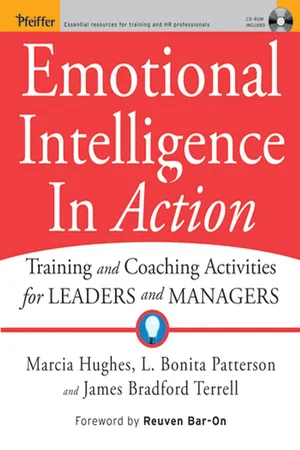
Emotional Intelligence In Action
Training and Coaching Activities for Leaders and Managers
- English
- ePUB (mobile friendly)
- Available on iOS & Android
eBook - ePub
Emotional Intelligence In Action
Training and Coaching Activities for Leaders and Managers
About this book
Emotional Intelligence in Action shows how to tap the power of EI through forty-six exercises that can be used to build effective emotional skills and create real change. The workouts are designed to align with the four leading emotional intelligence measures—EQ-I or EQ-360, ECI 360, MSCEIT, and EQ Map, —or can be used independently or as part of a wider leadership and management development program. All of the book's forty-six exercises offer experiential learning scenarios that have been proven to enhance emotional intelligence competencies.
PART ONE
Using Emotional Intelligence to Create Real Change
In Part One we explain the rationale for developing emotional intelligence (EI) and highlight four key EQ measures. In the first section we outline the case for emotional intelligence and explain why EI has such a powerful impact on effectiveness. In the next section we introduce the four most significant emotional intelligence measures and present a matrix for cross-referencing the individual exercises (workouts) in this book with the specific competencies in which each measure provides instruction.
If you are working with one of the four major measures—the EQ-i® or EQ-360™, ECI 360, the MSCEIT™, or EQ Map®—you can look up your measure of choice in the cross-reference matrix and find the workouts that apply. These workouts will help you develop the competencies important to you for whichever measure you use. The first three measures are reviewed in the newly released Encyclopedia of Applied Psychology (Cherniss, 2004).
Perhaps the best part is that you don’t have to be working with a measure at all! You can use these workouts independently to strengthen any competency that is needed. For example, if empathy is your focus, go to Workouts, 6.1, 6.2, and 6.3 and choose the one that is best suited to your situation.
CHAPTER 1
The Case for Emotional Intelligence
Would you like to be more effective in your work and in your personal life? Would you like to be able to better understand what you are feeling and why? Would you like to be able to participate more consciously in what you feel and how you respond, rather than just reacting in the same old patterns that you always have? Would you like to have more friends or be able to be closer and more open with the friends you have now? Would you like to be able to better monitor and motivate your progress toward your short- and long-term goals? Then you’ll Love exploring the world of emotional intelligence!
Exploring and developing our emotional intelligence not only makes us happier, it makes us able to motivate ourselves, manage stress in our lives, and resolve conflict with others. It gives us the skills to be able to encourage, comfort, discipline, and confront different kinds of people appropriately in different situations. It determines how effectively we express our emotions within the cultural contexts of our family, our workplace, and our community. It determines how well people listen to us and how well we are heard.
EMOTIONS: WHAT ARE THEY?
To effectively introduce the topic of emotional intelligence we need to start by talking a little bit about emotions and what they are. We like to say that emotions are about what we touch . . . not just what we touch with our fingers or our skin, what we touch with our eyes and ears, what we touch with our taste buds and the olfactory nerves in our noses. Emotions are how we feel about what we touch with our imagination, from the dread of a loud scary noise in the dark to those fifteen minutes of fame when you know you’re at the top of your game and everyone else gets to see. Emotions are what move us and motivate us. All three of these words—emotion, move, and motivate—share the Latin root emovare, which means to move. Emotions are what sustain us through our struggles and crown us in our victories. In fact when you really think about why we do anything that we do, there is always a feeling involved—something that we are avoiding and moving away from or something that we want and are moving toward. Fear and desire are two of our strongest emotions and have long been considered the most powerful motivators in the animal kingdom.
Research at the National Institute of Mental Health by Candace Pert has shown that emotions are very closely associated with neuro-peptides, long chain protein molecules that circulate throughout the organs of the body and act like “messenger molecules,” conveying information about what is happening in one part of the body throughout the entire system. In her book, Molecules of Emotion (1997), Pert considers emotions to be a transformative link between mind and body, the mysterious quantum mechanical interface where information turns into matter and our bodies synthesize the chemicals of consciousness.
Recognizing that our feeling responses are grounded in our biochemistry is an important understanding. Emotional states such as anger, sorrow, depression, and joy can be influenced and even directed by us, but this does not mean they can be turned on and off like a light bulb. It takes our body time to metabolize these chemical components—such as the adrenaline that is released when we feel frightened. The chemistry of emotions can help us change our viewpoint and see the world through different attitudinal lenses depending on how we are feeling. When we create and maintain positive thoughts about ourselves and our world through our self-talk, we support positive emotional states such as resourcefulness, optimism, and motivation.
A good way to imagine emotions is as an invisible link that connects people with each other and to some extent with all living creatures—they constitute a field of specific information that we sense and decode using the ancient instinctual languages of facial expression, smell, body posture, and the whole realm of nonverbal language. On top of all that, human beings are able to add another layer of sophisticated interpretation. Through our use of cognitive intelligence and semantic language, we are able to label our feelings and give them a wide variety of symbolic meanings with subtle degrees of texture and nuance.
Intelligence
Early in the 20th century psychologists began to devise tests for measuring cognitive ability and intellect in human beings. The eventual result was what we know today as the standardized IQ test. As research into human intelligence continued along these lines, it began to appear as if it was an inherited capacity and was not greatly influenced by any amount of educational effort. Adults did not necessarily have higher IQ scores than children, and over the course of their lifetime they didn’t seem to develop more. The view that intelligence was what was measured by IQ tests and that it was controlled by genetics generally prevailed into the 1970s. Yet when Weschler developed the IQ measure, he stated that there are other forms of intelligence besides the IQ he addressed.
Other scientists agreed with Weschler and were not satisfied with a static, one-dimensional definition of intelligence or the way in which it was measured. In the 1980s Howard Gardner published research that validated his work on “multiple intelligences,” demonstrating the importance of expanding that definition, and Reuven Bar-On coined the term “emotional quotient” in an attempt to differentiate emotional competencies from intellect. Leading research by John Mayer and Peter Salovey was instrumental in developing a theory of emotional intelligence that consists of four domains: perceiving emotions, facilitating thought, understanding emotions, and managing emotions. They were joined in their efforts by David Caruso and together developed the MSCEIT (Mayer-Salovey-Caruso Emotional Intelligence Test), a reliable, valid, ability-based assessment of emotional intelligence with a normative database of five thousand people.
Their definition of emotional intelligence emphasizes “intelligence” and differs significantly enough from others that we will include it here:
“‘Emotions’ refer to the feelings a person has in a relationship. For example, if a person has a good relationship with someone else, that individual is happy; if the person is threatened, he or she is afraid. Intelligence, on the other hand, refers to the ability to reason with or about something. For example, one reasons with language in the case of verbal intelligence, or reasons about how objects fit together in the case of spatial intelligence. In the case of emotional intelligence, one reasons with emotions, or emotions assist one’s thinking. That is, emotional intelligence, as measured by the MSCEIT™, refers to the capacity to reason with emotions and emotional signals, and to the capacity of emotion to enhance thought.” (Mayer, Salovey, & Caruso, 2001, p. 2)
For more information on their description of intelligence within the concept of emotional intelligence, see the discussion of the “concept of an intelligence that processes and benefits from emotions” in Mayer, Salovey, and Caruso (2000, p. 105).
The idea of having an ability-based emotional intelligence test with right and wrong answers may seem foreign to those who think emotions are too subjective to be quantified, but here is a simple explanation of how it works:
“Emotional skills can also be measured in an objective way through the use of ability, performance, or knowledge tests. Such tests would ask a series of questions like these:
• What is the cause of sadness?
• What is an effective strategy for calming an angry customer?
The MSCEIT™ (pronounced mess-keet) asks people to solve emotional problems, and the correctness of the answers is evaluated. In turn, a person’s scores are compared to a large, normative database to compute a sort of emotional intelligence quotient, or EI score.” (Caruso & Salovey, 2004, p. 75)
The Brain
Processing emotion is a non-conscious event. It is something we do intuitively that allows us to anticipate others’ behaviors in a more direct, immediate fashion than language can. Emotional intelligence is all about immediacy. The circuitry in our brains is set up to process emotional responses without having to consider them rationally. How am I feeling right now? How are you feeling right now? How are our feelings affecting each other and the actions we are choosing to take in this moment? These are the kind of critical comparisons that the limbic system, or emotional brain, is making for us constantly, most of it below the threshold of conscious awareness.
When sensory input enters our brain, it first is processed in the thalamus, which scans information for familiar patterns that may have been especially significant to us in the past. Such patterns are then forwarded to the hippocampus, which further screens them for threatening content before the amygdala’s final decision as to whether it should trigger the fight-or-flight response. If it turns out there is no precedent for fear, the information is then passed along to the neo-cortex, which is able to analyze it for meaning in a rational process.
The emotional circuits in the brain also regulate the balance of two critical hormones throughout the body, cortisol and DHEA. Cortisol plays many positive roles in bodily functions; however, it is often known as the “stress hormone” because stressful situations cause it to be secreted in exc...
Table of contents
- Praise
- About This Book
- About Pfeiffer
- Dedication
- Title Page
- Copyright Page
- Foreword
- Acknowledgments
- Introduction
- PART ONE - Using Emotional Intelligence to Create Real Change
- PART TWO - Exploring Fifteen Competencies of Emotional Intelligence
- PART THREE - Emotional Intelligence Workouts to Build Effective Skills
- Resources
- References
- About the Authors
- Index
- How to Use the CD-ROM
Trusted by 375,005 students
Access to over 1.5 million titles for a fair monthly price.
Study more efficiently using our study tools.
Frequently asked questions
Yes, you can cancel anytime from the Subscription tab in your account settings on the Perlego website. Your subscription will stay active until the end of your current billing period. Learn how to cancel your subscription
No, books cannot be downloaded as external files, such as PDFs, for use outside of Perlego. However, you can download books within the Perlego app for offline reading on mobile or tablet. Learn how to download books offline
Perlego offers two plans: Essential and Complete
- Essential is ideal for learners and professionals who enjoy exploring a wide range of subjects. Access the Essential Library with 800,000+ trusted titles and best-sellers across business, personal growth, and the humanities. Includes unlimited reading time and Standard Read Aloud voice.
- Complete: Perfect for advanced learners and researchers needing full, unrestricted access. Unlock 1.5M+ books across hundreds of subjects, including academic and specialized titles. The Complete Plan also includes advanced features like Premium Read Aloud and Research Assistant.
We are an online textbook subscription service, where you can get access to an entire online library for less than the price of a single book per month. With over 1.5 million books across 990+ topics, we’ve got you covered! Learn about our mission
Look out for the read-aloud symbol on your next book to see if you can listen to it. The read-aloud tool reads text aloud for you, highlighting the text as it is being read. You can pause it, speed it up and slow it down. Learn more about Read Aloud
Yes! You can use the Perlego app on both iOS and Android devices to read anytime, anywhere — even offline. Perfect for commutes or when you’re on the go.
Please note we cannot support devices running on iOS 13 and Android 7 or earlier. Learn more about using the app
Please note we cannot support devices running on iOS 13 and Android 7 or earlier. Learn more about using the app
Yes, you can access Emotional Intelligence In Action by Marcia Hughes,L. Bonita Patterson,James Bradford Terrell in PDF and/or ePUB format, as well as other popular books in Business & Leadership. We have over 1.5 million books available in our catalogue for you to explore.