- English
- ePUB (mobile friendly)
- Available on iOS & Android
eBook - ePub
About this book
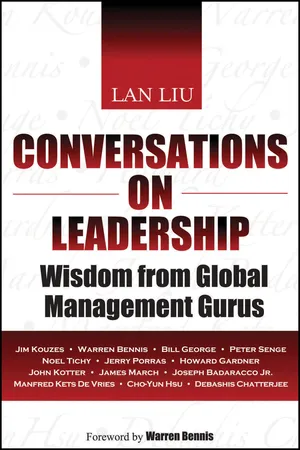
A veritable who's who in leadership, Conversations on Leadership features Warren Bennis, Jim Kouzes, John Kotter, Noel Tichy, Peter Senge, James March, Howard Gardner, Bill George, and others. Since each leader has a distinctive approach, this book provides the multi-faceted truths of leadership to broaden and deepen the understanding of the readers.
Information
PART I
Essential Leadership Qualities
CHAPTER 1
Jim Kouzes: Leadership is Everybody’s Business
Jim Kouzes is the co-author, with Barry Posner, of The Leadership Challenge, one of the most influential leadership books, which is currently in its fourth edition. He is the Dean’s Executive Professor of Leadership at the Leavey School of Business of Santa Clara University (SCU). He served as president, then CEO and chairman of the Tom Peters Company from 1988 to 2000, and directed the Executive Development Center at SCU from 1981 to 1987. The Wall Street Journal has cited him as one of the 12 best executive educators in the US.
Jim Kouzes traces his interest in leadership back to January 20, 1961, when he served in John F. Kennedy’s Honor Guard at the Presidential Inauguration as one of only a dozen Eagle Scouts. But it wasn’t until 1982 when he joined the staff at SCU that he, together with SCU professor Barry Posner, began to dedicate himself to serious research on the practice of leadership.
Kouzes and Posner became intrigued by what people did when they were exercising leadership at their best. They asked leaders across all types of organizations to tell them Personal Best Leadership stories, and they have been asking the same question since. Based on their research, they wrote The Leadership Challenge, first published in 1987, and presented The Five Practices of Exemplary Leadership (which is a registered trademark of Kouzes and Posner): (1) Model the Way, (2) Inspire a Shared Vision, (3) Challenge the Process, (4) Enable Others to Act, and (5) Encourage the Heart.
After more than 25 years’ continuous research, Kouzes and Posner maintain that the five practices are enduring and universal. In the preface to the fourth edition of The Leadership Challenge released in 2007, they write: “Nothing in our continuing research has told us that there is a magical sixth practice that will revolutionize the conduct of leadership, and nothing in our research suggests that any of the Five Practices are now irrelevant.”
With over 1.8 million copies sold and available in 22 languages, The Leadership Challenge is a bestseller around the world, including China. The appeal comes from its lucid structure: Leadership is about doing five things—and it comes with a guarantee. Kouzes and Posner write, “We also make you a promise: everything in this book is evidence-based. Everything we write about, everything we advise is solidly based in research—our own and others. If you engage in the practices we describe in this book, you will improve your performance and the performance of your team.”
While this sounds simple enough, simple does not mean easy. For example, in a marathon you need to complete 42 kilometers, which is quite simple but not easy at all. Having this clearly in mind, Kouzes and Posner offered this caveat: “There is a catch, of course. You have to do it with commitment and consistency. Excellence in anything—whether it’s leadership, music, sports, or engineering—requires disciplined practice.”
The Leadership Challenge is not only a book. Kouzes and Posner have created other products around it and also over a dozen other books. What is intriguing is that they always do it together as co-authors. Kouzes-Posner is not a co-brand, but a single brand. When I requested an interview with Kouzes, he recommended a three-way conversation together with “Barry.” Regrettably, when I visited Kouzes, Posner was busy with other commitments.
Unlike Posner, who has remained at SCU, Kouzes left academia for a while to run the Tom Peters Group Learning Systems in 1988 as president of the consultancy, and later on, CEO and chairman of the Tom Peters Company until 2000 (a role he refers to as that of a player/coach). Having come back to SCU as the Dean’s Executive Professor of Leadership, Kouzes is now more of a coach.
Expertise and experience aside, Kouzes is also a considerate coach. When I talked to him in San Francisco in June 2008, a month after a massive earthquake hit the province of Sichuan in China, he opened the conversation by asking whether the earthquake had affected any of my family. He also showed his thoughtfulness in the way that he had meticulously prepared notes for the list of questions I had submitted earlier. Even before we started our dialog, Kouzes was already modeling the way.
Leadership is about Ordinary People
Liu: In the preface of The Leadership Challenge, it says that the book is about how ordinary people exercise leadership at their best. By ordinary people, I think you mean people who are not in a very obvious, or very high, leadership position. So what does leadership mean to ordinary people?
Kouzes: Our work has been based on an assumption that leadership is not reserved for the people at the top. It’s not reserved for people who are elected officials. It’s not reserved for people who are military generals. It’s not reserved for people of any political status. You see “leadership” with the small “l” in every domain of life.
You see leadership on the playground with kids when someone is chosen as team leader or who emerges as a leader of a group. You see it in communities with their volunteers doing work, leading a project or leading a political activity.
You see leadership at home. In fact, the most important leadership role model for 18-30-year-olds, according to the research that Barry and I did, comes from family members, followed by teachers and coaches, then followed by community leaders, and, only after that, business leaders.
So it’s pretty apparent that leadership is not just something about people who are CEOs and those who make the cover of magazines. It is something that is not dependent on age, gender, or position. Leadership is something everyone can do.
Although we have interviewed many CEOs, what we wanted to know is not what CEOs do that makes them the most effective. We also wanted to know what made people who were in any leadership roles, regardless of level, effective.
So we decided to construct a research project that asked people from supervisor level all the way up to the very top of organizations. Given the nature of our study, the majority were middle managers. After the first edition of The Leadership Challenge we expanded our study to include student leaders, as well as others outside of formal organizations. We asked: What is it that you are doing when you are performing at your best as a leader? We collected hundreds of Personal Best stories, and we literarily took three-by-five cards and wrote down the specific behaviors from both the interviews and written cases that described what leaders did when at their best. We then organized these and it became our Five Practices.
If you are going to learn about leadership that is not based on a position, you need to study people who are across the range of leadership roles. The best way to do that is by asking them to tell a story about their best experience as a leader. If you do enough of that, you find enough people agreeing on certain things, and common themes become apparent. So like any initial observational research, that’s what we did. The Five Practices of Exemplary Leadership emerged from our analysis of the hundreds of cases and interviews.
Later, we tested the validity and reliability of our findings using an assessment questionnaire, The Leadership Practices Inventory (LPI), that measured the extent to which leaders engaged in The Five Practices and the impact these behaviors had on the attitudes and performance of team members. In addition to our research, after 25 years, more than 400 doctoral studies have been done using this model in a variety of different settings, testing its validity and its reliability. Ours is one of the most rigorously tested leadership models in use today.
Leadership is about Movement
Liu: Would you like to give a definition of leadership?
Kouzes: In our book, we define leadership as the art of mobilizing others to want to struggle for shared aspirations. And each of those words is chosen very carefully.
It is an “art” because even though we have tried to put some science to leadership—if leaders do certain things they will have these outcomes, and we do our best as researchers to validate this—there is a lot you can’t account for. There is a lot that comes from the person, the person’s style, and the person’s background. There’s also the culture of the company and the country, the industry, the state of the economy, and a host of other variables. Leadership is very much like a performing art, because you are doing it with other people or in front of other people. It’s not something you do on your own. It’s not an art like painting.
It is about “mobilizing others” because leadership is about movement. If you look up “manage” and “lead” in a dictionary, you’ll find that “manage” comes from the word “manus” which means “hand.” Being a manager is about essentially handling things, organizing and making sure everything is in good shape, and being efficient—those kinds of connotations. The origin of the word “lead” comes from the words “go,” “travel,” and “guide.” Leadership is about going places. So you are mobilizing others.
We use “want to” because people do their best only when they do things of their own volition and when they are personally committed. People who do it because they have to do it, because they are getting a paycheck, because they are afraid they will be punished by their manager, or because they are told to do it, do not produce the best outcome. So there is an element of making sure that people want to do this, not just have to do this.
And it is a “struggle.” Leadership is often presented as too easy: here is the formula, do these five things, and you should be successful. But in fact it’s all about hard work, difficulty, adversity, and challenge.
And last, leadership is about “shared aspirations” because it is not about the leader’s vision and values, it is about the collective. A leader represents a group of people, or represents a cause with a set of principles, not just himself or herself.
All of these are important elements of this definition. It’s also consistent with the origin, which is to “go,” “travel,” and “guide,” a sense of going someplace.
Managers must be Leaders
Liu: You have touched on the difference between leadership and management. Probably in many people’s minds, leadership is a better thing than management. What is your response to that?
Kouzes: Well, I had a manager title after my name for much of my career. My father had a manager title after his name. Managers tend to have a title. Leaders often do not. Managers are people who are most often appointed or selected. Leaders are people who often either emerge or might be elected. Management is a more formal operation. Leadership is often less formal. If you take some of the most recognized leaders historically—Mahatma Gandhi or Martin Luther King or even, say, Mao in his early years—they weren’t elected or appointed. They just led. They behaved in ways that attracted followers. So leadership is not about the title or position. It’s about the behavior.
There is a distinction between “manage” and “lead” based on their word origins and the way the functions are typically described. “Manage” is typically described as planning, organizing, staffing, directing, and controlling. Again, those practices have to do with keeping things in order, making sure everything is well-run and efficient.
Leadership is more about movement and going places and doesn’t necessarily have to do with anything being well organized. Often it may seem chaotic and disorganized because you are trying something new or going in a new direction. Things are unknown, and the process is often messy. It’s not as neat and tidy as management is often described.
That said, while there is a distinction between the two, we don’t find it necessarily very useful to make a big deal out of it. We try not to in our book because a manager—a person with a title—also has to be a leader. In today’s environment people expect both, not just one or the other. Managers must manage, and they must lead.
Now the same is not true f...
Table of contents
- Praise
- Title Page
- Copyright Page
- Dedication
- Foreword
- Acknowledgements
- Introduction
- PART I - Essential Leadership Qualities
- PART II - Leadership in Organizations
- PART III - Leading Through Storytelling
- PART IV - Complexities in Leadership
- PART V - Eastern Perspectives on Leadership
- AFTERWORD
- Index
Trusted by 375,005 students
Access to over 1.5 million titles for a fair monthly price.
Study more efficiently using our study tools.
Frequently asked questions
Yes, you can cancel anytime from the Subscription tab in your account settings on the Perlego website. Your subscription will stay active until the end of your current billing period. Learn how to cancel your subscription
No, books cannot be downloaded as external files, such as PDFs, for use outside of Perlego. However, you can download books within the Perlego app for offline reading on mobile or tablet. Learn how to download books offline
We are an online textbook subscription service, where you can get access to an entire online library for less than the price of a single book per month. With over 1.5 million books across 990+ topics, we’ve got you covered! Learn about our mission
Look out for the read-aloud symbol on your next book to see if you can listen to it. The read-aloud tool reads text aloud for you, highlighting the text as it is being read. You can pause it, speed it up and slow it down. Learn more about Read Aloud
Yes! You can use the Perlego app on both iOS and Android devices to read anytime, anywhere — even offline. Perfect for commutes or when you’re on the go.
Please note we cannot support devices running on iOS 13 and Android 7 or earlier. Learn more about using the app
Please note we cannot support devices running on iOS 13 and Android 7 or earlier. Learn more about using the app
Yes, you can access Conversations on Leadership by Lan Liu in PDF and/or ePUB format, as well as other popular books in Business & Corporate Finance. We have over 1.5 million books available in our catalogue for you to explore.