eBook - ePub
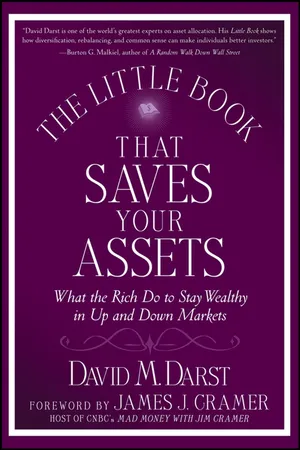
The Little Book that Saves Your Assets
What the Rich Do to Stay Wealthy in Up and Down Markets
- English
- ePUB (mobile friendly)
- Available on iOS & Android
eBook - ePub
The Little Book that Saves Your Assets
What the Rich Do to Stay Wealthy in Up and Down Markets
About this book
If you've ever wondered how investors continue to see substantial market-beating investment returns with portfolios that just seem to grow and grow, The Little Book that Saves Your Assets: What the Rich Do to Stay Wealthy in Up and Down Markets will reveal some secrets. David Darst, also known as Mr. Asset Allocations, shows you how to use savvy asset allocation strategies that you can use to invest like the rich do. This dynamic and easy-to-understand book allows you to rethink your asset allocation strategies and make the leap from mediocre to stellar returns.
Trusted by 375,005 students
Access to over 1.5 million titles for a fair monthly price.
Study more efficiently using our study tools.
Chapter One

We All Do It (Even if We Don’t Realize It)

Don’t Let Your Plan Be an Accident
IN AN EPISODE FROM THE hit television series The Sopranos, Tony Soprano asked his wife to let him bet her real estate earnings on what he thinks is a surefire gamble. When she asks why he doesn’t use the bundles of cash he has squirreled away over the years, Tony tells her that his cash is for emergencies and that all his other assets are tied up in what he calls asset allocation. Whether aware of it or not, we all have an asset allocation plan—even HBO drama characters. What I hope to do in this book is show you how to allocate your assets in such a way that you can meet your goals in a manner consistent with your personality.
Let’s first understand what asset allocation is and how it has evolved over the years. When I was first exposed to the concept back in the 1980s, asset allocation was pretty much limited to international assets. Japan and Europe in particular were coming into their own as legitimate financial markets and were behaving in a completely different way from the U.S. markets. China had opened up to the world, and Japan was well on the rise. In the United States, we were using non-U.S. stocks, bonds, and cash to help us achieve higher returns and stay diversified to avoid being totally dependent on a few investments to achieve our goals.
In the 1990s, the field of asset allocation began to broaden. New research was being developed, and we began to look at markets and portfolios differently. Instead of just buying a mutual fund and considering ourselves diversified, we began to look at the investment world in categories such as large cap or small cap. We looked at managers’ styles as being either growth or value, and we sought a balance of styles and capitalizations in our portfolio. As the decade progressed, manager and style selection became important tools to diversify investment portfolios.
By the late 1990s, a most curious thing began to unfold in the investment world. As the Internet and telecommunications became faster and more efficient, the world became much smaller. Much of the point of asset allocation is to find assets that not only can grow, but that behave in a manner different from other assets in the portfolio. When something is declining in price because of financial and economic events, it is nice to have something in the portfolio that is going up in price because of the same events. We call this noncorrelation and as you will see throughout the book, it is an important part of proper asset allocation. In the 1980s and early 1990s, you could generally achieve this by owning international stocks and bonds. Stocks in Japan tended to react primarily to Japanese events. European stocks were influenced by European news and generally moved differently from U.S. stocks. However, the approach of the New Millennium ushered in an increasingly global economy. Many of the same macro policies and factors that affected Ford also affected BMW and Toyota. Previously, all the fish swam in their own individual directions. As the planet shrank, the fish became a school and tended to swim together in the same way.
As we moved into the twenty-first century, new tools were created to meet investors’ needs for assets that would act differently from each other. Portfolios began to include new asset classes such as gold, commodities, real estate investment trusts, inflation-protected securities, and certain types of hedge funds, which became important tools to generate returns that were not related to the same events. We began looking at different styles of money management. Rather than just buying stocks and bonds, we looked at strategies such as merger arbitrage and short selling to round out portfolios and achieve the results we were hoping for.
At its heart, the essence of asset allocation is the search for noncorrelation. Let’s put it in football terms. To win at investing, we need to have a balanced team. We need to have parts of our portfolio that play great offense when times are good. We need defensive investments that are ferocious protectors of our territory when the economy is out of whack and things are not so great. Just as a good football team needs a good kicker to get points after touchdowns and kick field goals, we need some investments that provide steady excess returns regardless of economic conditions. To win, we have to be good at all aspects of the game. A sound asset allocation plan is how we build our team.
Just as a football team starts by evaluating players in the draft, to develop a plan we need to put together an organized current and projected view of you, your goals, your financial circumstances, and importantly, your behavioral and personality quirks. We have to have a general sense of what certain kinds of assets (such as stocks, bonds, cash, commodities, or real estate) can and cannot do for you. Once we have an idea of what we are working with and each player’s talents and abilities, we need to develop and follow a game plan. We have to develop a portfolio of diversified investments so that some of our assets tend to be doing well when other assets tend to be languishing. Once the game is under way, we need to look at the portfolio from time to time to see whether we should cut back on investments that have exhibited rapid growth or judiciously add to other sound investments that have temporarily declined in value. A good football coach is always looking at the whole field and paying attention to what can go wrong. So should we. We always need to be thinking about how various kinds of risks can affect our assets, so we can take steps to reduce or offset such risks.
In many ways, investors today are fortunate. In the past 10 years, I have seen an explosion in investment products and investment information sources. Now it is possible for all investors to use the tools that were once available only to institutions such as retirement funds, endowments, and the very wealthy. Financially oriented television and radio programs; Internet-based web sites and blogs; and abundant articles, books, and brochures provide objective (and sometimes, not so objective) education and advice about investing. New financial instruments such as open-end and closed-end mutual funds, exchange-traded funds (ETFs), and depositary receipts have made it much easier for everyone to access all kinds of asset classes. These range from small- and mid-cap domestic stocks to international stocks and bonds, to gold, silver, inflation-protected securities, and specialized investment strategies such as those that focus on specific industry sectors that profit when prices fall.
The good news is that everyone has an all-access back-stage pass to just about every type of investment, investment strategy, and risk management scheme there is. A brave new world of investment opportunity sits right outside your door (or inside the computer sitting on your desk), and you can put it to great use in growing your wealth, just as savvy and wealthy investors have for generations. First and foremost, you will have to decide if you are a do-it-yourselfer or if you prefer to bring in the pros. You may be brilliant at picking specific stocks, but have absolutely no interest in thinking about your overall portfolio, future planning, or risk management. Conversely, you may have no interest in picking stocks, and bonds may bore you, but you may love thinking about the big moves of asset allocation.
Putting together a game plan involves deciding what you need each player to do for the team. Likewise, proper asset allocation involves knowing what you want your assets to do for you. Are you at a stage in your life (and in a frame of mind) where it is more important to increase your wealth? For instance, if you are young and saving for college or for a newborn child, the money saved won’t be used for quite some time, and what those future tuition bills will look like could be anyone’s guess. The young parent will likely need a lot of money nearly 20 years in the future, and so these funds can be marked for aggressive capital growth, which may put them all in stocks. Stocks tend to be volatile and may swing wildly with short-term price declines and losses, but over time have tended to provide the highest return. However, if you are saving to buy a house in three years, you might not be willing to suffer any short-term losses. Therefore these funds will demand a different strategy, because you will want to protect the principal value.
Think of your money as the players on your team. You want quarterbacks to throw the ball accurately and tackles to block. Some of the most disappointed investors I’ve seen over the years had perfectly good investments; the problem was that they didn’t allocate their investments according to their needs, and so their returns suffered. Monies had to be pulled from stock funds before they experienced great appreciation; perfectly good bond funds were used improperly as long-term investments; and money market accounts were incorrectly used as retirement savings. It’s not enough to pick great investments—you have to pick the best investments for the right reasons.
We have our game plan. We know what we need each player to do. Now we have to look at what kind of field conditions we have, and what the weather will be like come game time. If we have a game plan built around throwing the ball and it’s raining with 20-mile-an-hour winds, we are going to need to make some adjustments to the plan. It is the same with our investments; we need to think about what type of economic, financial, political, and geopolitical environment we are likely to face. Of course, even economists disagree, and predictions for the future vary widely, but you do need to have a sense of where things might be going. Are the domestic and global economies expected to be in a period of progress, stagnation, or decline? Are the financial markets favorably positioned for investment, or are they undergoing an era of turmoil, turbulence, and high volatility? Are prevailing political trends (such as taxes, regulation, and public opinion) investor-friendly or unfriendly? Are nations and regions behaving toward one another in a cooperative way, or in a confrontational way? All these background conditions can affect your asset allocation decisions toward or away from stocks, bonds, cash, or other kinds of assets.
If you are playing offense and investing somewhat assertively or aggressively to take advantage of a favorable economic environment, you may have certain kinds of players on the field, such as domestic and international stocks. On the other hand, if you are playing defense, your players may be heavily weighted toward high-grade bonds, cash, and perhaps inflation-protected securities. Which players you use will be determined by your investment temperament, outlook, and personal circumstances. Picking the best investments is important, but we live in a world where you can’t just pick and be done with it. We inhabit a fast-changing world and global economy today. You need to reevaluate and rotate players in and out of the portfolio as the financial outlook changes, as your investments increase or decrease in value, and as your own monetary and personal situation changes over time.
One of the most fundamental elements of asset allocation is diversification. In my mind this is one of the most overused and least understood words in all of investing. True diversification involves having several distinct kinds of asset classes that perform differently from each other in different kinds of financial environments. For example, some investments, such as commodities and precious metals, may thrive in a high inflation environment while other assets, such as government bonds, tend to excel in a strongly disinflationary or deflationary environment. Depending on the financial outlook and the investor’s mindset, it generally makes sense to have exposure to at least a few and perhaps several asset classes. I’ve seen too many investors make the mistake of thinking that they have a diversified portfolio when in fact they own nothing more than a list of assets that all go up or down in price together. I counseled a gentleman who thought he had a diversified portfolio because he owned dozens of stocks. When I reviewed the list, I found that he had a great many airline and trucking stocks. He owned different types of passenger airlines and also delivery companies like Federal Express. He had read that having a large number of stocks was how you diversified a portfolio. His background was in the transportation industry and he thought the economy would do well, so he included the trucking and shipping companies. Guess what? This portfolio is totally nondiversified. The same economic events will affect just about every stock he owns in the same way. Rising oil prices would be negative for his entire portfolio. As I meet with investors and talk to financial advisors around the world, I find this approach all too common. I meet investors who own six different mutual funds and think they are diversified. If they are the large popular funds, the investors probably own many of the same stocks in each fund, and all of the funds will react the same way to the same events. In the late 1990s, fund after fund owned virtually the same Internet and technology stocks. It didn’t matter how many funds investors bought, they were just increasing their exposure to the dotcom bubble, not truly diversifying.
Diversification will not only make your portfolio less volatile, it will also make your reaction to the state of the markets more stable. Investment history is full of examples of how not keeping a strong focus on being diversified led to disaster. We can go all the way back to the 1970s, for example. Coming into the 1970s, things were great. The 50 largest stocks were considered the “Nifty Fifty,” one-decision stocks. Buy them and forget them, because they would only go up. Many investors did exactly that. Then came OPEC, inflation, and the resignation of the U.S. President. The American mood and the markets turned sour. As markets collapsed, losses mounted and people panicked. At the bottom, they sold the stocks they owned. Warren Buffett was one of the few who kept a cool head and bought stocks as prices hit rock bottom. He pounced on the bargains offered by panicky sellers. When the market crashed in October 1987, investors who had all their money in stocks got scared and sold. As a disciplined practitioner of asset allocation and diversification, Yale University was ready to tactically reallocate right after the 1987 selloff, from bonds and cash into stocks at what turned out to be historically low levels. More than five years after the 2000- 2002 tech stock bubble burst, the memory of the tech bubble remained vivid for many investors still suffering from embracing the new paradigm too tightly. In chasing hot investments and ignoring diversification in favor of the financial lottery ticket that tech stocks seemed to offer, investors exposed themselves to financial heartbreak and still wary, missed a lot of the 2003-2007 stock price recovery.
If you have your eggs in more than one basket, you will be subject to fewer extreme mood swings, from despondency when everything seems to be moving down in price, to euphoria when everything seems to be moving up in price, that may cause you to do exactly the wrong thing at the wrong time. In the late 1990s, investors who practiced asset allocation and paid attention to keeping their portfolios diversified were selling tech stocks to buy underpriced assets such as real estate investment trusts and bonds that subsequently did very well. The oft-cited mantra of Buy Low and Sell High is achieved through diversification. As assets rise and swell to too large a percentage of the portfolio, asset allocation has us selling them and redeploying the money into more out-of-favor sectors and asset classes. Buying Low and Selling High.
We buy low and sell high—the mantra of successful investing—by portfolio rebalancing. By establishing targeted percentages of your total portfolio that are to be placed in stocks, bonds, cash, real estate, and other investments based on your goals, asset allocation is like a navigation system. Along the way, the prices and returns of each investment in the portfolio will fluctuate in varying degrees. If you targeted an asset allocation of 50 percent in stocks and 50 percent in bonds ($50 in stocks and $50 in bonds, for a total portfolio of $100), and after one year, the stocks doubled while the bonds stayed flat, the portfolio would then be 67 percent in stocks and 33 percent in bonds ($100 in stocks and $50 in bonds, within a total portfolio of $150). To get back to the originally targeted 50-50 mix of equities and bonds, you will reallocate so that $75 is in stocks and $75 is in bonds. To do this, you would sell $25 out of the $100 stocks portfolio and with the proceeds buy $25 of additional bonds. This process is called rebalancing the portfolio. Buy Low, Sell High.
You can rebalance in either one of two ways: by price or by time. When an asset allocation is rebalanced to its target mix by time, you will allow the various asset classes in the portfolio to experience their upward or downward price changes until a predetermined amount of time has passed. The rebalancing is then carried out to arrive at the originally targeted asset allocation. The time period could be annual, semiannual, quarterly, or some other interval. The time frame will be based on how involved you wish to be and your attitude toward the markets and the economy. Although the by-time approach may lead to some degree of variation from the originally targeted asset allocation, this method may incur lower transaction costs than a rebalancing rule driven entirely by asset price changes. That is the other way to rebalance your portfolio. You simply rebalance your portfolio back to the original target allocations as soon as they experience a specified percentage deviation from the original percentages. For example, 5 percent, 10 percent, or some other percentage change might trigger a rebalancing to get back to the originally targeted asset allocation. Such a rebalancing rule tends to keep the portfolio fairly closely aligned with its originally targeted allocation, but at the same time, this method may require a closer level of portfolio monitoring and may generally incur greater transaction costs due to the possibility of more frequent asset percentage adjustments than the by-time approach.
The asset allocation approach to investing has one other enormous benefit. As we put together a portfolio and decide which assets we will or will not use to meet our goals, we are forced to think about risk in real terms. We all talk about risk in much the same way that we talk about eating a healthy diet, but few of us really do anything about it. Okay, so you understand that investing involves risk. Ask yourself how much you could stand to lose. No, really. How much can you take? How much of a loss can you withstand according to your goals? Can you take a loss on the money you are saving to buy a vacation home? How much would you be willing to lose, over what time frame, for your children’s college fund? What about your retirement? Now, what would be worse—losing that much money, or not gaining a certain amount? Asset allocation can’t make risk go away. Face it, life is full of risks and success is not a straight line up. What asset allocation does is force you to ask and answer some challenging questions which should lead you to a portfolio construction that will, hopefully, prevent you from doing something silly when things get tough, or when things are going exceedingly well. (It is often said that, due to euphoria, investors make more mistakes during bull market times than they do in bad times due to euphoria.) If you hold different types of investments, then your asset allocation strategy will bring a degree of realism to the investment process, in which you ask yourself whether the glass is half empty or half full. The arithmetic of risk and loss is well known. An asset that declines 50 percent in ...
Table of contents
- Praise
- Little Book Big Profits Series
- Title Page
- Copyright Page
- Dedication
- Foreword
- Introduction
- Chapter One - We All Do It (Even if We Don’t Realize It)
- Chapter Two - Everyone Needs an Uncle Frank
- Chapter Three - Building Your House
- Chapter Four - Parts of the Whole—Combining Dreams into a Plan
- Chapter Five - Two Strategies to Win the Battle for Investment Survival
- Chapter Six - Do You Know Where You Are Going?
- Chapter Seven - Mix, Don’t Match
- Chapter Eight - Our Minds , Our Selves
- Chapter Nine - The Jockey Matters as Much as the Horse
- Chapter Ten - Riding Out Storms
- Chapter Eleven - Build Your House on These Rocks
- Chapter Twelve - Count to Zen
- Chapter Thirteen - Seven Quick Ways to Ruin
- Chapter Fourteen - The Road Less Traveled that You Should Take Right Now
- Who Are You?
- What Do You Think?
- What Works for You?
- Don’t Take My Word for It
- Acknowledgments
Frequently asked questions
Yes, you can cancel anytime from the Subscription tab in your account settings on the Perlego website. Your subscription will stay active until the end of your current billing period. Learn how to cancel your subscription
No, books cannot be downloaded as external files, such as PDFs, for use outside of Perlego. However, you can download books within the Perlego app for offline reading on mobile or tablet. Learn how to download books offline
Perlego offers two plans: Essential and Complete
- Essential is ideal for learners and professionals who enjoy exploring a wide range of subjects. Access the Essential Library with 800,000+ trusted titles and best-sellers across business, personal growth, and the humanities. Includes unlimited reading time and Standard Read Aloud voice.
- Complete: Perfect for advanced learners and researchers needing full, unrestricted access. Unlock 1.5M+ books across hundreds of subjects, including academic and specialized titles. The Complete Plan also includes advanced features like Premium Read Aloud and Research Assistant.
We are an online textbook subscription service, where you can get access to an entire online library for less than the price of a single book per month. With over 1.5 million books across 990+ topics, we’ve got you covered! Learn about our mission
Look out for the read-aloud symbol on your next book to see if you can listen to it. The read-aloud tool reads text aloud for you, highlighting the text as it is being read. You can pause it, speed it up and slow it down. Learn more about Read Aloud
Yes! You can use the Perlego app on both iOS and Android devices to read anytime, anywhere — even offline. Perfect for commutes or when you’re on the go.
Please note we cannot support devices running on iOS 13 and Android 7 or earlier. Learn more about using the app
Please note we cannot support devices running on iOS 13 and Android 7 or earlier. Learn more about using the app
Yes, you can access The Little Book that Saves Your Assets by David M. Darst,David M. Darst in PDF and/or ePUB format, as well as other popular books in Business & Investments & Securities. We have over 1.5 million books available in our catalogue for you to explore.