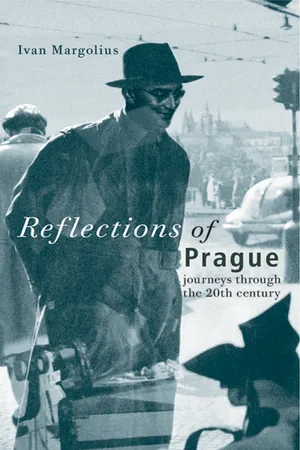
Reflections of Prague is the story of how a Czech Jewish family become embroiled in the most tragic and tumultuous episodes of the twentieth century. Through their eyes we see the history of their beloved Prague, a unique European city, and the wider, political forces that tear their lives apart. Their moving story traces the major events, turmoil, oppression and triumphs of Europe through the last hundred years – from the Austro-Hungarian Empire to the First World War; from the vibrant artistic and intellectual life of Prague in the times of Kafka, the Capek Brothers and Masaryk to years of hunger in a Polish ghetto and the concentration camps of Hitler; from the tyrannous rule of Stalin to the rekindled hopes of Dubcek and the subsequent Soviet occupation to liberation under Havel. Told from Ivan's perspective, it is a poignant but uplifting tale that tells of life lived with purpose and conviction, in the face of personal suffering and sacrifice.
'A remarkable book. This archetypical story of the twentieth century is intertwined with an almost stream-of-consciousness narrative of the history of the Czechs, of Prague, interspersed with samples of exquisite poetry by great contemporary poets. So the narrative flows like Eliot's sweet Thames full of the debris of tragic lives, of horrors, of moments of beauty and testimonies of love – all against the backdrop of man's inhumanity.' Josef Škvorecký
'A poignant and vivid mémoire of a child searching for traces of his father, lost in the murky ideologies of post war Central Europe. An engrossing book.' Sir John Tusa
Trusted by 375,005 students
Access to over 1.5 million titles for a fair monthly price.
We wave a handkerchief on parting, every day something is ending, something beautiful is ending.
Jaroslav Seifert, Píse
/A Song, 1929, translated by Ewald Osers
On returning to Prague I imagined I had seen my father. His slim figure, elegantly dressed in a dark single-breasted suit, white shirt and blue tie, appeared in the distance. He paused at Knihy bookshop in Na P
íkop
Street to look inside and check his reflection in the shop window. His hair was swept back, the receding hairline exposing his high forehead. Rimless spectacles framed his grey eyes, glinting in the bright morning light. The permanent smile on his lips, which I so loved, was still there. He checked the time on his Omega watch, lit a cigarette and walked on. Pushing through the crowd, I hurried to catch him but he disappeared into the darkness of Prague’s many passageways that criss-cross the inner city. l delved into the labyrinth of shadows to search for him.
At the far opening of one of the long tunnel-like arcades, I spotted our car parked at the kerb. Behind the wheel sat táta, my father Rudolf. Terrified I would not reach him before he drove away I started to run. I had to get there before it was too late. I ran desperately, my heart pounding, my long steps getting steadily shorter as I continued, my struggle becoming harder the further I went. I shouted as I ran, my adult voice turning into a child’s shriek: ‘Wait for me, wait for meee.’
There was no need to worry. Rudolf waited patiently, finishing his cigarette. He appeared gloomy and preoccupied, but as soon as he saw me, he cheered up. ‘Ahoj, Ivane! Where is your Mum?’ he asked through the open window and, after I finally opened the passenger door using the handle I could hardly reach and climbed into the car seat next to him, Rudolf added, remembering: ‘Oh yes, she said she’d follow us on a train, we’ll have to pick her up from Beroun; she has to finish a dust jacket design for publication.’
Enormously relieved that I had found him I sat there, admiringly looking up to him. I was out of breath, unable to speak.
I was nearly five years old.
His jacket was draped over a battered violin case on the rear seat; the brightly enamelled Communist Party badge decorated the peak of the jacket’s lapel. He was reading densely typed documents pulled out from his packed leather briefcase and propped up on the steering wheel, making notes in the margins with a gold fountain pen.
When I was older I learned that the papers must have been from the Ministry of Foreign Trade. Two years earlier, in 1949, he had been promoted to Deputy Minister and since then I had seen him only occasionally. He had to travel abroad, attend trade negotiations, Ministry and Party meetings, consult with other departments and write extensive analytical reports and economic statistics long into the night. Rudolf was putting all his knowledge and skill into trying to improve the difficult problem of the country’s ailing centralized economy. His time at home was limited to precious moments, which had to be savoured and appreciated. Even there I saw him sitting in his armchair or at his writing desk constantly leafing through books and documents; regretfully, he did not seem to have that much time to play with me.
I recalled how Heda, my mother, and he had argued the night before. They thought that I was asleep, but fragments of their sentences, whose meaning I hardly understood but found fascinating, penetrated the apartment walls into my bedroom.
‘Rudlo, you have to leave your job immediately … I’ve talked to lots of our old friends and they all say you have to go, whatever happens … Your position, high up in the Ministry, puts you next in line as the scapegoat when things go wrong,’ she pleaded, sounding very worried. ‘Haven’t our families suffered enough during the war? It’s a miracle that we both survived … And now this. I can’t face any more difficulties … ’ They must have been sitting in the living room on the red L-shaped sofa, facing each other. Rudolf got up and started pacing the floor. I heard the parquet blocks squeaking under his steps. Often, seeing other children being looked after by elderly family members, I wondered where my other relatives and grandparents were. Heda explained gently that they had all died during the war but never went into any details.
‘Kitten, the Party needs me … You know I tried to resign once but they ordered me to carry on.’ Apparently there could not be any respite, the five year plan had to be fulfilled and the Soviets were putting the Czechs under constant pressure. There was no one else there to take his place.
‘But, Rudlo, you’ve heard about the arrests, the disappearances, all the people at the top are vulnerable … When did you see your friends Eda, Artur and Evžen last? Where have they gone suddenly? Don’t you know they’ve been arrested? Haven’t you noticed most of the ones who are disappearing are Jews?’
‘That’s preposterous, Heda, you worry too much. The Party would not sink to the same level as the Nazis. There must be a totally rational explanation for this … I haven’t gone through the camps for nothing … To give up on what honestly I believe is right … If all the decent people leave now, things will get even worse.’
‘Micula Bradová, your cousin, phoned this morning.’
‘What about? How’s she? We should go and see them, I suppose,’ said Rudolf, and I heard him stop and strike a match to light his and Heda’s cigarettes.
‘It’s too late,’ said Heda. I heard her blow out smoke.
‘Why? Kitten, what’s happened?’ Rudolf was shocked.
Heda carried on, saying that there had been a party in the town of Ústí nad Labem to celebrate the anniversary of the construction company where Micula’s husband Rudolf Brada was a director, and that Micula was as worried about Brada’s steep rise in the Party ranks as she was about Rudolf. Micula had decided that it was the right moment to end it, and blurted out loudly in front of everyone how the Party had replaced all the important people in Ústí with incompetent ones and now nothing worked and there was a lot of corruption. On account of her ‘little’ public complaint Brada had been dismissed; it looked as if he was out of danger. ‘I should do the same with you,’ added Heda. ‘Rudlo, please think of your family and Ivan. It’s not just us; we’re responsible for him and his secure future now. What if they arrest you?’
Rudolf started pacing again. He was silent for some time. Then he begged Heda to believe him, he thought of both of us all the time, all he did was done for our better life. What reason could they have to arrest him? It could not happen to him, only those who made mistakes could possibly be in danger. His affairs were completely watertight. Comrades at the top including Gregor, his superior, knew that he was doing his best, they endorsed and supported him, he got every decision he made approved from above. He worked day and night, what he did was for the good of us, the country and the Party. He reminded Heda of how President Klement Gottwald thanked him when he had returned from London.
The living room went quiet. Rudolf sat down. I assumed that Heda went over, put her arm round his shoulders and had drawn him to her as I heard her tender offer in reconciliation: ‘Look Rudlo, let’s go to Lišno – or better still to Nouzov and Doctor Ške
ík’s as there it’ll be more private – for a few days before you go away again, and talk this over more … ’ I lost concentration then, and fell asleep.
Rudolf gathered his papers, put them in the briefcase and left it on the back seat. Our car was a beige Škoda Tudor 1101 saloon convertible, with a streamlined body and chrome ‘smiling’ radiator grille, the first post war production design. We called the car ‘Ferda’ after the ant, Ferda Brabenec – a heroic character in the Czech children’s stories by Ond
ej Sekora that I enjoyed leafing through at home. Ferda had folding tubular steel front seats which could be converted into comfortable couchettes when the backs were dropped. Rudolf, with my help, kept the car polished whenever he had a spare moment. He had bought Ferda second-hand three years ago. Not many people owned cars in the early 1950s and Rudolf sat in ‘him’ proudly. I always enjoyed being with Rudolf, sharing in his pleasures.
‘All right, settle down and we’ll be off to Nouzov. We’ll take the slow route through the countryside. It’ll be more fun. Let me roll down the roof and then it will be perfect.’
Rudolf got out to open the roof. This was the best way to appreciate a sunny spring day. We were parked in Ovocný trh, in Staré M
sto – the Old Town, where dark classical buildings stood on all sides colourfully dressed in both red and red-blue-white flags, and yellow hammer and sickle signs. The larger than life and rather intimidating portraits of Gottwald and the Greatest Leader Josef Vissarionovich Stalin, their names having been made clear to me, cast their watchful eyes on the bustling square below. Similar scenery was encountered in the rest of the town. Long red fabric banners stretched the full height of buildings framing Socialist slogans and pictures of the Communist heroes Marx, Engels and Lenin. Even shop windows had their goods shrouded in scarlet drapery and images of our beloved President. The May Day and Liberation Day celebrations were imminent. Then the proletarian masses, whose attendance was compulsory, demonstrated peacefully through the streets carrying placards, waving flags and singing songs and praises to our Party leaders. Along the Letná Plain the Party organized the Czechoslovak Army parade, which I liked watching, displaying shiny Russian tanks that rolled noisily along the streets leaving clouds of exhaust fumes behind. The tanks were followed by trucks towing large cannons and anti-aircraft guns, some with sharp-pointed Katyusha rocket launchers bunched up on the rear platforms, and the helmeted, khaki-dressed military units marching with rifles and machine guns drawn in readiness. ‘They are here to remind us of the Red Army’s victory over Nazism and who’s in charge,’ Heda had whispered to herself while holding my hand when we stood on the pavement the previous year.
Presently Rudolf returned into the car and we set off. In my teens Heda described to me how Rudolf loved to travel; it was always an adventure for him, a man and his machine in affinity with nature. In July 1931, as an eighteen-year-old, he and some friends had bought a 1926 Dodge – an old-fashioned car with a cubic body and spoke wheels – in Cleveland after they had attended a YMCA conference there. They had expl...
Table of contents
Cover
Title
Copyright
Dedication
Acknowledgements
Chapter 1: Journey with my Lost Father
Chapter 2: Lonely Times
Chapter 3: The Safety of Bratislava
Chapter 4: Rudolf
Chapter 5: Heda
Chapter 6: Rudolf: Into Adulthood
Chapter 7: Heda: Life’s Endings and Beginnings
Chapter 8: Between the Wars
Chapter 9: An Impotent Army
Chapter 10: Chances of Survival
Chapter 11: Transport to Łódź
Chapter 12: A Stumble out of Auschwitz-Birkenau
Chapter 13: Return to Prague
Chapter 14: From Idealism into Self-Destruction
Chapter 15: Politics Taking Over
Chapter 16: Stranded in the Forcefully Distorted Economy
Chapter 17: The Soviets Arrive
Chapter 18: Journeys of Misunderstanding
Chapter 19: Towards Manufactured Guilt
Chapter 20: Ways into Detention
Chapter 21: To Nowhere
Chapter 22: In the Name of the Party
Chapter 23: Making Trade
Chapter 24: Ruzyně Interlude
Chapter 25: The Theatre of Absurdity
Chapter 26: A Trip to the Land of No Return
Chapter 27: The Last Journey
Chapter 28: Sinking Deeper
Chapter 29: Towards Beauty
Chapter 30: A Walk from School
Chapter 31: Youthful Dreams
Chapter 32: The Emergence of Truth
Chapter 33: Living Anew
Appendices
Notes
Index
Endpaper
Frequently asked questions
Yes, you can cancel anytime from the Subscription tab in your account settings on the Perlego website. Your subscription will stay active until the end of your current billing period. Learn how to cancel your subscription
No, books cannot be downloaded as external files, such as PDFs, for use outside of Perlego. However, you can download books within the Perlego app for offline reading on mobile or tablet. Learn how to download books offline
Perlego offers two plans: Essential and Complete
Essential is ideal for learners and professionals who enjoy exploring a wide range of subjects. Access the Essential Library with 800,000+ trusted titles and best-sellers across business, personal growth, and the humanities. Includes unlimited reading time and Standard Read Aloud voice.
Complete: Perfect for advanced learners and researchers needing full, unrestricted access. Unlock 1.5M+ books across hundreds of subjects, including academic and specialized titles. The Complete Plan also includes advanced features like Premium Read Aloud and Research Assistant.
Both plans are available with monthly, semester, or annual billing cycles.
We are an online textbook subscription service, where you can get access to an entire online library for less than the price of a single book per month. With over 1.5 million books across 990+ topics, we’ve got you covered! Learn about our mission
Look out for the read-aloud symbol on your next book to see if you can listen to it. The read-aloud tool reads text aloud for you, highlighting the text as it is being read. You can pause it, speed it up and slow it down. Learn more about Read Aloud
Yes! You can use the Perlego app on both iOS and Android devices to read anytime, anywhere — even offline. Perfect for commutes or when you’re on the go. Please note we cannot support devices running on iOS 13 and Android 7 or earlier. Learn more about using the app
Yes, you can access Reflections of Prague by Ivan Margolius in PDF and/or ePUB format, as well as other popular books in History & Eastern European History. We have over 1.5 million books available in our catalogue for you to explore.