eBook - ePub
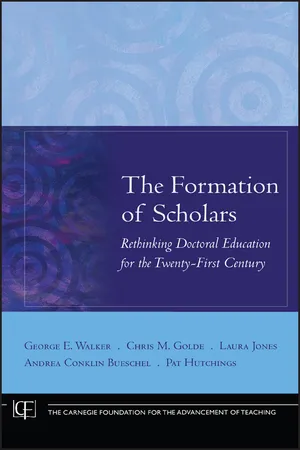
The Formation of Scholars
Rethinking Doctoral Education for the Twenty-First Century
- English
- ePUB (mobile friendly)
- Available on iOS & Android
eBook - ePub
The Formation of Scholars
Rethinking Doctoral Education for the Twenty-First Century
About this book
This groundbreaking book explores the current state of doctoral education in the United States and offers a plan for increasing the effectiveness of doctoral education. Programs must grapple with questions of purpose. The authors examine practices and elements of doctoral programs and show how they can be made more powerful by relying on principles of progressive development, integration, and collaboration. They challenge the traditional apprenticeship model and offer an alternative in which students learn while apprenticing with several faculty members. The authors persuasively argue that creating intellectual community is essential for high-quality graduate education in every department. Knowledge-centered, multigenerational communities foster the development of new ideas and encourage intellectual risk taking.
Information
CHAPTER 1
MOVING DOCTORAL EDUCATION INTO THE FUTURE
Even if you are on the right track, you’ll get run over if you just sit there.
—Will Rogers1
AS YOU READ THESE WORDS, some 375,000 men and women are pursuing doctoral degrees in institutions of higher education in the United States. Most are young adults—many with family commitments, and some juggling careers as well—but PhD programs are also populated by the occasional octogenarian and precocious teen. Some are in their first semester of work; others have been toiling for twenty years. Over 43,000 will graduate this year from the 400-plus institutions that offer the degree.2
Many of those who receive PhD’s will assume positions of leadership and responsibility in arenas that directly shape the lives we lead. A remarkable number of Nobel laureates from around the world received degrees at U.S. universities. Four of the ten most recent secretaries of state have been doctoral degree holders, as are five of the six current members of the Federal Reserve Board,3 and numerous world leaders. PhD’s develop life-saving medical interventions, shape social programs and policies, and turn their talents to entrepreneurial ventures in the global economy. Approximately one-half of those who receive doctorates this year will join the ranks of college and university faculty who educate today’s undergraduates, some of whom will become teachers themselves, in the United States and beyond, shaping the futures of our children and grandchildren. And some will prepare new PhD’s, so the effects of doctoral education ripple out across nations and generations.
The importance of doctoral education to this country’s current and future prospects can hardly be overestimated. The questions are: What will it take to ensure that the United States continues to be, as many have observed, “the envy of the world”? What will it take to meet the challenges that doctoral education faces today and to make the changes those challenges require?
Some of the challenges are long standing and well known. About half of today’s doctoral students are lost to attrition—and in some programs the numbers are higher yet. Those who persist often take a long time to finish and along the way find their passion for the field sadly diminished.4 Many are ill-prepared for the full range of roles they must play, be they in academe or beyond, and often the experience is marred by a mismatch between the opportunities available to students as they complete their work and their expectations and training along the way. In most disciplines, women and ethnic minorities are still underrepresented among doctoral students. And what makes all of these challenges yet more challenging is that few processes for assessing effectiveness have been developed in graduate education, and it is difficult to muster ambition or urgency for doing better in the absence of information about what needs improvement. Thus, one finds attitudes of complacency (“Our application numbers are strong and so is our national ranking, so where’s the problem?”), denial (“We don’t have problems with gender or ethnic diversity here”), and blame (“Students these days just aren’t willing to make the kinds of sacrifices we did to be successful”).
Complicating matters is a set of newer challenges, many of them emerging as we write, and only partly recognized and understood. New technologies are altering and accelerating the way knowledge is shared and developed. And the marketplace for scholars and scholarship is now thoroughly global. Much of the most important, pathbreaking intellectual work going on today occurs in the borderlands between fields, blurring boundaries and challenging traditional disciplinary definitions. The need for firmer connections between academic work and the wider world of public life is increasingly clear, as well. And graduate education, like higher education more generally, faces shifting student demographics, new kinds of competition, growing pressures for accountability, and shrinking public investment. In short, expectations are escalating, and doctoral programs today face fundamental questions of purpose, vision, and quality. The Will Rogers quip that opens this chapter seems made to order: “Even if you are on the right track, you’ll get run over if you just sit there.”
The Carnegie Initiative on the Doctorate
The good news is that doctoral education is, by its nature, in the business of asking hard questions, pushing frontiers, and solving problems, and over the past several years the five of us have been privileged to work closely with faculty and students from doctoral programs that have made the decision to not “just sit there.” The Carnegie Initiative on the Doctorate (CID) has involved eighty-four PhD-granting departments in six fields—chemistry, education, English, history, mathematics, and neuroscience (for the full list of departments, see Appendix B). Our emphasis in this book, and in the Carnegie Initiative on the Doctorate, was on the PhD, although many of our participating education departments also grant the EdD.5 By concentrating on a limited number of disciplines and interdisciplines rather than on doctoral education in general, the CID aimed to go deep and to work very directly with faculty and graduate students from the ground up. Thus, although the support and assistance of administrators, graduate deans in particular, and disciplinary societies was vital, the work was done by departments on matters within the control of departments—which is, after all, where the action is in graduate education.

Over the five years of the program, participating departments made a commitment to examine their own purposes and effectiveness, to implement changes in response to their findings, and to monitor the impact of those changes. Many used their participation to continue plans and activities that were already begun but would benefit from the structure, prestige, and interaction provided by a national initiative. Our role, in turn, included visiting the departments, interviewing campus team members, and bringing project participants together (sometimes by discipline, sometimes by theme) to report on their progress, learn from one another, and help us make sense of their experiences in ways that others can build on. (See Appendix A for a summary of the CID project.) In addition, both faculty and students participated in projectwide surveys, the results of which served as rich grist for discussion and debate about the preparation of scholars in the broadest sense, whether they work in industry, government, or academe. (See Appendix C for an overview of the CID surveys.)
Certainly there was much to discuss. Not surprisingly, in a project sponsored by The Carnegie Foundation for the Advancement of Teaching, an organization whose mission is to “uphold and dignify the profession of the teacher,” a recurring theme was the need for practices that will better prepare tomorrow’s PhD’s to be teachers, equipped with the knowledge and skills to convey their field’s complex ideas to a variety of audiences, not only in the classroom, but in the many other settings in which doctorate holders work. This is an arena in which higher education has made notable progress over the past several decades. Many institutions today—and most of those participating in the CID—offer training programs for graduate teaching assistants, sometimes through a campus-wide teaching center, but often through special opportunities housed in the department as well. And fields in which opportunities to teach have traditionally been limited (for example, neuroscience graduate programs often have no corresponding undergraduate program) are now finding creative ways to provide experience in the classroom. But what the CID has made clear is the need for much greater attention to the sequencing of these opportunities and to the need not only for more teaching but for better, more systematic feedback and reflection that can turn pedagogical experience into pedagogical expertise.
The same diagnosis holds, we believe, when it comes to preparation for the research role. Ironically, this aspect of doctoral education—the sine qua non of the doctorate—has largely been taken for granted and therefore ignored in reports and recommendations on graduate education that have appeared in the past several decades. Our view, in contrast, is that what might be called “the pedagogy of research” (and its different embodiments in different fields) is badly in need of attention. Most graduate faculty care deeply that their students learn how to ask good questions, build on the work of others, formulate an effective and feasible research design, and communicate results in ways that matter. But these outcomes are often more hoped for and assumed than designed into instruction. Although education at other levels is being reshaped by new knowledge about how people learn, these same insights seem to have washed over graduate education with little effect. For instance, whereas undergraduate education now embraces a host of strategies to engage students in research, those approaches have received less attention in doctoral education settings—even though the same faculty members may teach both undergraduate and graduate students. As a consequence, the central tasks and assignments that doctoral students encounter on the long road to research expertise, and the model of apprenticeship that shapes their interactions with faculty, have gone pretty much unchanged from generation to generation, the product of long-standing arrangements and rites of passage that work well for some students but poorly for others.
Even more distressing, CID participants told us, the rationale for program requirements has often been lost in the mists of history: students may well not understand why certain elements are required or toward what end, and faculty, if pushed, will acknowledge that there is no unified vision underpinning many of the experiences students are expected to complete. Departmental deliberations undertaken as part of the CID often uncovered inconsistent and unclear expectations, uneven student access to important opportunities, poor communication between members of the program, and a general inattention to patterns of student progress and outcomes. More alarming, the pressures of funded research may work against the kinds of risk taking, creativity, and collaboration that are increasingly the hallmark of cutting-edge intellectual work in today’s world. And worse yet, students may be treated as cheap labor in the service of an adviser’s current project and personal advancement.
Both doctoral students and faculty suffer under these circumstances. The life of a tenured faculty member may appear to be one of privilege and intellectual reward, but many are torn by increasing and competing demands for scholarship, fund raising, teaching and mentoring, community engagement, and family life. Their doctoral students, in turn, often feel burdened by debt, exploited as lab technicians or low-paid instructors, and disillusioned by the disgruntlement of overworked faculty mentors. The passionate zeal with which many students begin their studies is unnecessarily eroded, a loss that faculty decry as much as students do. It is hard, in short, not to be disheartened by the waste of human talent and energy in activities whose purpose is poorly understood. Serious thinking about what works in doctoral education, and what no longer works, is an urgent matter.
In the chapters that follow we will have much more to say about these and other very real challenges to doctoral education, and the ways in which today’s approaches fall short of what is needed as we move into the twenty-first century. But we will have much to say about creative solutions and approaches, as well, for we have had a marvelous perch for observing and learning through our work. What will be clear along the way is that no single set of best practices or models can fit the diverse settings that constitute the landscape of graduate education. What works in one field or on one campus may be quite wrong in another. What does work in all settings, we argue, and what is distinctly absent from most doctoral programs, are processes, tools, and occasions through which both faculty and graduate students can apply their habits and skills as scholars—their commitment to hard questions and robust evidence—to their purposes and practices as educators and learners.
Mirror, Mirror
The power of this process and its benefits are illustrated in the experience of Columbia University’s English department, where graduate students and faculty have worked together to bring about a number of immediate improvements as well as a renewed sense of intellectual community in which future improvements can take shape and thrive.
Long considered a premier graduate program in the field, consistently ranked in the top ten and home to a number of high-profile faculty stars over the years, Columbia’s Department of English and Comparative Literature is large and intellectually lively. Approximately eighteen new PhD students are admitted each year, all of them receiving five full years of funding. In addition to traditional areas within literary studies, graduate students can explore interdisciplinary interests through the Center for Comparative Literature and Society and the Institute on Women and Gender. Admission is highly competitive (around 5 percent) and the student-to-faculty ratio is an impressive five-to-one.
In August of 2001, Jonathan Arac, a member of the department during the 1980s, was invited to return from his position at the University of Pittsburgh to assume the role of chairperson. The department had undertaken a major overhaul of the graduate program a decade earlier, and when the opportunity arose to participate in the CID, Arac and his colleagues seized the moment. Though the doctoral program was in good health, a number of what Arac calls “stress points” had developed, including a sense that advising could be stronger and opportunities for graduate students to teach literature more abundant. As in many humanities departments, the “culture wars” of the 1980s and 1990s had taken a heavy toll, creating what the New York Times called “intellectual trench warfare” (Arenson, 2002, p. 1). A sustained focus on strengthening doctoral education was a welcome opportunity, Arac recalls, “to come together around substantive issues involving our work together” (J. Arac, interview with the authors, August 30, 2006).
As a participant in the Carnegie initiative, the department turned to its standing Committee on Guidance and Evaluation, which included David Damrosch, then director of Graduate Studies, several faculty members, and graduate students. Working in consultation with others in the department and with Arac, the committee created and administrated a survey of students, examined peer programs elsewhere, and eventually issued a report detailing fifty-four recommended changes in what Damrosch termed a “major review and overhaul of our graduate program’s requirements” (D. Damrosch, e-mail to the authors, March 11, 2004).
Although some of the proposals and subsequent changes were fine tunings, others required substantial changes. Oral examinations were redesigned to provide “a stronger and clearer structure, so that students and faculty will have a better idea of what they are setting out to do” (Department of English and Comparative Literature, 2004, section 4-A). The roles of dissertation committees were also rethought. An ambitious set of procedures for advising “at every stage of the program” was put in place, aimed especially at improving time to degree (Damrosch, 2006, p. 43). And, in response to the “stress point” about teaching, new opportunities were created for graduate students to teach introductory literature courses.
At a more general level, the experience of careful self-study raised awareness of possibilities for greater collegiality and communication among faculty and graduate students. “For students who are committing themselves to our profession, we can surely do a better job of consultation as we seek a good meeting of our interests and their needs,” the report declared (Department of English and Comparative Literature, 2004, section 3-J). In this spirit, the department launched a new seminar series that invites graduate students and faculty to question established notions of literary fields of study. The new structure creates a lively trading zone where senior faculty exemplify the traditions of scholarly discourse in the field, and up-and-coming junior faculty and graduate students can push the leading edge of new areas of inquiry.
But what was “truly memorable,” according to Arac, and “will stand a good long time in the department memory as a beneficial fruit” of work with the CID, was the process of “live remolding” through which the resulting document was vetted and negotiated by the department as a whole during a series of four ninety-minute meetings over a number of weeks. “Given that one of the symptoms of the ‘bad days’ of the 1990s was that ...
Table of contents
- Cover
- Contents
- Title
- Copyright
- Foreword
- Acknowledgments
- About the Authors
- Chapter 1: Moving Doctoral Education into the Future
- Chapter 2: Setting the Stage for Change
- Chapter 3: Talking About Purpose
- Chapter 4: From Experience to Expertise
- Chapter 5: Apprenticeship Reconsidered
- Chapter 6: Creating and Sustaining Intellectual Community
- Chapter 7: A Call to Action
- Appendix A: Summary Description of the Carnegie Initiative on the Doctorate
- Appendix B: List of Participating Departments
- Appendix C: Overview of the Surveys
- Appendix D: Graduate Student Survey
- Appendix E: Graduate Faculty Survey
- References
- Index
Trusted by 375,005 students
Access to over 1.5 million titles for a fair monthly price.
Study more efficiently using our study tools.
Frequently asked questions
Yes, you can cancel anytime from the Subscription tab in your account settings on the Perlego website. Your subscription will stay active until the end of your current billing period. Learn how to cancel your subscription
No, books cannot be downloaded as external files, such as PDFs, for use outside of Perlego. However, you can download books within the Perlego app for offline reading on mobile or tablet. Learn how to download books offline
Perlego offers two plans: Essential and Complete
- Essential is ideal for learners and professionals who enjoy exploring a wide range of subjects. Access the Essential Library with 800,000+ trusted titles and best-sellers across business, personal growth, and the humanities. Includes unlimited reading time and Standard Read Aloud voice.
- Complete: Perfect for advanced learners and researchers needing full, unrestricted access. Unlock 1.5M+ books across hundreds of subjects, including academic and specialized titles. The Complete Plan also includes advanced features like Premium Read Aloud and Research Assistant.
We are an online textbook subscription service, where you can get access to an entire online library for less than the price of a single book per month. With over 1.5 million books across 990+ topics, we’ve got you covered! Learn about our mission
Look out for the read-aloud symbol on your next book to see if you can listen to it. The read-aloud tool reads text aloud for you, highlighting the text as it is being read. You can pause it, speed it up and slow it down. Learn more about Read Aloud
Yes! You can use the Perlego app on both iOS and Android devices to read anytime, anywhere — even offline. Perfect for commutes or when you’re on the go.
Please note we cannot support devices running on iOS 13 and Android 7 or earlier. Learn more about using the app
Please note we cannot support devices running on iOS 13 and Android 7 or earlier. Learn more about using the app
Yes, you can access The Formation of Scholars by George E. Walker,Chris M. Golde,Laura Jones,Andrea Conklin Bueschel,Pat Hutchings in PDF and/or ePUB format, as well as other popular books in Education & Higher Education. We have over 1.5 million books available in our catalogue for you to explore.