- The link between patient safety and legal and regulatory compliance
- The role of accreditation and standard-setting organizations in patient safety
- Failure modes and effect analysis
- Voluntary and regulatory oversight of medical error
- Evidence-based outcomes and standards of care
- Creation and preservation of reports, data, and device evidence in medical error situations
- Claims management when dealing with patient safety events
- Full disclosure
- Patient safety in human research
- Managing confidentiality in the face of litigation
- Managing patient safety compliance through accountability-based credentialing for health care professionals
- Planning for the future
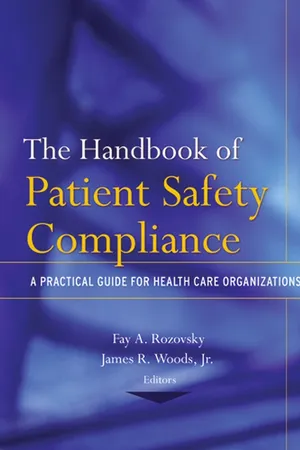
eBook - ePub
The Handbook of Patient Safety Compliance
A Practical Guide for Health Care Organizations
- English
- ePUB (mobile friendly)
- Available on iOS & Android
eBook - ePub
The Handbook of Patient Safety Compliance
A Practical Guide for Health Care Organizations
About this book
Written for virtually every professional and leader in the health care field, as well as students who are preparing for careers in health services delivery, this book presents a framework for developing a patient safety program, shows how best to examine events that do occur, and reveals how to ensure that appropriate corrective and preventative actions are reviewed for effectiveness. The book covers a comprehensive selection of topics including
Information
CHAPTER ONE
PATIENT SAFETY: Crossing the Chasm from Legal and Regulatory Compliance
Fay A. Rozovsky
The concept of patient safety caught mainstream attention with the publication of To Err Is Human: Building a Safer Health System (Kohn, Corrigan, and Donaldson, 2000). This Institute of Medicine (IOM) report captured worldwide attention with the suggestion that every year, 44,000 to 98,000 Americans lose their lives to medical error, a startling statistic. The data suggested that health care took more lives than those lost to motor vehicle accidents, breast cancer, AIDS, and workplace accidents. The report suggested that these deaths were due largely to bad systems in American health care. Regulatory and market-based strategies were offered in the IOM report, along with a goal of at least a 50 percent reduction in medical errors over a five-year period.
Two major themes emerged in To Err Is Human: that medical error is a systemic problem and that concerns about liability make health care systems hesitant to report errors. Yet without such information the health care field cannot learn effectively about mistakes and make positive changes.
Federal agencies responded with a report that delineated a number of recommendations for implementing the strategies discussed in To Err Is Human. The Quality Interagency Coordination Task Force report (QuIC, 2000) outlined a number of measures intended to effect positive change. At the state level, a number of jurisdictions have enacted legislation with the goal of improving patient safety. This legislation has taken many forms, from laws about voluntary and mandatory reporting of medical errors and adverse events (for example, in Florida, New York, and Pennsylvania1) (Flowers and Riley, 2001) to laws designed to encourage disclosure (for example, in Colorado2) to laws that set nurse-patient ratios (for example, in California3).
Systemic change has also been provoked by private organizations, associations, and accreditation bodies. Medical residency programs must now comply with well-defined parameters for the number of hours of work that program participants may perform.4 Patient safety indicators called never events have been promoted by the National Quality Forum (NQF).5 Additionally, the Joint Commission on Accreditation of Healthcare Organizations (JCAHO) has put in place a host of standards designed to enhance patient safety along the continuum of care (see, for example, JCAHO, 2004).
Notwithstanding this mosaic of federal and state laws and private initiatives, patient safety seems an elusive goal. That this is the case is reflected in subsequent reports from the IOM, data from other groups that collect information on medication errors, and case law reports. Frustration with persistent patient safety concerns has resulted in some rethinking about what can be done to reduce medical error. Moving from an approach premised on systemic change to more individual-based accountability is one step in this regard. Redesigning laws that address evidentiary protection is another area of serious consideration.
Clearly, patient safety is an evolving concept in contemporary health care. The terms that define patient safety continue to undergo change. Care providers, lawyers, and public policy professionals grapple with what can be done to bridge the chasm between the goal of patient safety on the one hand and on the other the legal and regulatory environment that must be put in place to promote significant reduction in medical error.
Terms That Define Patient Safety
In its recent report titled Patient Safety: Achieving a New Standard for Care, the Institute of Medicine pointed out that the patient safety field needs a standardized terminology to facilitate data aggregation (IOM, 2004). Absent a common taxonomy with terms that all can use, and absent a standardized format for obtaining and reporting data, the field will be hard pressed to learn and to improve systems. The lack of a coherent taxonomy means that health care organizations spend too much effort comparing apples to oranges rather than apples to apples and oranges to oranges. The lack of standardized information sets is ironic in a field driven by data. The reality is that an error barely averted might be a near miss at one health care organization and a good catch at another facility.
In Patient Safety, the IOM calls for a streamlined approach. If this approach is accepted, the health care field would use the HL7 Clinical Document Architecture format, which enables a user to incorporate a narrative section within the framework of a standardized taxonomy of terms. As new terminology is identified, it would be incorporated using the Systemized Nomenclature of Human and Veterinary Medicine or SNOMED CT. To facilitate use of this common ground of patient safety terminology, the National Library of Medicine would be funded to maintain and distribute the taxonomy. The World Health Organization would be encouraged to enhance the International Classification of Diseases (ICD) 9/10-CM E-codes to permit collection of information on adverse events. This would enable international comparisons in the patient safety arena.
From a legal and regulatory standpoint the 2004 IOM report portends new legal concerns. It includes suggestions about delineating omissions and commissions in medical error. It suggests employing both primary and secondary event types. The latter could be significant in litigation. Depending on the infrastructure of the taxonomy and the way in which these terms are used in a legal setting, these primary and secondary event types might translate into contributory negligence or comparative negligence if part of the accountability for an adverse event is ascribed to the patient or family caregiver. At a more fundamental legal level the taxonomy might also be used out of context by lawyers representing aggrieved patients. Terms like near miss, risk assessment index, and omission and commission could be portrayed in an electronic display before a jury and make more difficult for the defense the task of presenting factual information about what transpired in the occurrence.
There is a need for a consistent taxonomy of terms in the patient safety arena. There is a concomitant need for standardized data sets and other information with which to develop practical methods for error reduction. Using SNOMED CT and refreshing the content of ICD-9/10-CM E-codes are good starts. However, the developmental phase of the process needs to be schooled by an understanding of the ways the taxonomy and data may be used for other purposes. Medical malpractice litigation is but one example. The taxonomy and data might also be used in terminations of agreements between health care facilities and health plans, professional licensure proceedings, and regulatory inquiries by federal funding sources. If the terminology can be easily taken out of context and used for other purposes, the recoil may be a reluctance to use it. These concerns can be avoided. In developing the taxonomy and the data sets, several steps can be taken to ensure proper use:
- The passage of legislation and regulations defining specific and limited uses of the taxonomy for purposes of patient safety and medical error reduction
- The involvement of risk management professionals and health care attorneys in the process of developing a coherent, neutral taxonomy of terms
- The inclusion of data weighting and stratification to ensure accurate use of the information and apple-to-apple comparisons
- Restrictions on using data gathered in the reporting process as evidence in certain circumstances, including litigation
- The education of the public and the media on how to interpret the results of data gleaned from the process
Whether or not these strategies are implemented, health care organizations can take positive steps to limit potential harm from embracing a standardized taxonomy of terms and data aggregation for patient safety. Working with legal counsel, risk management, and health information professionals, senior leadership can implement safeguards with respect to
- Collecting data
- Applying terminology
- Using and explaining information in reports
- Educating staff
- Educating media
- Explaining information to the community
By taking such steps, health care facilities can preempt out-of-context reports or other information use. Staff will know what the data and reports mean within the framework of the health care organization. Legal counsel defending the organization will have a solid foundation from which to respond to out-of-context use of the data by plaintiffs’ counsel or those representing the government in an adjudicatory proceeding. The following example demonstrates this approach:
A hospital CEO learns that a patient safety report has received notoriety in the local press. The headline reads, “Falls out of control at local hospital.” The article describes the findings of a patient safety project focused on medical-surgical falls. It highlights the fact that some 10 patients suffered injuries in postsurgical falls. What the article does not include are some very important data: the 10 falls occurred among a patient population of 5,500 identified as “at risk” for postsurgical falls. All the injuries involved bruises and contusions. There were no fractured limbs or internal injuries. Rather than a project that portrayed a disaster in patient care, the study was the culmination of a patient safety program for those at risk of falling in the twenty-four hours following inpatient surgery. The study had been conducted after the environment of care had been revamped and staff educated on fall avoidance. The number of falls had been reduced from 105 for a similar cohort a year earlier, when 3 patients had suffered pelvic and wrist fractures and 2 had sustained concussions. Instead of a hospital “out of control” on falls, the study revealed a major victory in patient safety.Although the CEO has the public relations officer do some damage control, the public is irate. When confronted with the truth, the newspaper apologizes and promises to help unwind the false impression it created in its headline and story. The newspaper editor says that a reporter saw a storyboard on the study on a hospital bulletin board and misunderstood the information.
The lesson learned was this: when dealing with a new initiative (such as a patient safety taxonomy and data aggregation tool), make certain that all consumers of the information understand what they are reading and how to use the information.
The Legal and Regulatory Influences Constraining Patient Safety: Evidentiary Protection
A number of initiatives are underway to encourage the sharing of adverse-event information among health care organizations. The goal is to learn from these situations in order to reduce the likelihood of repetitions that could result in catastrophic injury. Few would dispute the importance of this laudable goal. Avoiding needless patient injuries while improving quality outcomes of care is a common theme found in acute care and other health care facilities. Aside from technical issues such as the taxonomy of terms and standardized data sets, some legal and regulatory constraints exist:
- Legal requirements for confidentiality of data
- Concern that identifying an adverse event will be tantamount to an admission of liability
- Fear that sharing data outs...
Table of contents
- Cover
- Table of Contents
- Title
- Copyright
- Figures, Tables, and Exhibits
- Foreword
- The Editors
- The Contributors
- Chapter One: Patient Safety: Crossing the Chasm from Legal and Regulatory Compliance
- Chapter Two: Patient Safety Laws and Regulations
- Chapter Three: Medical Error Reduction Initiatives Among Accreditation and Standard-Setting Organizations
- Chapter Four: Failure Modes and Effects Analysis: The Risks and the Rewards in Health Care
- Chapter Five: Medication Error Reduction: Voluntary and Regulatory Oversight
- Chapter Six: Benchmarking: Evidence-Based Outcome Information and Standards of Care
- Chapter Seven: Creation and Preservation of Reports, Data, and Device Evidence in Medical Error Situations
- Chapter Eight: Claims Management Risks in Patient Safety Events
- Chapter Nine: Full Disclosure
- Chapter Ten: Patient Safety in Human Research
- Chapter Eleven: Medical Error Reporting: Maintaining Confidentiality in the Face of Litigation
- Chapter Twelve: Managing Patient Safety Compliance with Health Professionals
- Chapter Thirteen: Planning for the Future
- Index
- End User License Agreement
Trusted by 375,005 students
Access to over 1.5 million titles for a fair monthly price.
Study more efficiently using our study tools.
Frequently asked questions
Yes, you can cancel anytime from the Subscription tab in your account settings on the Perlego website. Your subscription will stay active until the end of your current billing period. Learn how to cancel your subscription
No, books cannot be downloaded as external files, such as PDFs, for use outside of Perlego. However, you can download books within the Perlego app for offline reading on mobile or tablet. Learn how to download books offline
Perlego offers two plans: Essential and Complete
- Essential is ideal for learners and professionals who enjoy exploring a wide range of subjects. Access the Essential Library with 800,000+ trusted titles and best-sellers across business, personal growth, and the humanities. Includes unlimited reading time and Standard Read Aloud voice.
- Complete: Perfect for advanced learners and researchers needing full, unrestricted access. Unlock 1.5M+ books across hundreds of subjects, including academic and specialized titles. The Complete Plan also includes advanced features like Premium Read Aloud and Research Assistant.
We are an online textbook subscription service, where you can get access to an entire online library for less than the price of a single book per month. With over 1.5 million books across 990+ topics, we’ve got you covered! Learn about our mission
Look out for the read-aloud symbol on your next book to see if you can listen to it. The read-aloud tool reads text aloud for you, highlighting the text as it is being read. You can pause it, speed it up and slow it down. Learn more about Read Aloud
Yes! You can use the Perlego app on both iOS and Android devices to read anytime, anywhere — even offline. Perfect for commutes or when you’re on the go.
Please note we cannot support devices running on iOS 13 and Android 7 or earlier. Learn more about using the app
Please note we cannot support devices running on iOS 13 and Android 7 or earlier. Learn more about using the app
Yes, you can access The Handbook of Patient Safety Compliance by Fay A. Rozovsky, James R. Woods, Fay A. Rozovsky,James R. Woods, Jr. in PDF and/or ePUB format, as well as other popular books in Medicina & Sanità, amministrazione e assistenza pubblica. We have over 1.5 million books available in our catalogue for you to explore.